



-
Proud to be HUFLITers #07 | M.A. Tran My Uyen – A lectern where a teacher wishes only to “watch her children grow up”At the HUFLIT Faculty of Foreign Languages, M.A. Tran My Uyen (Vice Dean) goes by many names. Some call her “Ms My”; her students call her “mother”. Colleagues often compare her to Mother Au Co with a hundred children. Yet to become the “mother” of the lecture hall she is today, she went through a profound shift in thinking that completely changed a teaching philosophy built over more than 30 years.
-
New Cybersecurity Regulations: Opportunities for the Cybersecurity Field in the Digital EraThe new cybersecurity regulations taking effect on 1 July 2026 not only help complete the legal framework but also drive demand for talent in cybersecurity. This is also the moment when the discipline becomes a promising choice for young people who love technology and information security.
-
“GenZ Major Insights 2026” – Episode 9: Boundless Journeys with HUFLIT’s Tourism and Hospitality ProgramsMany students choose the Tourism and Hospitality field simply because they love to travel. But passion alone is not enough to pursue this field in the long run. What matters more is understanding the nature of the discipline, its professional requirements, and the qualities needed to grow in a professional service environment.
How to Divide Study Time Effectively to Study Less but Remember Longer
NGÀY: 16/03/2026
Chia Sẻ Qua
The reason you need to divide study time effectively?
Dividing study time effectively brings many practical benefits. First, it helps students complete more work in a shorter time, avoiding overload on the days near the exam. Second, when you have a specific plan, you will reduce stress and worry because you clearly know what you need to do and when. Third, allocating time reasonably helps balance between study and other activities such as fun, sports, developing soft skills.
Moreover, time-management skills are one of the soft skills most highly valued by employers. According to the report “Vietnam Workforce Skills 2024” by LinkedIn – the world’s largest professional social network with over 900 million members, 82% of employers in Vietnam consider time-management skills a top important factor when recruiting new personnel.

Effective time management helps study better and is highly valued by employers
>>>> SAVE NOW: 11+ effective ways of studying at university that students need to know
5 ways to divide study time effectively
After understanding the importance of time management, let’s learn 5 ways to divide study time effectively that you can apply today to improve your study results.
Lay out the priority tasks to do first
To do this, you need to list all the tasks to do in the week, then classify them by the Eisenhower matrix – a time-management method widely applied around the world. By this classification, you will know exactly where to focus and avoid wasting time on low-value tasks. This matrix divides work into 4 groups:
- Important and urgent: These are things to do immediately such as assignments due today, revising for the upcoming exam. Prioritise doing these first.
- Important but not urgent: Including studying lessons in advance, reading reference books, training skills. These are things that need a specific plan to carry out.
- Urgent but not important: Such as replying to non-urgent messages, participating in some group meetings not directly related to study. Can be done quickly or delegated to others.
- Not important and not urgent: Scrolling social media, watching entertainment videos. Should be limited or done after completing other tasks.
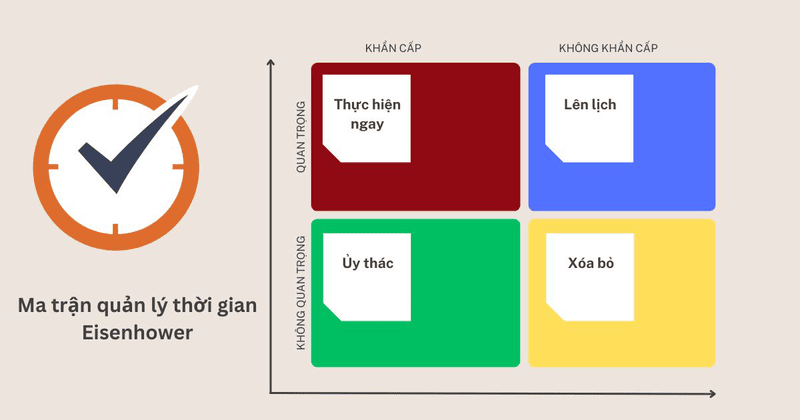
The Eisenhower matrix helps students correctly identify the tasks to prioritise to manage study time more effectively
Complete by the deadline set
Setting a deadline for yourself and strictly following it is one of the most effective ways to divide study time. When you commit to completing a task within a specific time, you will focus more and limit procrastination.
To apply this method, divide large tasks into smaller tasks with their own deadlines. For example, instead of setting the goal “complete the end-of-term essay”, divide it into: “research materials (first 3 days)”, “make an outline (day 4)”, “write the introduction and body (days 5-7)”, “conclusion and editing (days 8-9)”.
>>>> SEE NOW: Presentation skills for students: 10+ most effective tips
Stay away from distracting devices
Currently, students on average lose 23 minutes to refocus after each distraction by their phone or social media. This means that just checking your phone 3-4 times in a 2-hour study session, you have lost nearly half of the effective time.
To apply this way of dividing study time effectively, you need to create an optimal study environment. Turn off notifications on your phone or set the “Do Not Disturb” mode during study time. If possible, leave your phone somewhere else, not within reach. Use website-blocking apps such as Forest, StayFocusd to avoid accessing social media during study time.

Limiting distracting devices helps students maintain concentration and improve study effectiveness
Ask for help when necessary
When facing difficulty in study, don’t hesitate to ask lecturers, better friends, or seek support from study groups. Many universities such as HUFLIT have a teaching-assistant model (students helping each other) or study-consultation hours with lecturers.
In time management, you can also ask for help from your family. For example, ask them to remind you when it’s study time, or help with some housework so you have more study time. Using support tools and apps such as Google Calendar, Notion, Trello is also a way of “asking for help” from technology.
Other ways to divide time
Besides the 4 ways above, there are many other methods that help you divide study time more effectively:
- The 2-minute rule: If a task can be completed in 2 minutes, do it immediately instead of writing it into the to-do list. This helps reduce the to-do list and create motivation.
- Study during the “golden hour”: Everyone has a time of day when they work most effectively. Determine your own “golden hour” (early morning, evening, or late night) and arrange the hardest tasks in this time frame.
- The “eat the frog” technique: Start the new day by completing the hardest, most unpleasant task first. After “eating this frog”, everything else will become easier.
- Rest properly: Instead of studying continuously for 4-5 hours, intersperse short breaks. During the break, avoid looking at your phone or computer screen. Instead, stand up and walk around, drink water, or do a few light exercises.
Details of the steps to make an effective study schedule
To apply the way of dividing study time effectively methodically, you need to make a specific timetable. Below are 5 detailed steps that help you create a suitable and feasible study schedule.
Step 1: List all the tasks to do
The first step in making a timetable is to fully list all the tasks including: the class subjects, self-study time for each subject, homework, deadlines of essays or projects, revision time for the exam, extracurricular activities (clubs, volunteering), sports/exercise time, time for yourself (reading, hobbies), rest and sleep time, other personal tasks (eating, personal hygiene, travelling).

Fully listing all tasks helps students build a scientific and realistic study timetable
Step 2: Consider the study time
After listing the tasks, you need to estimate the suitable time for each task so the plan is feasible. Difficult subjects should be given an additional 2–3 hours of self-study for each hour in class and leave 20–30% reserve time for contingencies.
Step 3: Sketch an effective timetable template
At this step, you start building the timetable frame with paper, Excel or time-management apps. First, determine the fixed time frames such as study hours, eating, sleeping and travelling. Then, arrange the remaining tasks into the free time, prioritising important and urgent work, helping maintain long-term study effectiveness.

Building a clear timetable frame helps you proactively arrange work and maintain study effectiveness
Step 4: Complete the schedule
After having a draft, review the entire timetable to adjust it more reasonably. Ensure no time frame is overloaded, there is still enough rest time and a clear priority order. An effective timetable needs to be easy to follow, balanced between study and living, while flexible enough to change when necessary.
Step 5: Implement seriously
A timetable only really has value when you strictly follow it. Place the plan in an easy-to-see spot and use reminder tools to maintain discipline. Carrying it out regularly for at least 21 days will help form a good study habit. Each week, you should spend time re-evaluating the progress and adjusting the plan to suit your actual living rhythm.
Suggesting some effective study-time division templates
To help you better visualise how to divide study time effectively, below are some reference timetable templates:
Template 1: Timetable for first-year students
- 6:00 – 7:00: Wake up, personal hygiene, breakfast
- 7:00 – 11:30: Study in class
- 11:30 – 13:00: Lunch and rest
- 13:00 – 16:00: Study in class or self-study at the library
- 16:00 – 17:30: Sports or extracurricular activities
- 17:30 – 19:00: Dinner and relaxation
- 19:00 – 21:30: Self-study, doing homework
- 21:30 – 22:00: Personal time (reading, listening to music)
- 22:00 – 6:00: Sleep
Template 2: Timetable for final-year students (with internship)
- 6:00 – 7:00: Prepare to go to the internship
- 7:30 – 17:00: Internship at the company
- 17:30 – 19:00: Dinner, rest
- 19:00 – 20:00: Record the internship diary
- 20:00 – 22:00: Do the graduation project or exam revision
- 22:00 – 23:00: Personal time
- 23:00 – 6:00: Sleep
Template 3: Weekend timetable
- 7:00 – 8:30: Wake up, breakfast
- 8:30 – 11:30: Revise the week’s lessons
- 11:30 – 13:00: Lunch
- 13:00 – 15:00: Rest, fun
- 15:00 – 18:00: Prepare lessons for next week
- 18:00 – 21:00: Time for family, friends
- 21:00 – 23:00: Personal time, arranging things for the new week
Note that these are only reference templates. You need to adjust them to suit your circumstances, capacity and personal goals.
>>>> DON’T MISS: How long does 1 university semester last? What do students need to know?
The method of arranging study time that helps HUFLIT students study better
At HUFLIT, time-management skills are emphasised through many practical activities such as the talkshow “Secret of Time”, seminars such as “Time-management skills – THE TIME ZONE”, bringing useful “tricks” that help students both access theory and practise to improve study effectiveness and self-development.
In particular, HUFLIT organises thematic seminars on soft skills, including time-management skills. Here, students not only listen to theory but also practise directly with specific situations, thereby training time-management skills in reality.

The interesting time-management “tricks” for HUFLITers at the Seminar “Time-management skills – THE TIME ZONE
Frequently asked questions about how to divide study time effectively
How do you know whether you have arranged your time reasonably?
You can evaluate through actual results: coursework completed on time, not having to stay up late in a rush, a comfortable study spirit and still having time to rest and relax. If you frequently have to adjust the plan because of overload, your study schedule is not really reasonable.
What should I do when I get drawn into games and forget about studying?
Build a fixed timetable, set an alarm or use a time-management app to remind you. Applying the principle of “finish studying then play” and asking relatives to help remind you of study time will help you maintain discipline better.
How can I not get stressed when arranging time?
You should divide study tasks into small parts, study in short sessions and have rest between sessions. Combining light exercise and spending some time each day on a personal hobby will help the spirit be comfortable and study more effectively.
How to divide study time effectively not only helps you achieve good study results but also trains time-management skills. Start applying the methods shared in this article today to see a clear difference in study and life. If you want to study in an environment that is both solid in expertise and trains time-management skills, HUFLIT is a suitable choice.
>>>> LEARN MORE IN-DEPTH INFORMATION:
Does retaking a subject at university have any effect? Answers from A–Z
If you fail an elective subject, do you need to retake it? Advice to know
CONTACT INFO
Apply for admission at
tuyensinh.huflit.edu.vn
Find out information
huflit.edu.vn
Advising education enrollment