



-
Proud to be HUFLITers #07 | M.A. Tran My Uyen – A lectern where a teacher wishes only to “watch her children grow up”At the HUFLIT Faculty of Foreign Languages, M.A. Tran My Uyen (Vice Dean) goes by many names. Some call her “Ms My”; her students call her “mother”. Colleagues often compare her to Mother Au Co with a hundred children. Yet to become the “mother” of the lecture hall she is today, she went through a profound shift in thinking that completely changed a teaching philosophy built over more than 30 years.
-
New Cybersecurity Regulations: Opportunities for the Cybersecurity Field in the Digital EraThe new cybersecurity regulations taking effect on 1 July 2026 not only help complete the legal framework but also drive demand for talent in cybersecurity. This is also the moment when the discipline becomes a promising choice for young people who love technology and information security.
-
“GenZ Major Insights 2026” – Episode 9: Boundless Journeys with HUFLIT’s Tourism and Hospitality ProgramsMany students choose the Tourism and Hospitality field simply because they love to travel. But passion alone is not enough to pursue this field in the long run. What matters more is understanding the nature of the discipline, its professional requirements, and the qualities needed to grow in a professional service environment.
Should You Study Software Engineering or Artificial Intelligence – [Answer]
NGÀY: 03/03/2026
Chia Sẻ Qua
General introduction to the Software Engineering field
When considering whether to study software engineering or artificial intelligence, clearly understanding the nature, requirements and career opportunities of each field is an important factor.
What is the Software Engineering field?
The Software Engineering field trains engineers with the ability to analyse needs, design, develop, test and manage software systems serving enterprise practice. The field of study focuses on applying engineering principles to create effective, stable and easily scalable software products.
In the context of digital transformation, Software Engineering plays a key role in most fields such as business, finance, education and healthcare. The training programme focuses on foundation and application, with core content such as programming, data structures – algorithms, databases, software development and testing, helping students be ready to work right after graduation.
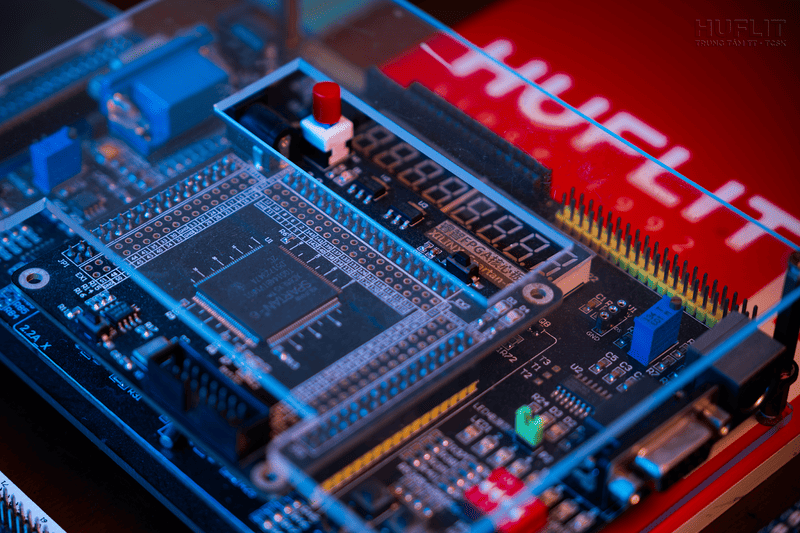
Software engineering trains engineers to design and develop modern software systems
The skills needed in the Software Engineering field
To study and work effectively in the Software Engineering field, students not only need a solid technical foundation but must also simultaneously develop thinking and soft skills. These competencies help software engineers adapt well to the real working environment and participate effectively in technology projects.
- Programming skills: The ability to use programming languages to build, edit and optimise software systems as required.
- Logical and algorithmic thinking: Helps analyse problems coherently, choose suitable algorithms and enhance processing performance.
- Problem-solving skills: Proactively detecting bugs, finding creative handling directions and providing feasible solutions during software development.
- Teamwork ability: Coordinating effectively with project members, sharing responsibility and ensuring common progress.
- Communication skills: Presenting ideas clearly, exchanging technical requirements with colleagues, customers and stakeholders.
- Time and project management: Knowing how to plan, monitor progress and arrange work reasonably in software projects.
- Meticulousness and attention to detail: Ensuring accuracy in each line of code, limiting bugs and enhancing product quality.

Programming skills, logical thinking and project management are the important foundation of a software engineer
>>>> SEE DETAILED INFORMATION: Should you study the artificial intelligence field? Job opportunities & Government objectives
Is it easy to find a job studying software engineering?
Students after graduation can take on many different roles in the technology ecosystem such as programmer, software development engineer, quality assurance (QA) specialist, DevOps engineer,… According to the report The Future of Jobs 2025 by the World Economic Forum (WEF), software engineer is in the top 4 fastest-growing professions by 2030.
In Vietnam, TopDev estimates that the IT human-resource demand can reach about 750,000 people by 2026, while the current workforce is only about 560,000, creating a gap of nearly 200,000 positions, showing very large job opportunities for students studying this field.
General introduction to the Artificial Intelligence field
In the context of technology becoming increasingly smart and deeply automated, Artificial Intelligence (AI) is becoming one of the key fields of the digital era. Below is an overview of the Artificial Intelligence field and the values this field brings.
The concept of the Artificial Intelligence field
The Artificial Intelligence (AI) field belongs to the computer-science field, focusing on researching and developing systems with the ability to learn, reason and make decisions similar to humans. The field of study trains personnel with a solid maths – informatics foundation, mastering AI technology and applying it in practice.
AI is currently widely applied in facial recognition, virtual assistants, chatbots, language translation, self-driving cars and many other fields. The training programme combines theory and practice with core areas such as machine learning, deep learning, natural language processing, computer vision and data mining, meeting the demand for high-quality personnel in the digital era.

AI combines mathematics, programming and machine learning to develop smart systems applied in many fields
What skills do you need to study Artificial Intelligence?
To study and develop long-term in the Artificial Intelligence field, students need to combine a solid academic foundation with thinking and practical-application skills. This is a field that requires deep-learning ability, continuous technology updating and solving complex real-life problems.
- Mathematical foundation: Especially linear algebra, probability – statistics and optimisation, helping to understand and build AI models.
- Programming skills: Proficiency in popular languages such as Python, together with the ability to use AI libraries and frameworks serving machine learning and deep learning.
- Data analysis and processing: Knowing how to collect, clean and analyse big data to train and evaluate models.
- Logical and algorithmic thinking: Supporting problem analysis, choosing suitable methods and optimising the efficiency of AI systems.
- Creativity: Proposing new approaches, improving models and applying AI to real-world situations.
- Problem-solving skills: Applying AI knowledge to handle specific problems in enterprises, healthcare, education, transport…
- A self-study spirit and technology updating: Ready to access new knowledge because AI is a very fast-changing field.
Job opportunities in the Artificial Intelligence field
The Artificial Intelligence (AI) field brings many career opportunities as it is widely applied in many fields. According to Future of Jobs 2025 by the World Economic Forum, AI is expected to create 170 million new jobs by 2030, higher than the number of jobs replaced, showing the very large growth potential of the field in the future.
Regarding job positions, AI learners can take on roles such as AI/Machine Learning engineer, Data Scientist, natural-language-processing (NLP) engineer, computer-vision engineer, DevOps AI specialist or AI researcher at R&D centres. These positions are all tied to developing and deploying smart applications, reflecting the long-term development potential and increasingly rising recruitment demand.

Job opportunities in the Artificial Intelligence (AI) field, with a salary ranging from 10 - 40 million VND depending on the position
>>>> ACCESS NOW: What do artificial intelligence graduates do? How much salary?
Should you study software engineering or artificial intelligence?
Whether to study software engineering or artificial intelligence, there is no absolutely right choice for everyone. Deciding on a suitable field of study needs to be based on many factors such as interest, personal ability and future career goals. Below are the important criteria that help you consider and make the right choice.
Choosing by personal interest
If you love building concrete products, seeing the applications, websites or systems you create being used in reality, Software Engineering is a suitable choice. The field of study aims at turning ideas into complete technology products, requiring logical thinking, creativity and a project-based working spirit.
At HUFLIT, Software Engineering focuses on designing, developing and operating modern software systems. Students study and practise with popular technologies such as React, Node.js, Laravel, Flutter, while also accessing AI applications early, helping develop smart software and meet the real needs of enterprises well.
Conversely, Artificial Intelligence is suited to those passionate about mathematics, algorithms and in-depth research, who want to learn how machines “learn” and make decisions. The AI field at HUFLIT trains students to develop machine-learning models, chatbots, natural language processing, computer vision and automated decision-making systems, aiming at the role of core-technology expert.

HUFLIT provides a modern learning environment, integrating AI in both fields
Choosing depends on your current ability and skills
Software engineering does not require too much of mathematics, but needs good logical thinking, meticulousness, teamwork and communication ability. If you once loved school informatics and like learning how software operates, this is an easily accessible field.
Meanwhile, AI requires a solid mathematical foundation (linear algebra, probability – statistics, optimisation), high analytical and self-study ability. The AI programme at HUFLIT is methodically designed with three pillars: the maths foundation for AI, programming – data structures and in-depth course units such as Machine Learning, Deep Learning, data analysis, image and natural-language processing.
Considering the level of difficulty and the ability to study
Software engineering has a medium level of difficulty, suited to most students. The study roadmap at HUFLIT goes from the programming foundation, databases to DevOps, software testing and real-world projects. Students participate in projects early, intern at enterprises and do projects tied to practical problems, including developing AI-integrated software.
Conversely, Artificial Intelligence is more academic in nature, requiring abstract thinking and perseverance. The programme at HUFLIT applies a method that combines foundational theory with real-world problems. This helps students step by step master advanced AI technologies in a learning environment supported by a modern lab system.

HUFLIT applies a project-based learning method and equips modern labs, helping students develop comprehensively
Considering career opportunities and the labour market
Software engineering has a broad and stable labour market, with high recruitment demand in most enterprises. HUFLIT students after graduation can take on positions such as smart software engineer, AI-integrated DevOps, AI-based testing specialist or technology-solution consultant for domestic and foreign enterprises.
Meanwhile, AI is a field with very large human-resource demand but a high quality requirement. HUFLIT AI students can work at research centres, technology corporations, banks, e-commerce with positions such as AI Engineer, Machine Learning Engineer, Data Scientist, Data Engineer or AI Researcher. HUFLIT’s strength is a learning environment tied to research and real-world application, helping students access enterprise requirements early.
Considering the salary and long-term development potential
Regarding income, AI usually has a higher starting salary, especially for in-depth and experienced positions. However, the number of AI positions requiring high skills is also more demanding. Software engineering has a clear career path, wide job opportunities, is easy to do freelance or remote for the international market, bringing long-term stability.

HUFLIT integrates AI, helping students flexibly develop skills and adapt to technology trends
>>>> LEARN MORE: What do software engineering graduates do? Which direction is suitable
Suitable for your personality and way of working
Software engineering is suited to practical people who like teamwork, aim at concrete products and are used to working to deadlines. The learning environment at HUFLIT focuses on teamwork, deploying enterprise projects, participating in workshops and hackathons, helping students train practical skills and product-development thinking.
Artificial intelligence is suited to people who like in-depth research, are patient with complex problems and have good self-study ability. AI students at HUFLIT participate in research projects, academic-rebuttal activities and access new technology together with a team of specialised lecturers.
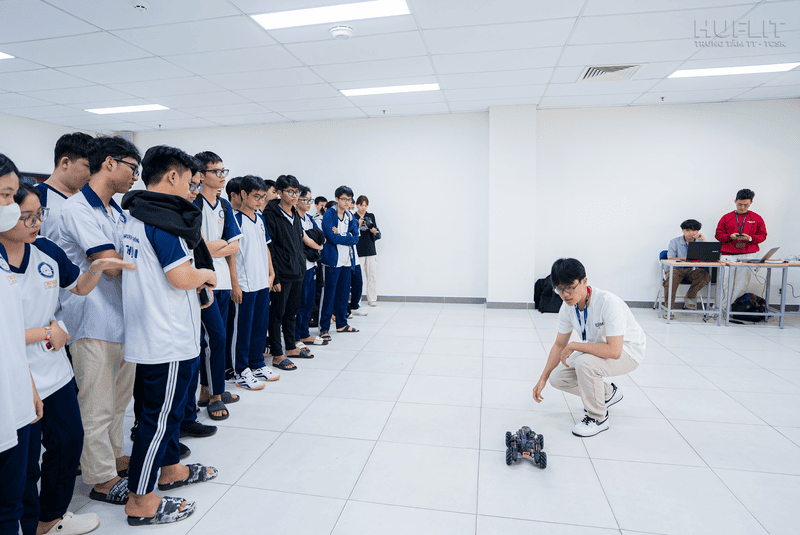
HUFLIT organises many academic activities so students train skills and access career opportunities
Questions related to software engineering and artificial intelligence
Before making the choice of whether to study software engineering or artificial intelligence, many people usually wonder about the skills needed as well as the difficulty of each field. Below are the common questions that help you visualise more clearly and choose what suits you.
What skills are needed to study Software Engineering?
Software engineering requires logical thinking and the ability to analyse problems to convert requirements into concrete products. Learners need to firmly grasp basic programming, data structures – algorithms, while also having teamwork, communication and project-management skills to coordinate effectively in a professional software-development environment.
Is the Software Engineering field easy to study?
Compared to many other technology fields, Software Engineering has a relatively good level of accessibility because the focus lies in practice and project deployment. If you have an interest in programming, persistently practise and proactively learn through real-world projects, students can completely keep up with the programme and develop solid career skills.
What skills are needed to study Artificial Intelligence?
Artificial intelligence requires a solid mathematical foundation (linear algebra, probability – statistics), proficient programming ability (especially Python) together with data-analysis and big-data-processing skills. Besides, logical thinking, research, creativity and the ability to solve complex problems are the deciding factors to pursue this field long-term.
The article above has helped clearly analyse the issue of whether to study Software Engineering or Artificial Intelligence based on ability, interest and career trends. Each field has its own strength and there is no right choice for everyone. With a training programme tied to practice and updating technology, HUFLIT is a choice worth considering for students who love the information technology field.
>>>> EXPLORE ARTICLES ON THE SAME TOPIC:
Is software engineering hard? A detailed answer 2026
Software Engineering and Information Technology: Differences & Opportunities
CONTACT INFO
Apply for admission at
tuyensinh.huflit.edu.vn
Find out information
huflit.edu.vn
Advising education enrollment