


-
Proud to be HUFLITers #07 | M.A. Tran My Uyen – A lectern where a teacher wishes only to “watch her children grow up”At the HUFLIT Faculty of Foreign Languages, M.A. Tran My Uyen (Vice Dean) goes by many names. Some call her “Ms My”; her students call her “mother”. Colleagues often compare her to Mother Au Co with a hundred children. Yet to become the “mother” of the lecture hall she is today, she went through a profound shift in thinking that completely changed a teaching philosophy built over more than 30 years.
-
New Cybersecurity Regulations: Opportunities for the Cybersecurity Field in the Digital EraThe new cybersecurity regulations taking effect on 1 July 2026 not only help complete the legal framework but also drive demand for talent in cybersecurity. This is also the moment when the discipline becomes a promising choice for young people who love technology and information security.
-
“GenZ Major Insights 2026” – Episode 9: Boundless Journeys with HUFLIT’s Tourism and Hospitality ProgramsMany students choose the Tourism and Hospitality field simply because they love to travel. But passion alone is not enough to pursue this field in the long run. What matters more is understanding the nature of the discipline, its professional requirements, and the qualities needed to grow in a professional service environment.
Should You Study Chinese or Korean? [Handbook 2026]
NGÀY: 05/03/2026
Chia Sẻ Qua
Should you study Chinese or Korean? An overview comparison
An overview comparison is the first step that helps you clearly understand the characteristics of each foreign language before choosing whether to study Chinese or Korean. When comparing Chinese and Korean, many people will realise that each language has its own advantages in writing system, pronunciation, grammar and application opportunities.
Chinese brings many advantages thanks to its close language relationship with Vietnamese, while Korean stands out for its scientific and easy-to-remember alphabet. In the section below, you can refer to the detailed comparison table of Chinese and Korean to make the most suitable choice for yourself.
| Comparison | Chinese | Korean |
| Alphabet and writing | Chinese uses Pinyin, consisting of initials, finals and tones. This language has tens of thousands of characters; each character can represent a word or be combined into a compound word. | Korean uses the Hangeul system with 40 characters (21 vowels, 19 consonants). The writing is composed of 3 basic strokes such as ㅇ, ㅡ and |
| Pronunciation | Chinese pronunciation is quite familiar to Vietnamese people because of many similar sounds. | Korean pronunciation requires firmly grasping 9 rules such as liaison, sound change, nasalisation, aspiration… |
| How to write characters | Writing Chinese characters requires high accuracy; even one wrong stroke changes the meaning. You need to firmly grasp the basic strokes and 7 character-writing rules. Traditional characters have more strokes than simplified ones. | Korean words are composed of characters, forming sentences in a clear order with clear spacing, helping learners access them more easily than Chinese characters. |
| Grammar | Chinese grammar has many points similar to Vietnamese, with no conjugation of past – present – future tenses. | Korean grammar is more complex, with many changes in verbs and the use of formal – informal sentences. |
| Listening skills | Chinese is easy to listen to thanks to many familiar Sino-origin words; you just need to firmly grasp Pinyin to listen and understand well. | Korean is clear in pronunciation; the separated sounds help Vietnamese people absorb listening quite quickly. |
| Study time | It takes about 4 months to reach a level equivalent to HSK 2 with 300 vocabulary words and 30 grammar topics. | In only about 3 months of practice, you can reach TOPIK 2 and communicate basically. |
Detailed analysis of job opportunities and economic potential
Learning about career opportunities is an important step that helps you determine which language choice brings long-term benefits. Each foreign language has its own advantage when considering Chinese-language job opportunities and Korean-language job opportunities in key fields.
For Chinese
For Chinese, the recruitment demand is increasingly rising thanks to the expansion of investment from China and Taiwan into the Vietnamese market. This is one of the foreign languages that brings many attractive positions, especially suitable for those looking for high-paying Chinese-language jobs. So specifically, what can you do by studying Chinese and what is the working environment like?
So what career does studying Chinese lead to? Chinese learners can participate in many potential fields such as manufacturing, logistics, e-commerce (especially platforms such as Taobao, 1688), tourism – hospitality, cross-border customer care and professional translation – interpreting.
Chinese Language graduates usually receive a starting 9 – 12 million VND/month for positions such as interpreter, language assistant or elementary teacher, and can reach up to 15 million if working at a foreign company. With 2 – 5 years of experience, income is usually 15 – 25 million, while higher roles such as senior interpreter or lecturer can reach 30 – 40 million.
In Vietnam, the presence of Chinese companies in Vietnam is increasingly clear. Many large corporations such as Huawei, Xiaomi, BYD, Luxshare, Foxconn, Haidilao, Oppo or Taiwanese import-export enterprises are expanding factories and offices. This creates a stable source of jobs and fast advancement opportunities for candidates proficient in Chinese.

Chinese opens up many stable job opportunities thanks to the strong development of Chinese enterprises in Vietnam
>>>> SAVE NOW: What do first-year students need to prepare? (checklist 2026)
For Korean
Korean continues to maintain a strong attraction thanks to the wide presence of Korean corporations in Vietnam, creating favourable conditions for those who wish to work for Korean companies. This is an ideal choice for those who like a professional, modern environment with fast advancement opportunities.
Korean learners can participate in outstanding fields such as technology (Samsung, LG), cosmetics, beauty, entertainment & communication, tourism – hospitality and education. The large recruitment demand helps you easily answer the question of what career studying Korean leads to, with many opportunities to become a translator – interpreter, office staff, customer care, production coordinator or a communication specialist for the Korean market.
Currently, HUFLIT also builds direct enterprise relationships in Korea: the Faculty of Oriental Languages and Cultures has signed a Memorandum of Understanding (MOU) with HITS CORPORATION – a reputable insurance-loss assessment enterprise – and BPx Company, which specialises in training and providing IT Comtor human resources and translators and interpreters in the information technology field. These cooperations help HUFLIT students easily access internships, experience real-world work and enhance job opportunities after graduation.
In Vietnam, large corporations such as Samsung, LG, Lotte, CJ, Hyundai or Shinhan Bank still hold outstanding positions, creating an abundant source of jobs and long-term development opportunities for those good at Korean.

Korean brings a competitive income and job opportunities in large Korean corporations
Should you study Chinese or Korean? Which language is easier to learn?
Should you study Chinese or Korean? To answer, you need to consider the ease and difficulty of each language in basic factors such as writing, pronunciation and grammar. Many people wonder which is harder between Chinese and Korean, but in reality this also depends on each person’s absorption ability and study goals, specifically:
About writing: Pictographic Chinese characters vs. the scientific Hangul alphabet
Chinese uses Chinese characters, a complex pictographic writing system, requiring learners to memorise many characters and practise writing each stroke correctly, different from the Chinese characters and Nom script of the past. Nevertheless, Vietnamese people have a big advantage thanks to the Sino-Vietnamese vocabulary that helps recognise and understand meanings faster. This significantly supports the process of reading comprehension and memorising new words.
Meanwhile, Korean uses the Hangul alphabet, which has a logical structure, is easy to learn and only takes a few hours to grasp the basics. Learners can learn the Korean alphabet quickly thanks to the clear sound-combining method and fewer characters. However, many Sino-origin words are written in Hangul, making it hard for learners to guess the meaning if they don’t know the word’s origin.
About pronunciation: Chinese tones vs. Korean aspiration and liaison
Chinese has a tone system easily associated with Vietnamese, but Chinese pronunciation easily causes confusion if the pitch is wrong. Learners must firmly grasp pinyin because some sounds are completely different from Vietnamese. This requires regular ear and mouth-shape training time.
Conversely, Korean has no tones but pronunciation is complex in its own way. Learners need to clearly understand Korean pronunciation rules to handle aspirated sounds, tense sounds and characteristic sound changes.
In particular, liaison in Korean is the part that easily makes many beginners “struggle” because the actual speaking speed is fast and the linking is quite strong.
About grammar
Chinese grammar is rated as friendlier thanks to a sentence structure close to Vietnamese, especially in the basic Chinese grammar parts. Sentences follow the familiar S – V – O order and words hardly change morphology, helping learners access it quickly and remember easily.
Meanwhile, Korean has a completely reversed structure. The elementary Korean grammar parts already require learners to get familiar with the S – V – O order along with a complex particle system. At the same time, Korean sentence structure changes according to the level of honorifics, making the learning process require patience and regular practice.

Chinese grammar is simple and close to Vietnamese, while Korean is more complex due to particles and the honorific system
>>>> DO NOT SKIP: Do you get bonus points on the university exam if you have an IELTS certificate?
Should you study Chinese or Korean: Which choice is for YOU?
The decision of whether to study Chinese or Korean depends on the personal goals and career orientation you are pursuing. Each language brings its own advantage in salary, job opportunities and development environment. The important thing is that you must clearly understand your interests, strengths and wish to choose the second language most suitable to your future.
Reasons to choose Chinese
What is studying Chinese for? Many people choose this language out of a passion for Chinese culture and a desire to understand more deeply about the ancient civilisation. Chinese opens up development opportunities in commerce, business and logistics. This is also a suitable choice for those with a good ability to memorise images.
Besides, using Chinese helps you easily find a job at industrial zones and manufacturing factories with Chinese investment. This language also brings a big competitive advantage in a multinational environment. If you don’t mind the challenge of Chinese characters and love exploring, Chinese is certainly a direction worth considering.

Chinese suits people who love culture, are strong in business and don’t mind conquering Chinese characters
Why choose Korean
Studying Korean because of idols is a common reason for many young people who love K-pop, K-drama and Hallyu culture. This language helps you understand more deeply about Korean music, films and beauty trends. At the same time, the benefit of studying Korean also lies in expanding career opportunities in large technology corporations. This is a suitable choice for those with good logical thinking to access the grammar.
Korean has an easy-to-learn alphabet, helping you quickly memorise and start basic communication. With the popularity of Korean enterprises in Vietnam, Korean proficiency will bring a big advantage in recruitment. If you are both passionate about entertainment culture and want to develop your career, Korean is a direction worth investing in.
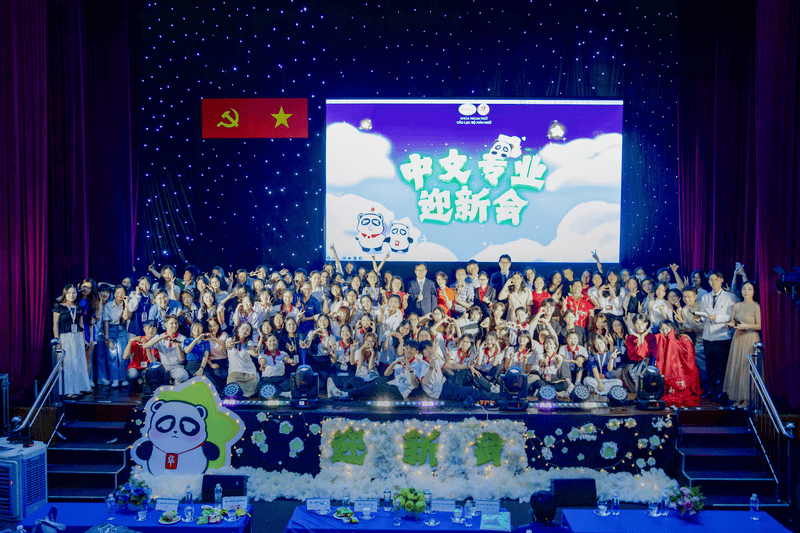
Korean is an ideal choice for those passionate about Hallyu and who want to work in Korean corporations
>>>> QUICK CLICK: [Answer] Which quality school should you choose for English Language?
Why choose the Chinese Language and Korean Language fields at HUFLIT?
Is HUFLIT good? With the two fields of Chinese Language and Korean Language, the school is becoming an outstanding choice for students who love Asian languages and culture. The study programme is designed practically, closely following recruitment demand, helping students confidently start their careers, specifically:
- An internationally standard training programme: HUFLIT builds a curriculum that closely follows enterprise practice, helping students not only be good at the language but also understand the professional context. The study roadmap is clear, easy to keep up with even for beginners. The listening – speaking – reading – writing subjects are implemented according to international standards, ensuring students use the language proficiently and confidently.
- An experienced lecturer team: Students study with a lecturer team with deep expertise, many of whom have studied or worked in China and Korea. Native lecturers participate in teaching, helping improve pronunciation, culture and language thinking. The teaching method is practical and lively, always encouraging students to communicate and develop soft skills.
- Modern facilities: HUFLIT is equipped with language labs, a rich Chinese – Korean material library and comfortable classrooms. A safe, comfortable learning environment supports students in practising pronunciation, doing exercises and in-depth research. Modern equipment helps increase study effectiveness and practical ability.
- Vibrant student activities: The school has many Chinese and Korean clubs for students to practise communication weekly. Cultural festivals, workshops, debate competitions and art performances help students immerse themselves in the native culture, such as Echoes of Vietnam (7SEC English Club), HUFLIT Career Fair, the English debate “The Sailors”, professional Dubbing competitions, the Korean Culture Festival and the Japanese Culture Festival. These activities create a natural training environment, enhancing language skills and quick reflexes.
- Wide-open internship & job opportunities: HUFLIT has a strong affiliated enterprise network in Vietnam, China and Korea such as HITS CORPORATION (Korea), BPx Company (Korea), while also maintaining a good relationship with the Consulate General of China in Ho Chi Minh City, creating favourable conditions for students to access scholarship programmes and exchange opportunities. Students easily access internship positions in commercial, logistics, manufacturing companies and technology corporations. After graduation, students have a competitive advantage thanks to practical language skills and early enterprise experience.
FAQs – Frequently asked questions
Below are the answers to common questions from learners, helping you understand better before choosing a suitable language. Each answer is presented concisely, easy to grasp and complete in meaning.
Should you study both Chinese and Korean in parallel?
You can study the two languages in parallel, but this is a very challenging choice. You should master one language before studying the second language to avoid confusion about pronunciation, vocabulary and grammar.
How long does it take to master Chinese/Korean?
The time to master depends entirely on each person’s level of effort. Usually, you need about 1 – 2 years to communicate basically (equivalent to HSK 4 or TOPIK 3 – 4) and 3 – 4 years of in-depth study to reach a proficient level.
Should you study the HSK certificate (Chinese) or TOPIK (Korean)?
Both certificates are very important because they are internationally standard measures of foreign-language capacity. Many employers require these certificates, and HUFLIT has a training programme that helps students prepare for and achieve the levels according to their goals.
The article above has helped you better understand whether to study Chinese or Korean, depending on each person’s goals and orientation. Whichever language you choose, persistence and the right study method are always the deciding factors. If you want to study in a professional environment rich in experience, HUFLIT is a choice worth considering for your future journey.
>>>> DO NOT SKIP THE USEFUL ARTICLES:
CONTACT INFO
Apply for admission at
tuyensinh.huflit.edu.vn
Find out information
huflit.edu.vn
Advising education enrollment