


-
Proud to be HUFLITers #07 | M.A. Tran My Uyen – A lectern where a teacher wishes only to “watch her children grow up”At the HUFLIT Faculty of Foreign Languages, M.A. Tran My Uyen (Vice Dean) goes by many names. Some call her “Ms My”; her students call her “mother”. Colleagues often compare her to Mother Au Co with a hundred children. Yet to become the “mother” of the lecture hall she is today, she went through a profound shift in thinking that completely changed a teaching philosophy built over more than 30 years.
-
New Cybersecurity Regulations: Opportunities for the Cybersecurity Field in the Digital EraThe new cybersecurity regulations taking effect on 1 July 2026 not only help complete the legal framework but also drive demand for talent in cybersecurity. This is also the moment when the discipline becomes a promising choice for young people who love technology and information security.
-
“GenZ Major Insights 2026” – Episode 9: Boundless Journeys with HUFLIT’s Tourism and Hospitality ProgramsMany students choose the Tourism and Hospitality field simply because they love to travel. But passion alone is not enough to pursue this field in the long run. What matters more is understanding the nature of the discipline, its professional requirements, and the qualities needed to grow in a professional service environment.
Review: Should You Study a Language Discipline? Opportunities and Challenges
NGÀY: 16/03/2026
Chia Sẻ Qua
Should you study a language discipline in 2026?
The trend of the language discipline in 2026 shows that this is still a full-of-potential choice, especially when combined with technology and other specialisations. Language is a cultural “bridge” that AI cannot yet completely replace.
The truth about AI’s impact on the language discipline
AI today can support fast translation, process raw text and increase work productivity. However, AI still has limitations when handling cultural nuances, emotions, communication context and the human factor. Work requiring negotiation, persuasion, in-depth translation-interpreting or cross-cultural communication still needs humans at the centre, with AI playing the role of a support tool.
What AI can do:
- Quickly translate technical text and instruction documents
- Support word lookup and phrase suggestions
- Rough translation for translators to edit faster
What AI does not do well yet:
- Understand culture, history, social context
- Translate literature, poetry, creative marketing slogans
- Simultaneous interpretation in conferences (requires fast reflexes + context understanding)
- Multicultural business negotiation (requires high EQ)

AI today can support fast translation and increase work productivity
>>>> SEE MORE: [Answer] English Language, which quality school to choose?
The global labour-market potential for personnel good at foreign languages
Multinational corporations, FDI enterprises and international organisations increasingly need multilingual personnel who understand the local market and culture. Personnel good at foreign languages have a big advantage in fields such as international business, logistics, marketing, tourism, education and technology.
According to information cited by Tri Thuc Magazine, candidates possessing Chinese-language ability usually have an income 10–40% higher than the general level. This trend is clearly recorded in the Salary and Personnel – Recruitment Market Report 2026 conducted by JobOKO.
Language is the key that opens up international thinking and knowledge
Understanding and using foreign languages helps learners access original materials, international research, technology trends and new knowledge that a translation sometimes does not convey fully. Language also trains multidimensional thinking, adaptability and continuous learning. These are the core capabilities for sustainable development in the era of globalisation and AI. Specific benefits:
- Accessing original materials, the latest technology (90% of scientific knowledge is in English)
- The opportunity to study abroad, work internationally
- Deeply understanding the culture and thinking of other civilisations
- Expanding a global relationship network
- Increasing promotion opportunities (employees good at foreign languages are promoted 2-3 times faster)
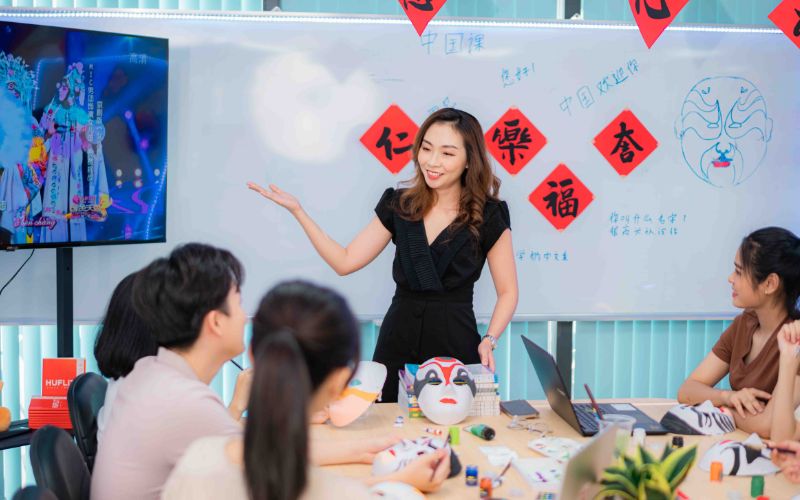
Understanding and using foreign languages helps learners access original materials, international research
The “hottest” language disciplines and the opportunity for a thousand-dollar income
Which language to study for a high salary is a question many young people care about. Below is a comparison table of the average salary you can refer to:
| Language | Starting salary (million/month) | Salary with 3-5 years of experience | Market demand |
| English | 12-20 | 25-50 | Very high (global) |
| Chinese | 15-25 | 30-60 | High (Chinese FDI) |
| Japanese | 18-28 | 35-70 | High (Japanese FDI) |
| Korean | 15-23 | 28-55 | Medium – High |
| German/French | 14-22 | 30-65 | Medium |
English Language: The global language that is never outdated
English continues to hold the role of the common language in business, education and technology worldwide. The outstanding direction today is Business English – serving work in enterprises, negotiation, international trade and TESOL – teaching English in an international environment, bringing wide-open job opportunities and stable long-term income. For instance:
- Business English specialist at a multinational enterprise
- External-relations staff, international relations, senior secretary – assistant
- International marketing, import-export, logistics specialist
- English teacher/lecturer, TESOL, enterprise training

You can work as a Business English specialist at a multinational enterprise
>>>> QUICK LOOK: Do you need to take IELTS to study English Language? Detailed answer
Chinese/Japanese/Korean Language: The strong FDI investment wave in Vietnam
The increase in investment from China, Japan and Korea leads to a large demand for personnel fluent in these languages at industrial parks, technology corporations, manufacturing and import-export enterprises. People good at Chinese, Japanese, Korean have a clear advantage in management, external-relations, logistics and technical positions. For example:
- Interpreting – translating at industrial parks, factories, technology corporations
- Director’s assistant, FDI project coordinator
- Purchasing, import-export, logistics staff for Chinese – Japanese – Korean enterprises
- HR, administrative specialist in foreign-invested companies
- Department manager, production manager (after accumulating experience)
The trend of studying Language combined with economic specialisations
The “Language + Management / Marketing / Logistics” model is becoming a strategic choice, helping learners not only communicate well but also deeply understand business operations. This combination expands career opportunities, increases promotion ability and creates a sustainable competitive advantage in the global labour market. For instance:
- Language + Management: project management, operation management, international customer management
- Language + Marketing: international marketing, multilingual content, agency account
- Language + Logistics: supply-chain coordination, import-export documents, logistics sales
- Language + Trade: B2B sales, international market development
Why is HUFLIT the top choice to study a language discipline?
Studying a language at HUFLIT brings many unique advantages. HUFLIT University – Ho Chi Minh City University of Foreign Languages – Information Technology – is a school specialising in foreign-language training with more than 25 years of experience.
A realistic-standard and dynamic foreign-language training environment
HUFLIT builds a study environment centred on real communication, helping students form natural language reflexes instead of only learning theory. Students regularly use foreign languages in class, presentations, teamwork and academic exchange, thereby enhancing confidence in communication.

HUFLIT builds a study environment centred on real communication
A study programme integrating informatics skills and AI technology
Not stopping at pure language training, HUFLIT integrates informatics skills and AI application into the study programme. Students access tools supporting translation-interpreting, text processing, terminology lookup and work-process optimisation with technology. Through it, students learn to use AI as a smart support tool, increasing productivity and accuracy in work.
The opportunity to intern and work in a widespread partner network
HUFLIT owns a diverse network of domestic and foreign enterprise partners, including FDI companies, international organisations, import-export, tourism, education and media enterprises. For instance, Samsung, LG, Panasonic, Bosch, CJ Group, CJ Logistics, AEON Vietnam, etc. This enables students to access the real working environment right while still at school.
Through internship, observation and linked-recruitment programmes, students have the opportunity to face reality, accumulate experience and expand professional relationships, increasing the possibility of having a job right after graduation.
A prime location in the centre of HCMC convenient for trade
HUFLIT is located in District 10 – the centre of HCMC, a vibrant area with many enterprises, international organisations, cultural and educational centres. This location helps students easily connect with the labour market and academic, career activities.
>>>> FOLLOW MORE: How long to study Chinese to become an interpreter? Roadmap 2026
The roadmap to become the “version that cannot be replaced” by AI
To not be overwhelmed by AI, language-discipline learners need to develop a comprehensive skill set including: emotional intelligence (EQ), cultural understanding, technology capacity and critical thinking. These are the factors helping humans keep the central role in communication, negotiation and handling complex situations that AI can only support, not replace.
Focusing on emotional intelligence (EQ) and cultural-negotiation ability
EQ helps language workers understand the emotions, intentions and cultural context of the partner, thereby choosing a suitable and effective way of expression. In translation-interpreting, diplomacy or international business, the subtlety in communication and the ability to handle cultural differences are the core value that AI cannot yet copy.
Mastering AI tools to enhance translation-interpreting productivity
Instead of being wary, learners need to see ChatGPT, DeepL and AI language tools as “colleagues” that help speed up lookup, translation and draft editing. Humans keep the role of quality control, handling context and nuance, while AI supports the technical part, thereby enhancing work effectiveness.
Equip an additional minor to break through
Combining Language + Marketing or Language + IT helps expand the career scope, meeting the multi-skilled personnel demand of modern enterprises. When you are both good at foreign languages and understand the specialisation, learners will increase their self-worth and become hard-to-replace human resources in the AI era.
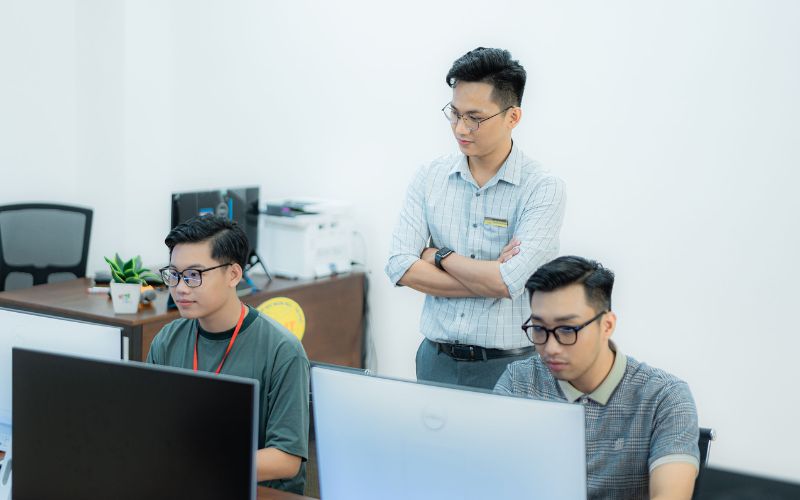
You should combine Language + Marketing or Language + IT to enhance skills
FAQ: Frequently asked questions when choosing to study a language discipline
Faced with the strong development of AI and the global labour market, many candidates and parents wonder whether studying a Language discipline is still suitable and has many job opportunities. Questions around career orientation, income and competitiveness are being cared about more than ever.
Is learning a language difficult?
Learning a language is not difficult if you have the right method and a good practice environment. At HUFLIT, students learn by the communicative method, focusing on using the language in reality instead of only learning grammar. With perseverance and regular practice, you can completely reach a proficient level.
Is HUFLIT’s tuition high?
Tuition for the Foreign Languages discipline at HUFLIT ranges from 16-20 million VND/year, at the medium level compared to reputable foreign-language schools in HCMC. In particular, HUFLIT has many scholarship policies of up to 100% of tuition for students with excellent achievements and difficult circumstances.
Which language should you choose to easily find a job?
English is still the safest choice with the highest job demand. However, Chinese, Japanese, Korean are trending to increase strongly due to FDI. The advice is to study English as the main + one East Asian language as the minor to increase career opportunities.
Should you study a language discipline? The answer is yes, but on the condition that you not only study pure language but must combine it with technology, a specialisation and developing EQ. HUFLIT, with an international-standard training environment, a team of native lecturers and a technology-integrated programme, is an ideal choice for you to become a language expert who cannot be replaced by AI.
>>>> LEARN MORE IN-DEPTH INFORMATION:
Should you study Chinese or Korean? [Handbook 2026]
Is learning a foreign language difficult? 3 factors to conquer every language
CONTACT INFO
Apply for admission at
tuyensinh.huflit.edu.vn
Find out information
huflit.edu.vn
Advising education enrollment