



-
Proud to be HUFLITers #07 | M.A. Tran My Uyen – A lectern where a teacher wishes only to “watch her children grow up”At the HUFLIT Faculty of Foreign Languages, M.A. Tran My Uyen (Vice Dean) goes by many names. Some call her “Ms My”; her students call her “mother”. Colleagues often compare her to Mother Au Co with a hundred children. Yet to become the “mother” of the lecture hall she is today, she went through a profound shift in thinking that completely changed a teaching philosophy built over more than 30 years.
-
New Cybersecurity Regulations: Opportunities for the Cybersecurity Field in the Digital EraThe new cybersecurity regulations taking effect on 1 July 2026 not only help complete the legal framework but also drive demand for talent in cybersecurity. This is also the moment when the discipline becomes a promising choice for young people who love technology and information security.
-
“GenZ Major Insights 2026” – Episode 9: Boundless Journeys with HUFLIT’s Tourism and Hospitality ProgramsMany students choose the Tourism and Hospitality field simply because they love to travel. But passion alone is not enough to pursue this field in the long run. What matters more is understanding the nature of the discipline, its professional requirements, and the qualities needed to grow in a professional service environment.
Should You Live in a Dormitory or a Rented Room? An Answer for New Students
NGÀY: 05/03/2026
Chia Sẻ Qua
An overview comparison between Dormitory and Rented room
Choosing which accommodation form will depend on the financial conditions, personality and living needs of each student. Below is a detailed comparison by important criteria that you can refer to.
About living costs
About living costs, according to Dan Tri newspaper, living in a dormitory in Ho Chi Minh City usually ranges around 800,000 – 1.5 million VND/month for rooms of 4–8 people, including electricity and water at the set rate and basic amenities.
Meanwhile, renting a room outside is more expensive, averaging 2.5 – 4 million VND/month, not counting arising costs such as electricity, water, internet or parking; the total cost can reach 4–5 million VND/month. Thus, the dormitory is a more economical choice, while a rented room brings freedom but is more expensive.
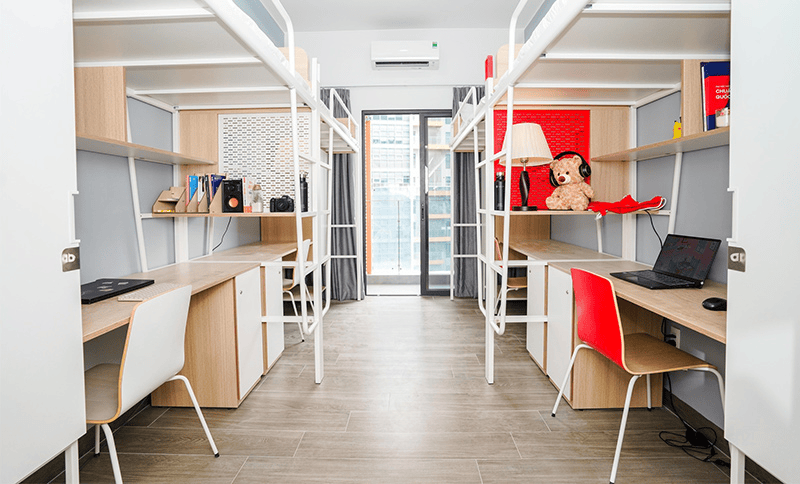
The dormitory suits those who need to save costs
About Security and Management
The dormitory has 24/7 security, guards on duty, surveillance cameras and quite strict control of entry and exit times. Thanks to this, this environment is rated safer and especially suitable for first-year students or those who want clear management.
In a rented room, the level of safety will depend largely on the area, the landlord and the surrounding neighbours. Some rental areas have guards or fingerprint-lock gates, but there are also places with loose security. Therefore, students should note to check the surrounding area, prioritise rental rooms with cameras and sturdy doors, and limit leaving vehicles outdoors overnight.
>>>> POCKET IT: 20+ part-time jobs for students hot 2026
About Freedom and private space
When living in a dormitory, students must comply with curfew hours, regulations on receiving guests, noise and using common property. Private space is also more limited due to living with many people, with activities almost all taking place collectively.
On the other hand, a rented room has a higher level of freedom and privacy. You can cook for yourself, decorate the room, invite friends over or adjust your living schedule as you wish. This is a suitable choice for those who like comfort and want to control their own living space.
About the Study and Socialising environment
The dormitory will create a favourable environment for students to meet new friends, study in groups, share materials or participate in the school’s extracurricular activities. Living in a student community also helps you easily integrate, expand relationships and have many more interesting experiences.
In a rented room, the environment tends to be quiet and private, so it will help you focus on studying well if you know how to organise yourself. However, to connect with friends or participate in activities, you need to be more proactive, because there is no collective bonding as in the dormitory.
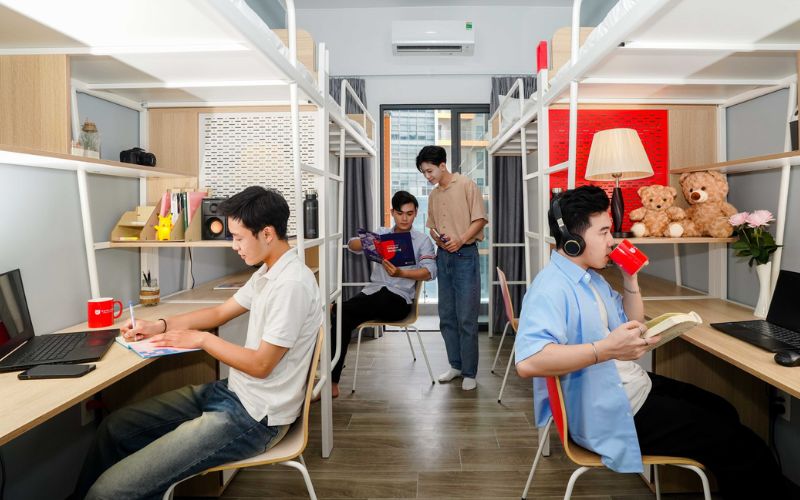
The dormitory will create a favourable environment for students to meet new friends
When should you live should you live in a dormitory or a rented room? Dormitory?
If you are wondering whether you should live in a dormitory, consider your financial goals and lifestyle to have the most suitable choice for yourself. Let’s answer this question.
You are a new student, not yet familiar with the city
If you are a new student and wondering where first-year students live, the dormitory is a choice that helps you adapt to the university environment more easily than ever. A safe living environment with strict management and friends around to support you will reduce the pressure in the first months of getting used to the new life.
Should you live in a dormitory or a rented room if you want to save costs to the maximum?
For those whose top priority is saving living costs, the dormitory is almost the cheapest choice. The monthly fee, including electricity, water, internet, cleaning and common utilities, is fixed and does not arise much. This will help you easily manage finances, especially when your main source of income still depends on your family.
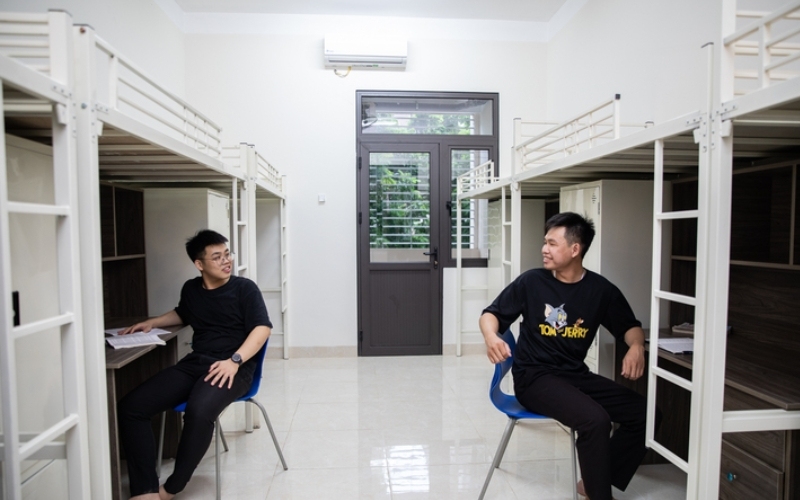
Living in a dormitory will help you save more costs
>>>> SAVE NOW: Part-time job experience for HUFLIT students 2026
You prioritise studying and the school’s activities
If you want to join university clubs and immerse yourself in dynamic student life, consider living in a dormitory. Living near the school helps you get to class on time, access the library, self-study rooms or academic events without spending much time travelling.
Should you live in a dormitory or a rented room? When should you live in a Rented room?
Choosing between a dormitory and a rented room usually depends on the needs, personality and living habits of each student. Below are a few factors you can consider.
You need private space and quiet
If you are an introvert, easily distracted or need quiet to study effectively, a rented room is a much more suitable environment than a dormitory. Private space allows you to arrange your own study corner and living schedule without being affected by noise from roommates.
In addition, privacy also helps you have a real place to rest after a long day of studying. You can comfortably relax, read books, listen to music or catch up on sleep without fear of being disturbed. For those who are easily stressed or need personal space to recover energy, a rented room is a very suitable choice.
You want freedom in time and activities
A rented room will help students freely go about daily activities without being affected by many factors. You can come home late without worrying about the gate being closed, cook any dish you like, or adjust your schedule to suit your study and work. This is especially advantageous for those who have evening shifts, participate in projects, clubs or have to travel a lot.

A rented room will help students freely go about daily activities
You already have experience living independently and want to take a part-time job
If you are used to taking care of yourself, managing time and spending, then living in a rented room will help you be more proactive when taking a part-time job. In addition, living in a rented room is also a good environment to train your financial independence. You have to pay for electricity, water, internet, food spending yourself… This helps you mature faster and gain real-world life experience.
>>>> QUICK LOOK: Should students take part-time jobs or not? A handbook from A-Z
Frequently asked questions (FAQ)
Below are the accommodation questions that students are interested in when preparing to find a rented room or choose a suitable place to live. Let’s find out now.
Can you cook in the dormitory?
Most dormitories today do not allow students to cook in their rooms to ensure fire prevention and fighting (PCCF) safety and avoid affecting communal living. Devices such as electric stoves and mini gas stoves are usually completely banned because of the potential risk of fire, explosion and electrical overload.
However, many dormitories have common kitchen areas for students, equipped with electric stoves, sinks, exhaust fans or a centralised cooking area. Students need to comply with each dormitory’s regulations on usage time, hygiene and safety when cooking.
Should first-year students share a rented room?
Sharing a room has some notable advantages such as helping to share rental, electricity and water costs and other living expenses. Living together also creates opportunities to socialise and support each other in studying and life. However, the disadvantage is that conflicts easily arise if the two people have different lifestyles, living habits or schedules. In addition, you need to be wary of cases of pretending to look for a roommate in order to commit fraud and appropriate property.
The advice is that first-year students should share with acquaintances, close friends or people with similar personalities to limit risks. Before deciding, agree clearly from the beginning on costs, hygiene, schedules and living regulations to avoid misunderstandings later.
What is the average cost for a student renting a room in Ho Chi Minh City?
On average, a student renting a room in Ho Chi Minh City will spend around 5–7 million VND/month, including: rent (2–3 million/person if sharing), electricity and water, Internet, food (2–3 million), travel, study and other arising costs.
For areas near the centre or private rooms, the cost can be higher. This figure is only an estimate. Because the actual spending level also depends on each person’s needs, the location of the rented room and living habits.
Whether to live in a dormitory or a rented room has no absolutely correct answer, because the most suitable choice will depend on the finances, personality and living habits of each student. The important thing is that you clearly understand your own needs and choose a place that helps you study, live and develop yourself best. Wherever you choose, HUFLIT advises you to always prioritise safety and comfort first.
>>>> SEE MORE USEFUL ARTICLES:
Should you take a part-time job or join a club – Which choice is suitable?
International joint programmes: The roadmap to owning an international degree
CONTACT INFO
Apply for admission at
tuyensinh.huflit.edu.vn
Find out information
huflit.edu.vn
Advising education enrollment