



-
Proud to be HUFLITers #07 | M.A. Tran My Uyen – A lectern where a teacher wishes only to “watch her children grow up”At the HUFLIT Faculty of Foreign Languages, M.A. Tran My Uyen (Vice Dean) goes by many names. Some call her “Ms My”; her students call her “mother”. Colleagues often compare her to Mother Au Co with a hundred children. Yet to become the “mother” of the lecture hall she is today, she went through a profound shift in thinking that completely changed a teaching philosophy built over more than 30 years.
-
New Cybersecurity Regulations: Opportunities for the Cybersecurity Field in the Digital EraThe new cybersecurity regulations taking effect on 1 July 2026 not only help complete the legal framework but also drive demand for talent in cybersecurity. This is also the moment when the discipline becomes a promising choice for young people who love technology and information security.
-
“GenZ Major Insights 2026” – Episode 9: Boundless Journeys with HUFLIT’s Tourism and Hospitality ProgramsMany students choose the Tourism and Hospitality field simply because they love to travel. But passion alone is not enough to pursue this field in the long run. What matters more is understanding the nature of the discipline, its professional requirements, and the qualities needed to grow in a professional service environment.
Is Learning Japanese Hard or Easy: The Real Reasons and How to Conquer It
NGÀY: 01/04/2026
Chia Sẻ Qua
Is learning Japanese hard or easy?
Learning Japanese has certain challenges, especially in the writing system and distinctive expression. However, any foreign language is bewildering when you start; the important thing is that you clearly understand the difficulties to have a suitable learning direction.
For Vietnamese people, Japanese has some advantages such as not conjugating verbs by person and familiarity with Sino-Vietnamese words, making learning Kanji easier to approach than in many other countries. Therefore, whether learning Japanese is hard or easy depends largely on your method, roadmap and perseverance.
>>>> SEE INFORMATION: Tips for learning Japanese quickly without “cramming”
Reasons why many people find Japanese difficult
To have an objective view, we need to specifically analyse the difficulties that Japanese learners often encounter.
The alphabet – Three different writing systems
This is the biggest barrier that makes many people feel Japanese is too complex. Unlike most other languages that have only one alphabet, Japanese uses three writing systems in parallel:
- Hiragana (ひらがな): Comprising 46 basic characters, used to write native Japanese words, grammatical particles and verb endings. For example: わたし (watashi – I), です (desu – to be).
- Katakana (カタカナ): Also 46 characters, used to write loanwords, foreign proper names, sounds and emphasis. For example: コーヒー (koohii – coffee), アメリカ (Amerika – America).
- Kanji (漢字): Chinese characters, with thousands of characters. According to the regulations of the Japanese Ministry of Education, high-school students need to learn 2,136 commonly used Kanji characters (常用漢字 – Jouyou Kanji). Each Kanji character can have many readings (On and Kun readings) and different meanings depending on the context. For example: 食 (eat) can be read as “しょく” (shoku) in 食事 (shokuji – meal) or “た” (ta) in 食べる (taberu – to eat).
Learners must memorise the shape, reading and meaning of these thousands of characters, and know when to use which one. A Japanese sentence frequently combines all three types of characters, for example: 私はコーヒーを飲みます (Watashi wa koohii wo nomimasu – I drink coffee) has both Kanji (私-飲), Hiragana (は-を-みます) and Katakana (コーヒー).
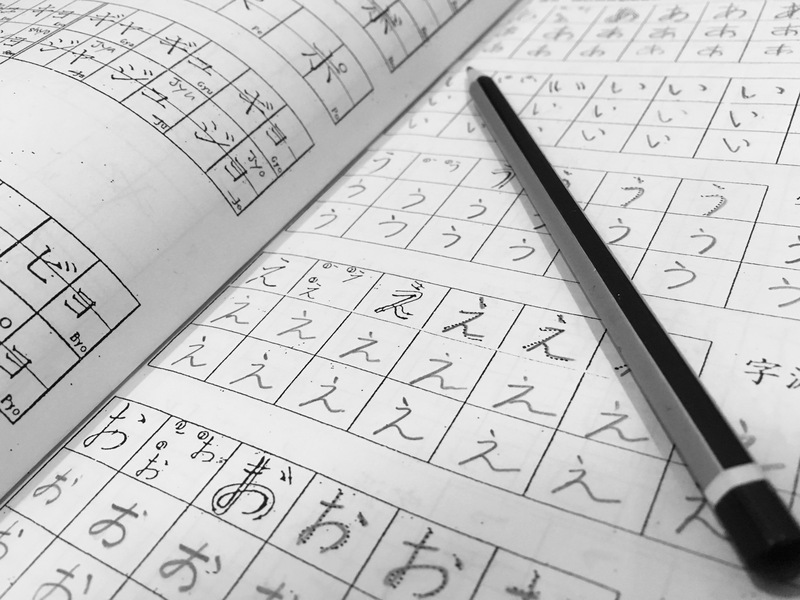
The Japanese alphabet has three different writing systems
Grammar – Completely different from Vietnamese
Although there are some similarities, Japanese grammar still has many basic differences compared to Vietnamese:
- Word order: Japanese follows the Subject – Object – Verb (SOV) order, completely the reverse of Vietnamese (SVO). For example: “I eat rice” in Japanese is 私はご飯を食べます (Watashi wa gohan wo tabemasu – I + rice + eat).
- Particles (Joshi): These are small particles such as は、が、を、に、で、へ… placed after nouns to indicate the grammatical role in the sentence. Distinguishing and correctly using particles is one of the biggest difficulties, even for advanced learners. For example: the subtle difference between は and が confuses many people.
- Complex honorific forms: Verbs and adjectives must be conjugated in many different forms depending on tense (present, past), form (affirmative, negative) and level of formality (plain, polite, respectful, humble).
- Verb forms: Each verb has more than a dozen conjugated forms such as the dictionary form, ます form, て form, た form, ない form, conditional form, potential form, passive form, causative form… Learners need to memorise the conjugations and clearly understand how to use each form.
>>>> DON’T MISS:Should you study Chinese or Japanese? An A-Z analysis
Pronunciation – Has many challenges
At first, Japanese pronunciation seems simple because it has only 5 vowels (a, i, u, e, o) and not many difficult sounds like English. However, there are still its own challenges:
- Long and short vowels: The difference in vowel length creates completely different meanings. For example: おばさん (obasan – aunt) is completely different from おばあさん (obaasan – grandmother). A small mistake in length can cause a serious misunderstanding.
- Special sounds: The small つ sound (sokuon – geminate consonant), the ん sound (final n), the は sound (read as wa when a particle but read as ha when an ordinary character), the ら行 sound (Japanese r is close to Vietnamese l but not exactly the same).
- Rhythm and pitch: Japanese has pitch accent that affects meaning. For example: はし can mean “bridge” or “chopsticks” depending on which sound is accented high.
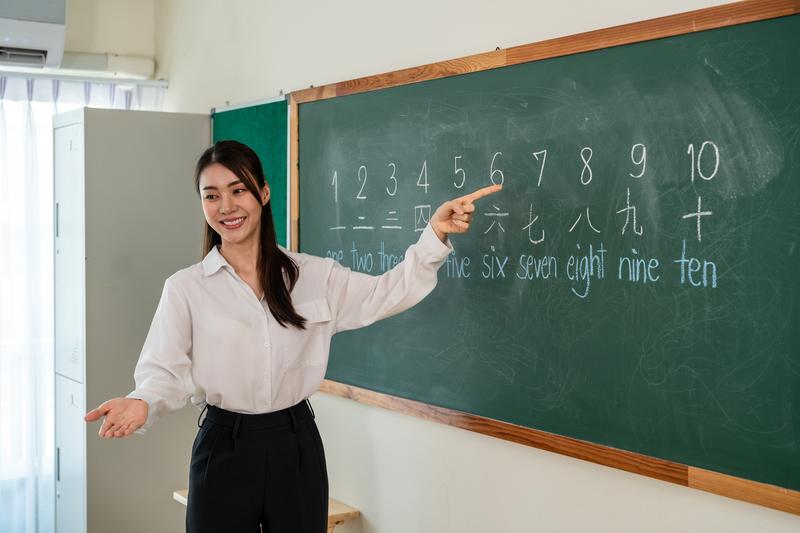
Japanese pronunciation brings many challenges for learners
Honorifics – The level of respect that makes Japanese more complex
One of the factors that makes Japanese complex for learners is the honorific system. Not simply a way of speaking politely, honorifics also express the level of respect, social position and the relationship between speaker and listener. Therefore, understanding and correctly using honorifics is a big challenge but also the key that helps you communicate in Japanese more naturally and correctly.
- Honorifics (敬語 – Keigo): This is one of the most complex and important aspects of Japanese, reflecting the deep culture of respect of Japanese people. There are three main types of honorifics:
- Respectful language (尊敬語 – Sonkeigo): Used to respect the person mentioned (superiors, customers, elders). For example: instead of 食べる (taberu – eat), use 召し上がる (meshiagaru).
- Humble language (謙譲語 – Kenjougo): Lowering one’s own actions to respect others. For example: instead of 言う (iu – say), use 申す (mousu).
- Polite language (丁寧語 – Teineigo): Expressing general politeness, using ます (masu) and です (desu).
Advice to help learners conquer Japanese more easily
Is learning Japanese hard or easy? Although there are many challenges, with the following advice, you can completely learn Japanese effectively and achieve good results.
Firmly grasp the basic knowledge right from the first day
To learn Japanese effectively, you need to build a solid foundation from the start by memorising Hiragana, Katakana and firmly grasping N5 grammar before studying advanced levels. Standard pronunciation should also be trained early to avoid forming bad habits. Studying regularly every day and clearly understanding the essence of sentence structure will help you progress sustainably and easily conquer higher levels.
Choosing suitable materials, avoiding waste
For beginners, the two most popular textbook sets are Minna no Nihongo (Japanese for Everyone) and Genki. Minna no Nihongo has a large exercise system, suitable for self-study or class study. Genki leans towards communication, with explanations in English, suitable for self-learners. Besides the main textbook, supplement more:
- Vocabulary-learning apps: Anki, Memrise, Quizlet with JLPT card sets
- Kanji-practice apps: Wanikani, Kanji Study, Obenkyo
- Grammar materials: “A Dictionary of Basic Japanese Grammar” by Makino & Tsutsui
- Listening-practice materials: NHK News Easy, Japanese Pod 101
- Manga, anime with subtitles: to learn real-world vocabulary and culture
Finding a reputable, quality teaching address
Self-studying Japanese is completely feasible but will encounter many difficulties, especially in pronunciation, honorifics and complex grammar points. Studying at a reputable school or centre will help you:
- Have a clear, systematic study roadmap from basic to advanced
- Be guided by professional lecturers, have pronunciation errors corrected and questions answered promptly
- Have a practice environment with fellow learners and Japanese teachers
- Be evaluated with periodic tests to know your capacity and adjust your learning method
- Approach Japanese culture through extracurricular activities
>>>> CLICK NOW: Review:Should you study a language field? Opportunities and challenges
Learning Japanese is no longer difficult at HUFLIT
The Japanese Language programme at HUFLIT is designed with a methodical training roadmap from basic to advanced, comprehensively developing the 4 skills of listening – speaking – reading – writing and strengthening real-world communication practice. Students are oriented to reach a learning outcome equivalent to JLPT N2, J-Test level C, Nat-Test 2Q or above, creating a competitive advantage when applying for jobs or studying abroad.
The programme focuses on enhancing the ability to use Japanese through early contact with Japanese lecturers. This helps students train reflexes and standard pronunciation right from the first years. At the same time, the University expands exchange and study-abroad opportunities from 6 months to 2 years at many reputable universities in Japan, bringing valuable international learning experience.
Besides, students also take part in a diverse range of academic activities and Japanese cultural experiences, especially Japanese debate contests to train mettle, confidence and professional presentation skills. This is the ideal environment to develop language capacity in parallel with global-integration skills.

HUFLIT brings a professional Japanese-learning environment for students
Frequently asked questions about whether Japanese is easy or hard to learn
Many people when starting to learn often wonder whether Japanese is easy or hard to learn, and why this language is considered challenging for beginners. In reality, the level of difficulty depends on the learning goal, method and the time you invest. Below are the frequently asked questions about whether Japanese is easy or hard to learn to help you better understand this issue.
Is Japanese really harder than English?
Japanese is difficult in its writing system comprising hiragana, katakana and kanji – something English does not have. You must memorise thousands of characters with many different readings. However, the grammar is quite logical with clear rules and fewer exceptions than English. Japanese pronunciation is also simpler with only 5 vowels, few breathy sounds, and no th or rolled r like English.
How long do you have to study to be able to communicate in basic Japanese?
If you maintain 1–2 hours every day studying regularly with the right method, after about 3–6 months you can communicate at a basic level (N5-N4). This means you can introduce yourself, ask for directions, shop, order food and talk about your interests and daily work.
At what age is it suitable to start learning Japanese?
There is no age limit for learning Japanese. Children, students and working people can all start, as long as they have a clear goal and learning motivation.
- Children (6-12 years old) learn languages very quickly due to a flexible brain, easily absorbing standard pronunciation. However, a fun method is needed and they should not be forced.
- Teenagers (13-18 years old) are the ideal age because they have good memory, have time to study and higher self-discipline. Many study to take the Japan study-abroad exam or pursue the Japanese Language field.
- Adults (18+ years old) have advantages in logical thinking, self-study ability and clear goals (work, study abroad, settlement). Although memory may be slower than children, if persistent they still achieve good results.
Whether learning Japanese is hard or easy depends very much on the approach, learning method and training environment. Learning Japanese has its own challenges, but with a suitable method and perseverance, you can completely conquer this language. If you are interested in the Japanese Language field at HUFLIT, contact us for advice and start your effective learning journey today.
>>>> READ MORE GOOD ARTICLES:
Japan market development specialist – Details from A to Z
What skills does a Japanese translator need? Is the salary attractive?
CONTACT INFO
Apply for admission at
tuyensinh.huflit.edu.vn
Find out information
huflit.edu.vn
Advising education enrollment