



-
Proud to be HUFLITers #07 | M.A. Tran My Uyen – A lectern where a teacher wishes only to “watch her children grow up”At the HUFLIT Faculty of Foreign Languages, M.A. Tran My Uyen (Vice Dean) goes by many names. Some call her “Ms My”; her students call her “mother”. Colleagues often compare her to Mother Au Co with a hundred children. Yet to become the “mother” of the lecture hall she is today, she went through a profound shift in thinking that completely changed a teaching philosophy built over more than 30 years.
-
New Cybersecurity Regulations: Opportunities for the Cybersecurity Field in the Digital EraThe new cybersecurity regulations taking effect on 1 July 2026 not only help complete the legal framework but also drive demand for talent in cybersecurity. This is also the moment when the discipline becomes a promising choice for young people who love technology and information security.
-
“GenZ Major Insights 2026” – Episode 9: Boundless Journeys with HUFLIT’s Tourism and Hospitality ProgramsMany students choose the Tourism and Hospitality field simply because they love to travel. But passion alone is not enough to pursue this field in the long run. What matters more is understanding the nature of the discipline, its professional requirements, and the qualities needed to grow in a professional service environment.
Is Learning Chinese Easy? Secrets to Learning Quickly and Effectively
NGÀY: 05/03/2026
Chia Sẻ Qua
Is learning Chinese easy?
Whether Chinese is easy to learn is a question many people wonder about when starting to learn this language. Chinese is a pictographic language with a rich system of Han characters, and the learning process also depends on previous language knowledge, listening – speaking – reading – writing ability, study method, time, persistence and the study environment.
The factors affecting the Chinese-learning process
Clearly understanding these factors will help you build an effective study method and shorten the time to absorb the language. Some important factors to note include:
- Previous language knowledge: Those who already have a second-language foundation or know basic Han characters usually absorb Chinese faster, because they are already used to the way of learning new vocabulary and language structures.
- Listening – speaking – reading – writing ability: Each skill directly affects study progress. Those with good listening and speaking ability will communicate faster, while reading – writing ability helps expand vocabulary and deeply understand grammar.
- Study method: Choosing a study method suitable to yourself is the factor that determines effectiveness. For example, learning through apps, videos, flashcards or in-person classes all have different advantages and disadvantages.
- Time and persistence: Learning Chinese requires regular practice. Spending time each day and maintaining a study habit will help knowledge be remembered long-term.
- Study environment: Studying in an environment with teachers, friends or native speakers helps improve communication skills and practise regularly, thereby progressing faster than self-studying alone.

The factors include language knowledge, listening – speaking – reading – writing skills, study method, time, persistence and the study environment
>>>> READ NOW: Should you learn English or Chinese? Analysis 2026
The common difficulties when learning Chinese
Recognising and clearly understanding the common difficulties will help learners prepare better, choose a suitable study method and progress quickly. Some main difficulties include:
- Complex Han characters: Chinese uses a pictographic character system with more than 80,000 characters and 214 radicals. Remembering and correctly writing Han characters requires time, patience and a smart study method.
- Hard-to-remember tonal pronunciation: Chinese has 4 main tones and one light tone, but the pronunciation of these tones is completely different, the pitch changes and there are many complex rules. In addition, syllables such as z, c, s, zh, ch, sh or j, q, x are easily confused, especially when lacking a direct practice environment.
- Grammar different from Vietnamese: The sentence structure and word order in Chinese are completely different from Vietnamese, making learners easily confused when writing, translating or reading comprehension.
- Vocabulary with many homophones, hard to remember: Chinese has hundreds of thousands of vocabulary words, in which many words are homophones but have different meanings, causing difficulty for remembering and using accurately.
- Difficult to practise listening – reading comprehension: Even when firmly grasping vocabulary and grammar, many people still have difficulty in reading comprehension or accurately translating sentences.

Recognising the common difficulties helps learners choose a suitable method and progress faster
Some benefits of learning Chinese
Learning Chinese not only helps improve language competence but also opens up many opportunities in study, work and international communication. Absorbing Chinese early helps you comprehensively develop foreign-language skills and cultural understanding.
Expanding career opportunities
Learning Chinese opens up many attractive career opportunities. Proficient people can work at Chinese companies, participate in export – import. The ability to communicate directly with partners helps improve work efficiency. This is a great advantage in the current labour market. In addition, Chinese also helps you take on interpreting work, document translation-interpreting. Opportunities in the fields of education, tourism and international business are also more open.

Being proficient in Chinese opens up many career opportunities
Increasing international communication ability in the HUFLIT environment
Learning Chinese at HUFLIT helps students confidently communicate with Chinese people and international friends through practical study activities. The classroom environment, group projects and international simulations create conditions for regular language training. Through exchange programmes and international events, students expand their relationship network and soft skills. Thanks to this, students not only have solid Chinese but are also ready to work in a multicultural environment.

Learning Chinese at HUFLIT helps students improve international communication skills and be confident in a multicultural environment
>>>> SEE MORE: Should you learn Chinese or Korean? [Handbook 2026]
Developing foreign languages and thinking at HUFLIT
Learning Chinese helps students access a language with a different character system and sentence structure from Vietnamese. Getting familiar with Han characters, tones and new grammar stimulates the brain to be more flexible, improving logical-thinking ability. The environment at HUFLIT combines theory and practice, helping students apply knowledge to projects, presentations and group activities. Diverse learning promotes creativity, critical thinking and problem-solving ability.
Having the opportunity to study abroad and explore Chinese culture
Learning Chinese helps students easily integrate, deeply experience Chinese culture and expand study-abroad opportunities. HUFLIT always equips a solid language foundation and connects with international programmes. Students will have the opportunity to cooperate with leading Chinese universities such as Wuhan University, Chongqing University and Southwest University.
In addition, HUFLIT students also have the opportunity to access scholarships granted by the Chinese Consulate General in HCMC. Over the past 3 years, the Chinese Consulate General in HCMC has always accompanied HUFLIT through scholarship programmes and academic activities, especially with the presence of Mr. Xu Zhou – Acting Consul General at the scholarship-award ceremonies, demonstrating practical care and support for HUFLITers on the journey of exploring Chinese language and culture.
Learning Chinese at HUFLIT opens up study-abroad opportunities and a deep experience of Chinese culture
Effective Chinese-learning strategy for beginners
With a training orientation tied to reality, HUFLIT offers a methodical Chinese-learning path for beginners, combining a solid language foundation and practical application skills. Students study with experienced lecturers, access updated curricula, focusing on standard pronunciation, communication and language reflexes.
Start with Pinyin before learning Han characters
When starting to learn Chinese, getting familiar with Pinyin is the most important step. This is a Latin transcription system that helps learners recognise the correct reading, distinguish tones and firmly grasp basic pronunciation. Being proficient in Pinyin will make the study process easier, because you already have a standard pronunciation foundation.
Learners need to practise listening and speaking daily
Every day, you should spend time listening to audio, podcasts, watching Chinese videos or films, combined with practising conversation to improve language-reflex skills. The habit of regularly practising listening and speaking not only improves listening skills but also expands vocabulary, improves reflexes and makes you more confident when applying Chinese in daily life.

Practising listening and speaking daily helps Chinese learners improve pronunciation, language reflexes
Use effective vocabulary-learning methods
For effective learning, you should start with basic characters and gradually expand to more complex words and phrases. Learning by topic such as family, work, travel helps create meaningful connections, easy to remember and apply to real life. Using support tools such as flashcards, Chinese-learning apps (Hanzii, Duolingo, Pleco, HelloChinese, Anki) helps practise vocabulary and write Han characters conveniently.

Learning vocabulary by topic, combining apps and images helps remember Han characters long-term and use them effectively
>>>> SEE DETAILS: Should you learn Chinese or Japanese? A-Z analysis
Make a study plan and practise regularly
To learn Chinese effectively, making a specific study plan is an important step. Start by determining short-term and long-term goals, such as learning 20 new words each week or completing one Pinyin lesson each day. Breaking knowledge into manageable parts will help you not be overloaded and maintain study motivation.
Participate in Chinese-learning clubs
One of the ways to make learning interesting and effective is to participate in study clubs. Here, students have the opportunity to practise communication, exchange experience, while increasing interaction and study motivation.
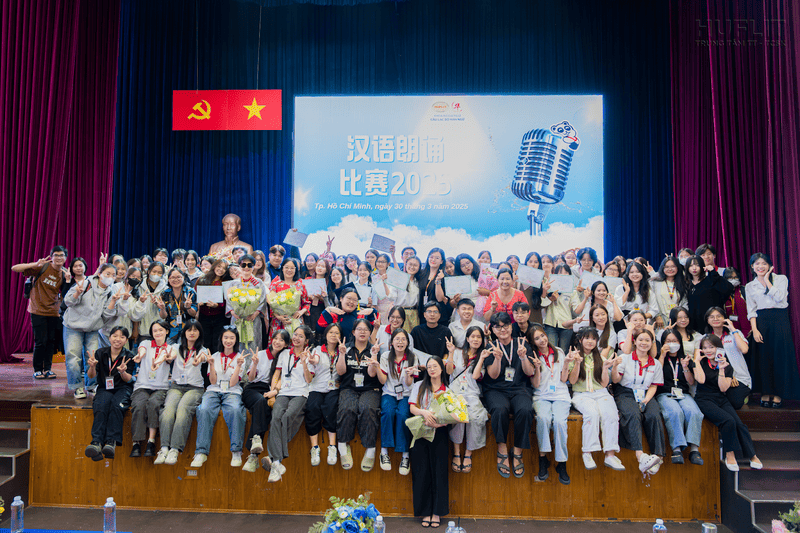
HUFLIT offers many practical programmes, notably “HUFLIT 2025 Expressive Reading – HUFLIT 2025 年汉语朗诵比赛”. This is an activity in the academic programme series of the HUFLIT Chinese Language Club, aiming to arouse a passion for Chinese and improve reading and speaking skills for students of the Chinese Language discipline.
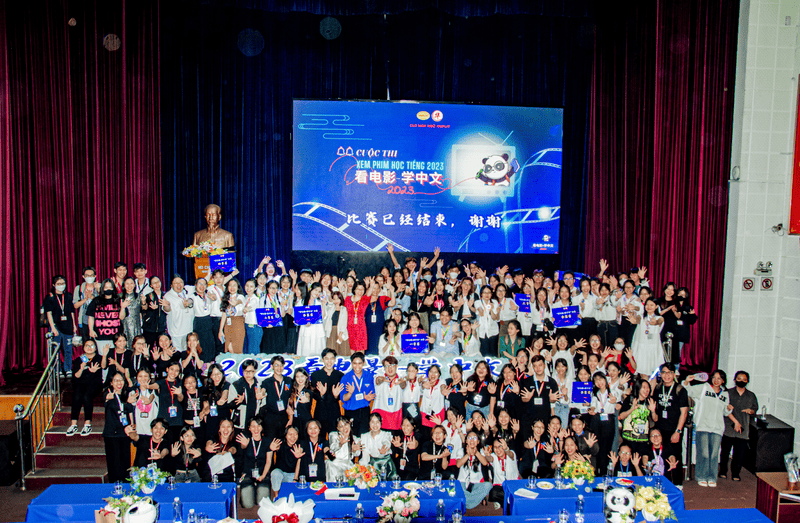
The Chinese club helps students improve communication skills and practise the language
What benefits do students have when learning Chinese at HUFLIT?
The Chinese Language discipline at HUFLIT has been taught since 1997, with more than 26 years of experience, providing many specialisations suitable to students’ career needs, from office work, business Chinese to Chinese – English bilingual. The programme is designed to international standards, updating the latest knowledge and teaching methods.
The benefits of learning Chinese at HUFLIT include:
- A methodical and flexible training programme: The study content is divided into small topics, easy to follow and apply, suitable for each specialisation such as office work, business Chinese and Chinese – English bilingual.
- Experienced and native lecturers: The team of lecturers from Master to Doctor, graduated from prestigious schools in Vietnam and China, ensuring international-standard knowledge and practical experience.
- An interactive study environment: Modern classrooms, library, practice rooms, combined with soft skills such as communication, presentation, negotiation, helping students develop comprehensively.
- Internship and job opportunities: Students are connected with Chinese enterprises, practise professional knowledge and train teamwork and time-management skills, increasing practical application ability.
- Developing foreign languages and diverse skills: Besides Chinese, Chinese – English bilingual students also have the opportunity to improve English and career-support skills such as journalism, communication, tourism, foreign-language teaching.

HUFLIT helps students firmly grasp Chinese and develop career skills
Some frequently asked questions about whether learning Chinese is easy
Below are some frequently asked questions with detailed explanations for new learners.
How long does learning Chinese take to communicate basically?
To be able to communicate basically, students usually need about 3 – 6 months if studying regularly 1 – 2 hours each day. During this time, you need to grasp about 300 – 500 basic vocabulary words along with common sentence patterns in daily communication.
Is learning Han characters or pronunciation harder?
In the early stage, pronunciation is harder because Chinese is a tonal language, and correctly pronouncing the tones initially usually causes confusion. In the long term, Han characters are harder because of the large number of characters and being easy to forget without a reasonable study method.
Is learning Chinese grammar like English?
Chinese grammar is generally easier than English, not too complex in terms of tenses or verb conjugation. Learners just need to get familiar with using complements, arranging sentence order and applying common structures in communication. Practising through writing sentences, reading comprehension and conversation will help remember long-term and use proficiently in real situations.
How to remember Han characters faster?
To learn Han characters effectively, you should apply many combined methods: learning by radical and splitting characters by structure for easy memory, associating characters with images or stories, while reviewing repeatedly by cycle. In addition, using Han characters in sentences and real communication will help remember long-term and develop language-reflex ability.
The article above answers the question of whether learning Chinese is easy and the factors affecting the study process. At HUFLIT, students are methodically trained, practise regularly and study with experienced lecturers. The interactive study environment makes absorbing knowledge easier, helping students confidently use Chinese in study and future work.
>>>> SEE MORE RELATED ANALYSES:
What do students need to do to graduate with a job: Detailed roadmap
Conditions for studying a cross-field Master’s 2026: What to prepare
CONTACT INFO
Apply for admission at
tuyensinh.huflit.edu.vn
Find out information
huflit.edu.vn
Advising education enrollment