



-
Proud to be HUFLITers #07 | M.A. Tran My Uyen – A lectern where a teacher wishes only to “watch her children grow up”At the HUFLIT Faculty of Foreign Languages, M.A. Tran My Uyen (Vice Dean) goes by many names. Some call her “Ms My”; her students call her “mother”. Colleagues often compare her to Mother Au Co with a hundred children. Yet to become the “mother” of the lecture hall she is today, she went through a profound shift in thinking that completely changed a teaching philosophy built over more than 30 years.
-
New Cybersecurity Regulations: Opportunities for the Cybersecurity Field in the Digital EraThe new cybersecurity regulations taking effect on 1 July 2026 not only help complete the legal framework but also drive demand for talent in cybersecurity. This is also the moment when the discipline becomes a promising choice for young people who love technology and information security.
-
“GenZ Major Insights 2026” – Episode 9: Boundless Journeys with HUFLIT’s Tourism and Hospitality ProgramsMany students choose the Tourism and Hospitality field simply because they love to travel. But passion alone is not enough to pursue this field in the long run. What matters more is understanding the nature of the discipline, its professional requirements, and the qualities needed to grow in a professional service environment.
Is Learning a Foreign Language Difficult? 3 Factors to Conquer Every Language
NGÀY: 16/03/2026
Chia Sẻ Qua
Decoding: Is learning a foreign language difficult?
Whether learning a foreign language is difficult or easy depends greatly on each language and the learner’s foundation. According to the US Foreign Service Institute (FSI), languages are divided into different difficulty levels, from the group needing about 600–750 study hours such as English, French to the group above 2,200 hours such as Chinese, Japanese, Korean. This shows that the difficulty level of a foreign language mainly comes from the differences in grammar, sound and writing system compared to the mother tongue.
The psychological barriers that make learning difficult
The fear of learning a foreign language does not come from the nature of the language but from the learner’s own psychology. The fear of being wrong, the fear of being judged when pronouncing incorrectly, or the fear of not being understood by native speakers are the most common psychological barriers.
Many Vietnamese people, although they have studied English for more than 10 years in general school, still dare not open their mouth to communicate for fear of making mistakes. This is exactly why creating a safe study environment that encourages experimentation and accepts mistakes is so important.
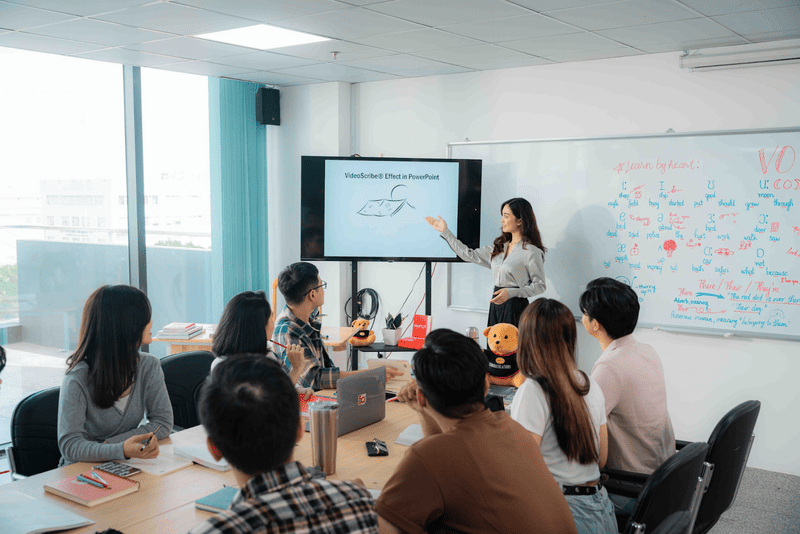
The fear of learning a foreign language comes from the learner’s own psychology
The impact of the environment and the study method
The foreign-language study method plays a deciding role in the final result. According to a survey by the Cambridge Language Education Association published in 2023, up to 80% of successful learners achieve proficient communication skills thanks to a continuous practice environment, while only 20% depends on innate talent or a good memory.
Many people learn a foreign language by the traditional method focusing on reading, writing and memorising vocabulary, ignoring the real-communication factor. As a result, after many years, they still cannot confidently use the language in real situations such as a job interview, presentation or business negotiation.
>>>> READ NOW: Good at foreign languages, what discipline should you study? 4+ profession groups that “make money”
The misconception about a “talent” for learning foreign languages
Many people believe that a talent for foreign languages is innate, only for a few special people. However, according to the research of Dr. Stephen Krashen – the famous American linguist, author of the “Language Acquisition” hypothesis, learning a foreign language is a skill that can be accumulated and developed through regular practice, completely independent of genes or IQ.
Krashen affirms that the human brain has the ability to absorb a new language at any age, as long as there is enough “comprehensible input” – language input that can be understood. This means anyone can be good at a foreign language if they apply the right method and practise persistently.
3 core factors deciding whether learning a foreign language is easy or difficult
To clearly understand the factors of being good at a foreign language, we need to analyse the three main pillars directly affecting the study process and result.
The similarity between the mother tongue and the new language
The language similarity between Vietnamese and the language you are learning creates a considerable advantage. Vietnamese people usually learn Chinese more easily than Westerners because both languages are tonal and have many similar Sino-Vietnamese words. For example, the word “học sinh” in Vietnamese reads almost like “學生” (xuéshēng) in Chinese.
Conversely, Vietnamese people learning English encounter difficulty in the grammar system of tenses, number and article usage – factors that do not exist in Vietnamese. However, the advantage is that Vietnamese has absorbed a lot of modern English vocabulary, helping learners remember and associate more easily.

The language similarity between the mother tongue and the language being learned helps learning be faster and easier to absorb
A clear study goal and a personalised roadmap
A clear foreign-language study roadmap helps learners focus their energy in the right direction. According to the “Talent Guide 2025” report by Navigos Group – the company owning Vietnam’s No. 1 job-search site VietnamWorks, up to 52% of employers prioritise candidates with practical foreign-language skills (able to communicate, negotiate, work with international partners) over those who only have high TOEIC, IELTS certificates but cannot apply them in work.
The frequency of exposure and the intensity of daily practice
Practising a foreign language every day is the golden key to success. According to research from FSI, just 600-750 hours of active practice (about 1-2 hours each day over 1-2 years), you can reach a B2 level – enough to work professionally. The important thing is the quality of practice: listening, speaking, reading, writing must be combined in balance, in which listening and speaking are prioritised to develop language reflexes.
Why does learning a foreign language at HUFLIT help “turn the difficult into easy”?
Ho Chi Minh City University of Foreign Languages – Information Technology (HUFLIT) has built a foreign-language study ecosystem with many outstanding advantages, helping students shorten the time to conquer a foreign language from many years to just a few semesters.
A practical environment, learning goes hand in hand with doing
The most outstanding point at HUFLIT is the rich practical environment. HUFLIT students not only study theory in the lecture hall but also participate in foreign-language clubs such as the Chinese Club, 7SEC Club (English Club), Japanese Club, etc., student-exchange programmes and direct communication with native lecturers from many countries.
Besides, the school also regularly organises activities helping students practise, communicate and apply foreign languages outside the classroom such as English In Action – a series of English-practice activities with talkshows, debates, speeches, presenting ideas in English, “Bookaholic” a connection activity for the love of reading and English, helping students both learn and exchange about culture – language. In addition, HUFLIT also organises TOEIC workshops, thematic talkshows helping students improve critical-thinking skills.
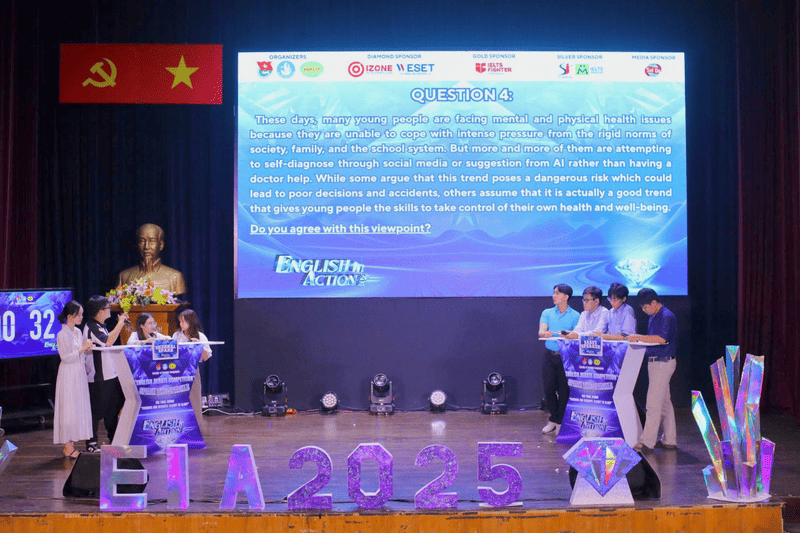
English In Action - a series of English-practice activities with talkshows, debates, speeches, affirming the mettle of HUFLIT students
A modern teaching method, breaking dry theory
The HUFLIT training programme focuses strongly on developing listening – speaking skills instead of only teaching textbook grammar. The lessons are designed according to the “Task-Based Learning” model, in which students must complete real tasks in the foreign language such as presenting projects, simulating business negotiation, writing professional emails, interviewing customers.
Instead of memorising 1,000 vocabulary words and then forgetting them after the exam, HUFLIT students learn vocabulary in the specific context of the profession. In addition, the school also focuses on enhancing lecturers’ modern-method teaching capacity to improve the effectiveness of foreign-language training in line with the digital-era trend and practical application in the classroom.
Language combined with technology – The leading trend at HUFLIT
HUFLIT focuses on integrating digital technology and smart learning platforms into teaching, especially in foreign-language training. Students use AI tools such as ChatGPT to practise conversation, correct grammar errors and expand vocabulary. In addition, the school also invests in modern labs with pronunciation-practice software, a digitalised learning-material system and an e-learning platform helping students access study materials 24/7.
In particular, HUFLIT also cooperates with INTESOL Vietnam and international partners to organise the International TESOL Conference 2025 discussing the role of AI (including chatbots and study assistants) in the modern English classroom. Thanks to this, students can apply technology effectively and be more confident when communicating in English.
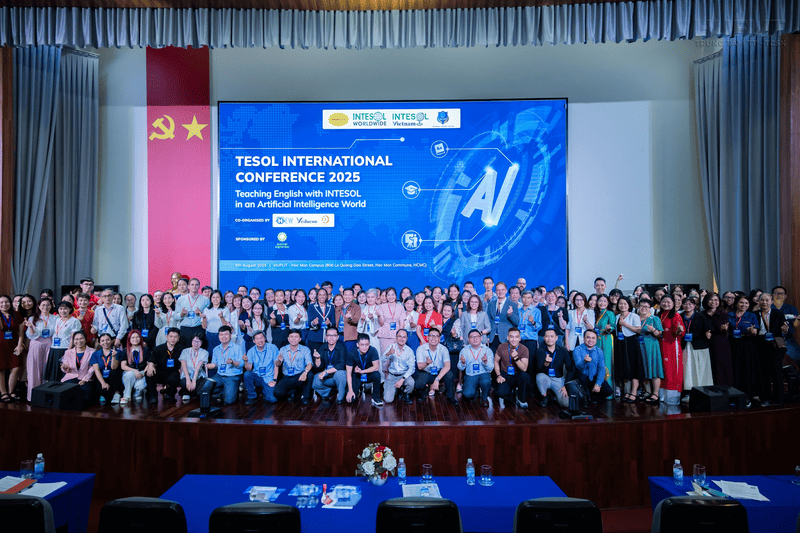
HUFLIT also cooperates with INTESOL Vietnam to organise the International TESOL Conference 2025 discussing the role of AI in the modern English classroom
>>>> READ MORE: International cooperation specialist: The “hot” discipline and opportunities at HUFLIT
Secrets to conquering a foreign language for beginners
No matter where you choose to study, the following fast foreign-language learning tips will help you progress remarkably in a short time.
Build a habit of “immersing” yourself in the language every day
The habit of learning a foreign language is more important than studying for many hours at once and then giving up. Make the foreign language part of your daily life such as watching films, YouTube videos in the language you are learning with bilingual subtitles; listening to podcasts, foreign music while on the road; setting your phone and social-media interface to the target language.
Use AI tools to support smart learning
AI technology has revolutionised the way we learn foreign languages. Using AI to learn a foreign language gives you a “teacher” available 24/7 at no cost. You can use ChatGPT to:
- Correct grammar and suggest more natural writing
- Practise conversation on specific topics (shopping, job interview, booking a hotel room)
- Explain the difference between synonyms
- Create vocabulary flashcards by topic
Apps such as Anki help you remember vocabulary long-term with the spaced-repetition algorithm; HelloTalk connects you with native speakers for language exchange; Shadowing apps help you practise pronunciation by imitating right after the native speaker’s voice.
Look for a study community to progress together
Foreign-language group study brings motivation and effectiveness many times greater than studying alone. When you have friends studying together, you will have people to practise conversation with, correct each other’s mistakes and remind each other to maintain the study habit. At universities such as HUFLIT, students participate in study groups, vibrant foreign-language clubs, creating a healthy competitive environment and mutual support.
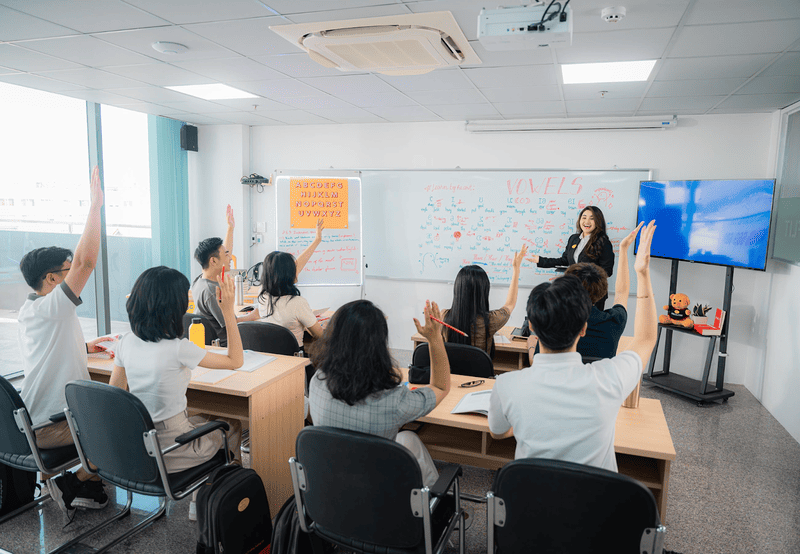
Studying in groups, studying with friends when learning a foreign language will bring higher motivation and effectiveness
>>>> QUICK ADD: The secret to becoming an excellent international business specialist
FAQ: Frequently asked questions about learning a foreign language
- What age is best to learn a foreign language?
Although children have a more natural ability to absorb language, adults can completely be good at a foreign language thanks to logical thinking ability, clear motivation and a systematic study method. There is no concept of being too late to learn a foreign language; you just need the right method and perseverance.
- Which language is easiest for Vietnamese people to study?
Chinese, Korean, Japanese have many similarities with Vietnamese in culture and some language factors. However, easy or difficult depends on personal goals and interests. English is still the language with the most study materials and application opportunities.
- Does learning a foreign language help increase salary?
According to the “Talent Guide 2025” report by Navigos Group, candidates fluent in a foreign language have an average salary 30-50% higher than those who only use Vietnamese. In particular, positions requiring Japanese, Korean, Chinese have a more attractive salary due to the scarce human resources.
- How long does it take to be good at a foreign language?
With regular study of 1-2 hours each day, you can reach a basic communication level (A2-B1) after 6-12 months, and a proficient working level (B2-C1) after 1-2 years. The speed depends on the language similarity, the study method and the practice environment.
Whether learning a foreign language is difficult is no longer a worry when you clearly understand the nature of the study process and have a clear roadmap. With the right method, a practical environment and perseverance, anyone can conquer a foreign language successfully. Contact HUFLIT today for detailed advice on high-quality foreign-language training programmes!
>>>> EXPLORE THE RECOMMENDED ARTICLES:
Should you study International Relations and English Language? See details from A-Z
Can studying economic law let you become a lawyer? Explore now
CONTACT INFO
Apply for admission at
tuyensinh.huflit.edu.vn
Find out information
huflit.edu.vn
Advising education enrollment