


-
Proud to be HUFLITers #07 | M.A. Tran My Uyen – A lectern where a teacher wishes only to “watch her children grow up”At the HUFLIT Faculty of Foreign Languages, M.A. Tran My Uyen (Vice Dean) goes by many names. Some call her “Ms My”; her students call her “mother”. Colleagues often compare her to Mother Au Co with a hundred children. Yet to become the “mother” of the lecture hall she is today, she went through a profound shift in thinking that completely changed a teaching philosophy built over more than 30 years.
-
New Cybersecurity Regulations: Opportunities for the Cybersecurity Field in the Digital EraThe new cybersecurity regulations taking effect on 1 July 2026 not only help complete the legal framework but also drive demand for talent in cybersecurity. This is also the moment when the discipline becomes a promising choice for young people who love technology and information security.
-
“GenZ Major Insights 2026” – Episode 9: Boundless Journeys with HUFLIT’s Tourism and Hospitality ProgramsMany students choose the Tourism and Hospitality field simply because they love to travel. But passion alone is not enough to pursue this field in the long run. What matters more is understanding the nature of the discipline, its professional requirements, and the qualities needed to grow in a professional service environment.
How to Write a Professional and Impressive Job CV for Students
NGÀY: 05/03/2026
Chia Sẻ Qua
What parts does a student’s job CV structure include?
According to a survey by TopCV – Vietnam’s leading online recruitment and CV creation platform with more than 3 million users, a professional student CV needs 5-7 main sections. Arranging the sections in the CV in the correct logical order will help employers easily grasp the information and evaluate candidates more accurately.
Personal Information (Personal Information)
This is the first and most important part of the CV, helping employers know who you are and how to contact you. The personal information in the CV needs to be complete but does not need to be too detailed about private life.
The required information:
- Full name (in bold, larger font size than the content)
- Phone number (ensure the phone is always on and reachable)
- Professional email (name.surname@gmail.com, avoid emails like cutegirl2003@…)
- Current address (only need to write the district and city)
- LinkedIn profile or portfolio website (if any)
Optional information:
- Date of birth (unless the company requires it)
- Marital status
- ID/Citizen ID number
Note: The profile photo should be a straight-angle portrait, with formal attire, a plain background, and a natural, confident expression. Avoid using selfies, travel photos or over-edited photos.

Personal information is the important opening part of the CV, helping employers determine who you are and how to contact you
>>>> LEARN MORE: Part-time job experience for HUFLIT students 2026
Career Objective (Career Objective)
How to write the career objective is usually the part that gives students the biggest headache. The career objective is a short 2-3 sentence paragraph that helps employers understand what you are looking for and what you can contribute to the company.
The SMART objective-writing formula:
- S – Specific (Specific): Clearly state the position you are applying for
- M – Measurable (Measurable): Can mention specific short-term goals
- A – Achievable (Achievable): Suitable to your current level
- R – Relevant (Relevant): Tied to the job and the company
- T – Time-bound (Time-bound): Mention a time frame (6 months, 1 year…)
Example of a good objective: “A fresh graduate in Marketing at HUFLIT with a GPA of 3.5/4.0, looking for a Marketing Executive position to apply knowledge of Digital Marketing and data analysis skills. Wishing to contribute to the company’s brand development and develop into a Marketing Manager in the next 3 years.”
Example of a poor objective: “Looking for a stable job with a high income to develop myself.”
Education (Education)
For students, education in the CV is the most important part because this is your main “strength”. Arrange it in reverse chronological order (the most recent education first).
The information needed:
- University name
- Field of study/Specialisation
- Study period (from month/year to month/year)
- GPA/Average score (if 3.0/4.0 or higher or 7.0/10 or higher)
- Graduation ranking (if Good or Excellent)
- Scholarships (if any)
Information that can be added:
- Specialised subjects related to the applied position
- Thesis/graduation project topic
- Certificates and academic awards
Example:Ho Chi Minh City University of Foreign Languages – Information Technology (HUFLIT) Bachelor of Information Technology | 09/2020 – 06/2024
- GPA: 3.6/4.0 (Good ranking)
- Graduation project: “Applying AI in customer sentiment analysis” – Score 9.0
- Outstanding subjects: Machine Learning (3.8), Web Development (3.7), Database Management (3.6)

Education helps employers evaluate your knowledge foundation, especially important for students
Work Experience & Extracurricular Activities
The work experience section of a student CV is usually where you feel most “empty”. However, you can completely fill in here your internship, part-time work, volunteer work, or real-world project experiences. What is important is how you present and highlight the skills and results achieved from those activities.
How to present:
- Company/organisation name
- Position/Role
- Time (month/year)
- Job description and achievements (3-5 bullet points, using action verbs)
Note: If you don’t have official experience, combine this section with “Extracurricular Activities” to form the “Experience & Activities” section.
>>>> READ NOW: Should students take part-time jobs or not? A handbook from A-Z
Skills (Skills)
The skills in the CV need to be clearly classified so that employers can easily evaluate them. According to LinkedIn Learning research in 2024, 92% of employers rate soft skills as equally important as professional skills. The skill classification includes:
Hard Skills (Hard Skills):
- Computer skills: MS Office (Word, Excel, PowerPoint), Photoshop, Canva…
- Professional skills: Programming (Python, Java…), Accounting (MISA, SAP…), Marketing (Google Analytics, Facebook Ads…)
Soft Skills (Soft Skills):
- Teamwork
- Communication and presentation
- Time management
- Problem-solving
- Critical thinking
Foreign languages:
- English: IELTS 7.0 (or describe: Good communication, good reading comprehension)
- Japanese: N3
- Chinese: HSK 4
How to assess: You can use a scale (Basic – Average – Fairly good – Good) or a status bar (••••○ = 4/5).

The skills in the CV need to be clearly classified so that employers can easily evaluate them
A detailed guide on how to write a CV for students without experience
According to a survey by Anphabe – Vietnam’s leading human-resource consulting company in the “Vietnam Best Places to Work 2024” report, 78% of employers are willing to recruit fresh graduates if the CV demonstrates potential and a learning attitude. So how can a CV for someone without experience still be impressive?
Highlighting the “Education” section with GPA and specialised subjects
When you don’t have work experience, how to write education in the CV becomes a key factor. This is when you need to “exploit” the education section to the maximum.
How to highlight:
- GPA and ranking:
-
- If GPA is 3.0/4.0 or higher (or 7.0/10 or higher): Write it clearly
- If GPA is below this level: You can skip it or only write the GPA of specialised subjects
- Related subjects: List 4-6 subjects directly related to the applied position and with high scores.
For example, English Language students at HUFLIT can emphasise subjects on Translation-Interpreting (8.5), Academic Writing (9.0), or Anglo-American Culture (8.8) when applying for editor, foreign-affairs assistant, or content writer positions. These are highly practical subjects that equip the in-depth language skills that employers are looking for.
- Thesis/Graduation topic: If your topic is related to the applied job, describe it briefly:
- Topic name
- Research objective
- Methods used
- Results achieved
Example: “Thesis: ‘Applying AI chatbots in customer care for small and medium enterprises’
- Building a chatbot using Python and Natural Language Processing
- Integrated into a test website, reducing response time by 40%
- Achieved a score of 9.2/10, recommended by the lecturer to present at the faculty seminar”
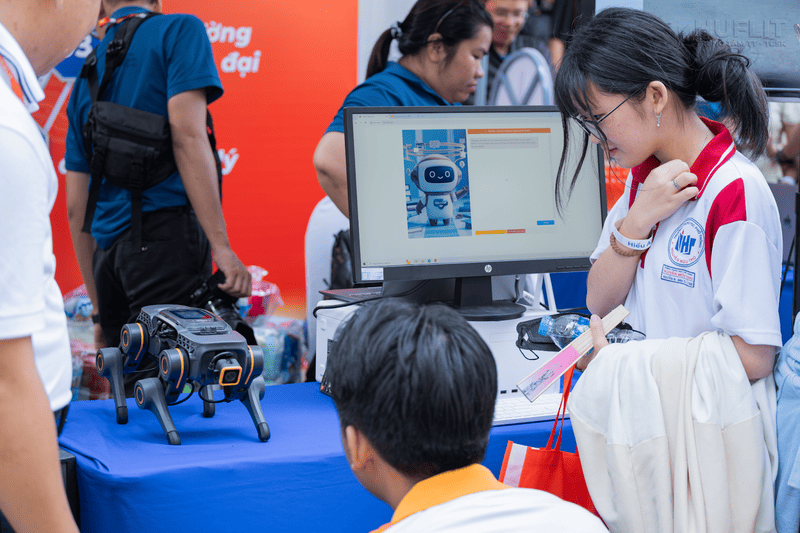
When you don’t have experience, highlighting the Education section with GPA and specialised subjects becomes a key factor in the CV
Turning “Experience” from zero into a bright spot
Not having official work experience does not mean your CV is empty. You can completely put into your CV part-time jobs, internship experience, or highly applied study projects to demonstrate your skills and real-world capacity.
The types of “experience” you can have:
- Internship at a company (paid or unpaid)
- Part-time work (tutor, part-time staff, freelancer…)
- Volunteer at organisations and events
- Highly applied study projects
- Competitions, hackathons, workshops
The STAR formula to describe experience:
- S – Situation: The context, circumstances
- T – Task: The task you took on
- A – Action: The specific action you did
- R – Result: The result achieved (should have figures)
Internship example:Marketing Intern | ABC Company | 06/2023 – 09/2023
- Supported the team in planning content for 3 social media channels (Facebook, Instagram, TikTok)
- Wrote and posted 45 posts, averaging 2,000 interactions/post, up 25% compared to the previous quarter
- Analysed insights and made weekly campaign effectiveness reports
- Participated in organising a new product launch event with 200 guests
Part-time example:English Tutor | Freelance | 01/2022 – 06/2024
- Tutored English for 8 secondary and high school students
- Built personalised lesson plans according to each student’s ability
- 6/8 students improved their scores by 15-30% after 3 months of study
- Trained communication, patience and time-management skills
Taking advantage of “Extracurricular Activities” and “Personal Projects”
Extracurricular activities and personal projects in the CV are the two “golden” sections for students to prove soft skills and proactive learning ability.
Extracurricular activities:
Head of Communications, HUFLIT IT Club | 09/2022 – 06/2023
- Led a team of 5 people in charge of the club’s fanpage and website
- Increased followers by 300% (from 500 to 1,500) in 6 months
- Organised 2 workshops on AI and Blockchain, attracting more than 150 students to attend
- Developed leadership, project management and teamwork skills
The dynamic clubs at HUFLIT such as the Information Technology Club, Japanese Club, English Club and Startup Club are a great opportunity for students to accumulate experience in event organisation, teamwork, project management and soft-skill development – all of which can be put into the CV to impress employers.
Personal projects:
Online sales website | Personal project | 03/2024
- Built an e-commerce website using ReactJS, Node.js, MongoDB
- Integrated online payment and order management
- Applied knowledge from the E-Commerce subject at HUFLIT
- Demo link: [github.com/yourname/project]
Vocabulary-learning mobile app | Group project | 11/2023
- Developed an Android app that helps learn English vocabulary with flashcards and gamification
- Role: Developer – building the database and smart revision features
- The app has 500+ test users, achieving 4.2/5 stars
- Second prize at the “HUFLIT Innovation Challenge 2023” competition
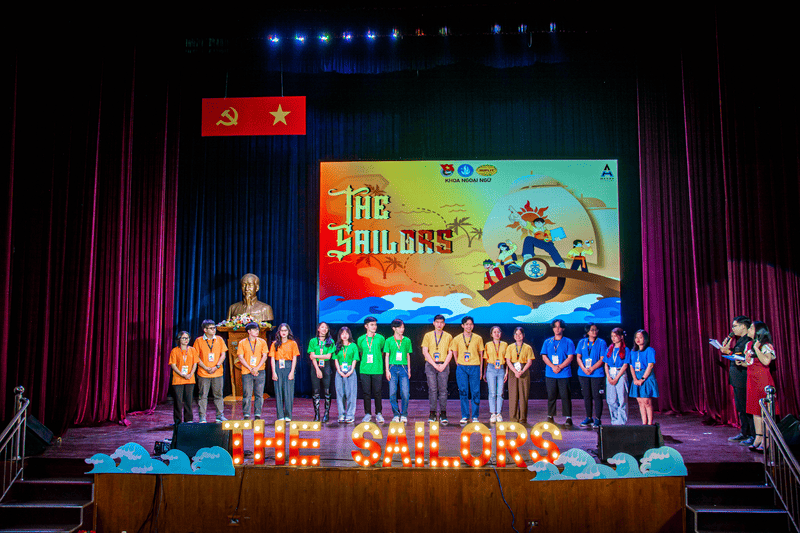
Personal projects in the CV demonstrate self-study ability and a proactive spirit, especially useful when you don’t have work experience
>>>> UPDATE NOW: What do students need to do to have a job upon graduation: A detailed roadmap
How to present “Skills” to convince employers
The soft skills for students and office informatics skills sections in the CV need to be presented specifically, provable by specific evidence instead of just listing.
Hard Skills (Hard Skills):
Office informatics:
- Microsoft Office: Word (Advanced), Excel (Pivot Table, VLOOKUP), PowerPoint (Template design)
- Google Workspace: Docs, Sheets, Slides, Forms
- Basic design: Canva (Proficient), Photoshop (Basic)
Professional skills (depending on the field):IT field:
- Programming languages: Python (Proficient), Java (Average), JavaScript (Fairly good)
- Framework: ReactJS, NodeJS, Django
- Database: MySQL, MongoDB
- Tools: Git, Docker, VS Code
Marketing field:
- Digital Marketing: Google Analytics, Facebook Ads Manager, basic SEO
- Content Creation: Content writing, video editing (CapCut, Premiere)
- Management tools: Trello, Notion, Google Calendar
Soft skills: Instead of just listing, tie them to evidence:
- Teamwork: Participated in 10+ group projects at HUFLIT, took on the leader role in 3 projects
- Presentation: Presented 5 times in front of a class of 50+ students, achieving an average score of 8.5/10
- Time management: Balanced studying (GPA 3.5), part-time work (20h/week) and club activities
Foreign languages:
- English: IELTS 7.5 (Listening 8.0, Reading 8.5, Speaking 7.0, Writing 6.5) – December 2023
- Japanese: JLPT N3 – July 2023
The “fatal” errors students need to avoid when writing a CV
According to a CareerBuilder survey, 58% of CVs are rejected right at the screening round due to CV-writing errors that could be avoided. Below are the things to avoid in the CV that you need to note when writing a CV.
Errors about presentation form and design
Some errors when presenting the CV you should note to avoid losing points in the eyes of employers:
Hard-to-read fonts or too many fonts:
- Should use: Arial, Calibri, Times New Roman, Helvetica (size 11-12pt for content, 14-16pt for headings)
- Avoid: Comic Sans, decorative fonts, or using more than 2 font types in the same CV
Garish colours:
- A professional CV format usually uses a maximum of 2-3 colours
- The main colour should be black or dark grey
- The accent colour can be navy blue, blue, blue-grey (avoid overly bright pink, yellow, orange)
An unbalanced layout:
- Page margins: 1.5-2cm on each side
- Clear spacing between sections
- Even margins, not misaligned
- Don’t leave too much text or too sparse
An unprofessional photo:
- Avoid selfies, photos cropped from group photos, over-filtered photos
- Should use an ID photo or a straight-angle portrait
- Formal attire, a plain background, even lighting
Too long or too short:
- A student CV should be kept to 1 page (maximum 1.5 pages)
- Avoid a CV under 0.5 pages because it looks “empty”
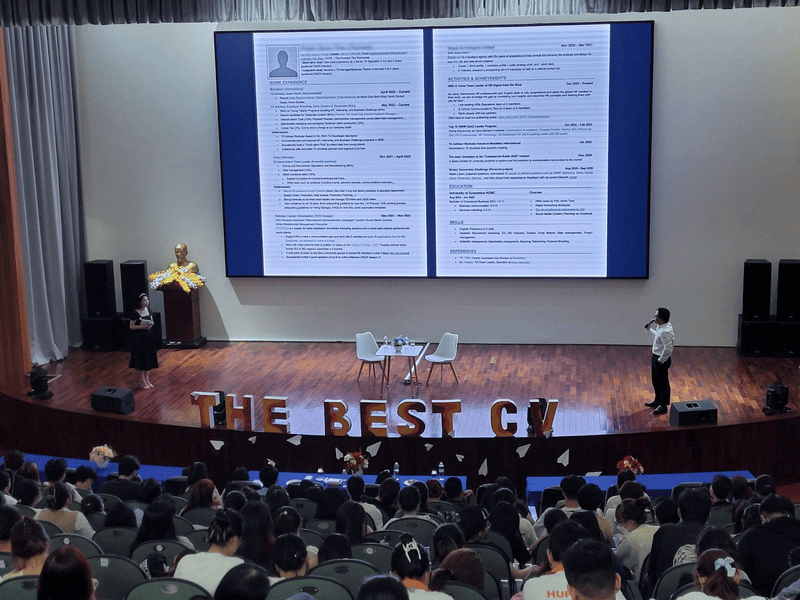
CV presentation and design errors such as using too many fonts or hard-to-read fonts can cause the profile to lose points in the eyes of employers
Errors about content and information
Spelling and grammar errors: This is the most basic CV error to check but many students make it.
How to avoid:
- Use spell-checking tools (Grammarly, LanguageTool)
- Re-read the CV at least 3 times
- Ask friends or relatives to read it for you
Dishonest information:
- Do not exaggerate GPA, certificates, roles
- Do not make up experience that isn’t real
- Employers may request the transcript and original certificates to verify
Vague career objective:
- Avoid: “Looking for a suitable job to develop myself”
- Should: “Applying for the Marketing Executive position to apply Digital Marketing knowledge and content-creation skills, contributing to the company’s brand growth”
Listing too much irrelevant information:
- No need to write hobbies as “reading books, listening to music, travelling” if not related to the job
- Only focus on what employers care about
Using negative language:
- Avoid: “Although I have no experience…”, “Although I just graduated…”
- Should: “A fresh graduate with a solid foundation in…”
Errors when sending the application CV
Unprofessional file naming:
- Avoid: CV.pdf, Job application.docx, 123456.pdf
- Should: CV_NguyenVanA_MarketingExecutive.pdf
Unsuitable file format:
- Should send a PDF file to keep the formatting intact
- Only send a Word file (.docx) if the employer specifically requires it
An unprofessional job-application email: How to send the CV by email is no less important than the CV content.
- The email subject should:
-
- Be clear: [Application] Marketing Executive Position – Nguyễn Văn A
- Not: Job CV, Application, Hello
- The email content should:
-
- Address politely
- Introduce yourself briefly
- State the applied position
- Attach the CV and related documents
- Thank them and wait for a reply
Example of a good email:
“Dear Recruitment Department,
My name is Nguyễn Văn A, a fresh graduate in Marketing at HUFLIT University. I am very interested in the Marketing Executive position at the company and believe I can contribute positively with my knowledge of Digital Marketing and 3 months of internship experience at XYZ company.
I am attaching my CV and Portfolio for your company’s consideration. I very much look forward to the opportunity to discuss further in an interview.
Sincerely thank you!
Best regards, Nguyễn Văn A Phone: 0901234567 Email: vana.nguyen@gmail.com”
Sending mass CVs without editing:
- Each applied position should have a customised CV version
- Adjust the career objective, skills, and focuses to suit the JD
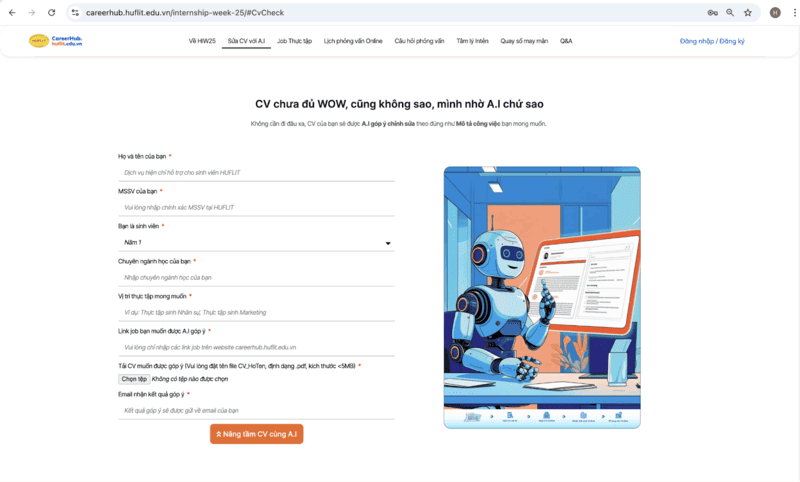
Many candidates make errors when sending the CV such as unprofessional file naming, making it hard for employers to track the profile
Suggested impressive & professional job CV templates for students
Choosing a student job CV template suitable to the profession and personal style also affects the first impression. Below are the 3 most popular CV template styles for students without experience.
The minimalist style CV template (Minimalist)
Characteristics:
- Simple, clean design
- Neutral colours (black, white, grey)
- Focus on content, few graphics
- Standard, easy-to-read font
Suitable for fields:
- Accounting – Auditing
- Human Resources
- Office administration
- Banking – Finance
- Law
Advantages: Professional, easy to read, suitable for the ATS (Applicant Tracking System) system
Download beautiful CV templates: You can find free templates on Canva, TopCV, or Microsoft Word Templates.

The minimalist style CV template uses a clean design with a clear layout and minimises decorative elements
The creative style CV template (Creative)
Characteristics:
- Eye-catching design with prominent colours
- Has infographics, charts, icons
- Non-traditional layout (2 columns, asymmetric)
- Demonstrates creativity and personality
Suitable for fields:
- Marketing – Communication
- Graphic design
- Advertising
- Art
- Content Creator
Advantages: Makes a strong impression, demonstrates creative ability
Note: Not suitable for traditional companies/fields, may not pass the ATS
CV template for IT / Engineering students
Characteristics:
- Focus on the Technical Skills section (Skills)
- Has a prominent Projects section (Projects)
- Modern, technological design
- Has GitHub, Portfolio, LinkedIn links
Special structure:
- Personal information (with GitHub, LinkedIn)
- Skills summary (Summary)
- Technical Skills (Technical Skills) – this section is prioritised first
- Projects (Projects) – describe 3-4 outstanding projects in detail
- Experience (Experience)
- Education (Education)
Suitable for fields:
- Information Technology
- Software Engineering
- Data Science
- Electronic Engineering
- Mechanics
Example of the Projects section in an IT CV template for students:
E-commerce website | ReactJS, Node.js, MongoDB
- Built an online sales website with full features: cart, payment, order management
- Integrated the VNPay payment API and an automatic email-sending system
- Applied JWT authentication and bcrypt for security
- GitHub: github.com/yourname/ecommerce-project
Frequently asked questions (FAQ)
Should a student’s CV be longer than 1 page?
According to TheLadders research, employers spend an average of only 6-7 seconds to skim a CV for the first time. For students without much experience, a CV of 1 A4 page is optimal.
Reasons:
- Concise, easy-to-grasp information
- Demonstrates the ability to synthesise and prioritise information
- Suitable for employers’ fast-reading habit
- Avoids the situation of being “wordy” but with little value
Exception: If you have a lot of experience, projects and certificates that are really valuable, it can extend to 1.5 pages, but absolutely not more than 2 pages for students.
Is a photo mandatory in the CV?
In Vietnam, a photo in the CV is not mandatory but is encouraged. According to a JobsGo survey, 82% of Vietnamese employers want to see a photo in the CV to have a first impression of the candidate.
When you should have a photo:
- Customer-facing positions (Sales, Customer Service, Reception…)
- Service, tourism, hospitality fields
- Companies with a traditional culture
When you may not need a photo:
- Applying to international companies (US, UK, Canada…) where attaching a photo may be considered a discriminatory criterion
- Technical, IT positions where skills are absolutely prioritised
Professional CV photo standards:
- A portrait photo, taken straight-on
- Formal attire (shirt, suit)
- A plain-coloured background (white, light blue, grey)
- The face occupies 60-70% of the frame
- A natural, confident expression, preferably with a slight smile
- A sharp photo with even lighting
What do you write in the CV if you have no experience?
Some content you can write:
- Focus strongly on Education: high GPA, scholarships, awards, related specialised subjects, projects, graduation theses, certificates, completed online courses.
- Internship experience: Paid or unpaid internships, internships at the school in real-world projects
- Part-time work: Tutor, part-time staff (F&B, sales, admin…), Freelancer (design, content writing, translation…)
- Extracurricular activities: Member/Executive board of a club, participating in organising events and seminars, volunteering for social programmes
- Personal projects: Programming projects, websites, apps, personal blogs, YouTube channels, competitions and hackathons participated in
- Skills:
-
- Hard skills: Informatics, professional, certificates
- Soft skills: With specific evidence from the above activities
The golden formula: Instead of just listing “What I did”, answer “What results I achieved” with specific figures.
How to write a job CV for students is not difficult if you firmly grasp the structure, know how to highlight your strengths and avoid basic errors. As a HUFLIT student, you can take advantage of the practical training environment, real-world projects and the Career Center system to create a truly impressive CV.
>>>> SEE MORE RELATED ARTICLES:
7 ways to overcome exam pressure effectively for candidates 2026
CONTACT INFO
Apply for admission at
tuyensinh.huflit.edu.vn
Find out information
huflit.edu.vn
Advising education enrollment