


-
Proud to be HUFLITers #07 | M.A. Tran My Uyen – A lectern where a teacher wishes only to “watch her children grow up”At the HUFLIT Faculty of Foreign Languages, M.A. Tran My Uyen (Vice Dean) goes by many names. Some call her “Ms My”; her students call her “mother”. Colleagues often compare her to Mother Au Co with a hundred children. Yet to become the “mother” of the lecture hall she is today, she went through a profound shift in thinking that completely changed a teaching philosophy built over more than 30 years.
-
New Cybersecurity Regulations: Opportunities for the Cybersecurity Field in the Digital EraThe new cybersecurity regulations taking effect on 1 July 2026 not only help complete the legal framework but also drive demand for talent in cybersecurity. This is also the moment when the discipline becomes a promising choice for young people who love technology and information security.
-
“GenZ Major Insights 2026” – Episode 9: Boundless Journeys with HUFLIT’s Tourism and Hospitality ProgramsMany students choose the Tourism and Hospitality field simply because they love to travel. But passion alone is not enough to pursue this field in the long run. What matters more is understanding the nature of the discipline, its professional requirements, and the qualities needed to grow in a professional service environment.
How Long Does It Take to Study Chinese to Become an Interpreter? Roadmap 2026
NGÀY: 05/03/2026
Chia Sẻ Qua
How long does it take to study Chinese to become an interpreter?
There is no exact figure that applies to everyone, but the time to study Chinese can be estimated based on the HSK levels and the level of personal investment. To be able to work as an interpreter, you need to reach HSK 6 and have real-world practical experience. Specifically:
| HSK level | Average study time |
| HSK 1 – HSK 4 | 1 – 1.5 years |
| HSK 5 – HSK 6 | 2 – 4 years |
| > HSK 6 | >4 years |
The foundation stage (HSK 1 – HSK 4): Building the language’s roots
In this stage, learners focus on getting familiar with the Chinese character system, basic communication and core vocabulary. The average time is about 1 – 1.5 years to complete the HSK 4 study roadmap, depending on each learner’s study level and absorption ability. After reaching HSK 4, learners can handle tasks such as basic work communication, translating documents or being a language assistant.
At HUFLIT, this stage is designed methodically and in-depth, with a clear roadmap from basic to advanced. The curriculum closely follows the capacity of each level, combined with lecturers who follow closely and support to the maximum. Thanks to this, students will grasp a solid foundation, ready to enter more advanced courses.
The output targets at HUFLIT ensure that upon graduation students have a solid foundation of knowledge and skills. In particular, for the Chinese Language field, students reach Chinese proficiency of HSK 5 or higher or equivalent to study the advanced parts and prepare for postgraduate study. At the same time, they are ready to apply the language to a professional working environment, translation, translator,…

The HSK 1-4 stage helps build a solid foundation for the language
>>>> CLICK NOW: [Answer] Which quality school should you choose for English Language?
The in-depth stage (HSK 5 – HSK 6): Ready for the interpreting profession
Learners in the in-depth stage have the ability to use Chinese proficiently, understand the culture and firmly grasp specialised vocabulary. The average time to reach HSK 5 – HSK 6 is usually 2 – 4 years, depending on the level and study goals. This is the minimum level for you to start working as a professional interpreter.
With a solid foundation from the training process, HUFLIT students are trained to master translation – interpreting skills through practice and real-world professional experience. Thanks to this, they are ready to conquer the highest requirements in the profession, from professional projects to work opportunities at home and abroad. This stage helps students confidently seize career opportunities and develop their careers.
How long does it take to study Chinese to become an interpreter?
After reaching HSK 6, learners can aim to become a booth interpreter or specialised interpreter. It usually takes more than 4 years from the start of studying Chinese to master the language like a native speaker and specialise in a specific field such as economics, healthcare or engineering.
Therefore, students at HUFLIT are trained according to the exact roadmap that experienced lecturers have gone through. The school focuses on internationally standard training methods, strengthening information-processing skills and accumulating specialised knowledge, ensuring a solid foundation for the professional interpreting profession.
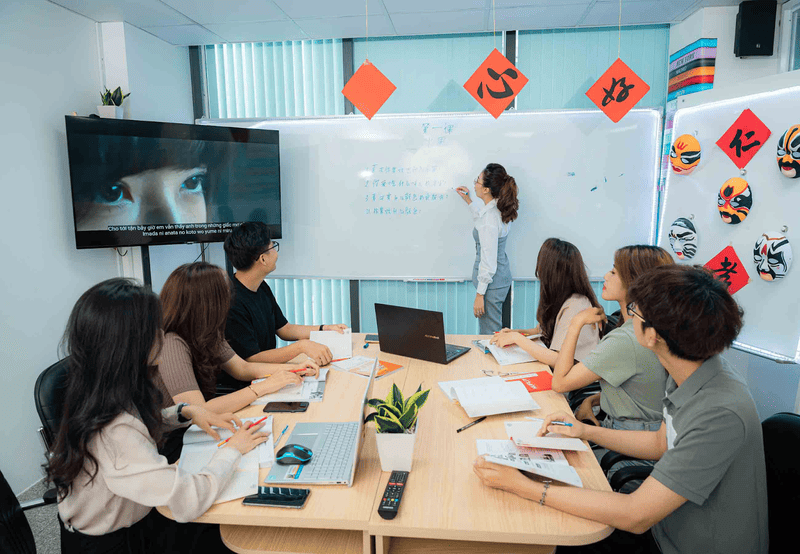
Reaching HSK 6 is a preparation step to become an interpreter
The 4-step roadmap to becoming a professional Chinese interpreter
To become a professional Chinese interpreter, you need a methodical Chinese study roadmap, clear from foundation to in-depth. Applying an effective Chinese study method combined with firmly grasping the Chinese study steps will help you advance step by step firmly in the profession.
Step 1: Determine your goal and choose a suitable study method
First, you need to clearly determine your study goal and choose a suitable study method, especially when considering where to study Chinese. Currently, there are 3 common paths to study Chinese including self-study, studying at a centre and studying at a formal university. Each option has its own advantages: self-study to save costs, studying at a centre with a clear roadmap, or studying at a formal university to have a foundation and a recognised degree.
One of the outstanding universities to study the Chinese Language field is HUFLIT. Here, students are both equipped with foundational knowledge and trained in in-depth practical skills through interpreting classes, situation simulations and real-world projects. At the same time, building a large alumni network, creating a solid foundation for an interpreting career.

Formal Chinese helps open the door to professional study and career
Step 2: Conquer the necessary HSK and HSKK certificates
To get closer to the interpreting profession, taking the HSK and HSKK certificate exams is an important step. HSK tests reading and writing skills, while HSKK (the communication competency exam) assesses speaking ability, helping you prove comprehensive capacity in Chinese. Learners should set a goal to at least reach HSK 5 and Advanced HSKK to be eligible for a Chinese interpreting qualification.
Studying at HUFLIT, students participate in HSK/HSKK exam-practice simulation activities designed by each level, closely following the real exam and taught by a team of teachers with many years of experience. The programme combines theory and practice, direct speaking practice, increasing the chance of achieving a high certificate and being ready to enter the professional interpreting profession. In addition, the school also regularly organises programmes such as the National Chinese Speech Contest to train students’ ability to refine their Chinese.

Student Thượng Thị Vân Anh of the HUFLIT Faculty of Foreign Languages won a consolation prize at the Chinese Speech Contest
>>>> SEE MORE: Should you study English or Chinese? Analysis 2026
Step 3: Train the 5 GOLDEN skills of an interpreter
To become a professional interpreter, firmly grasping interpreting skills is indispensable. Clearly understanding what an interpreter needs will help you orient your training process effectively.
- Listening and short-term memory skills (short-term memory): Help receive information quickly and accurately.
- Shorthand note-taking skills (note-taking): Support recording important information during live interpreting.
- Communication and conduct skills: Ensure information is conveyed flexibly, suitable to the context.
- Cultural – social understanding: Helps interpret accurately, avoiding deviations in context and nuance.
- Cultivating specialised knowledge: Enhances the ability to handle professional terminology in the fields of economics, healthcare, engineering,…
At HUFLIT, these skills are focused on training through practical subjects at the Faculty of Chinese Language, ensuring direct contact with real professional situations. Small-scale classes help lecturers closely follow each of the student’s skills, from listening, communication, situation handling to specialised terminology.
Besides, students also have the opportunity to learn about Chinese culture, history and society, helping to enhance comprehensive understanding and the ability to make use of it in real-world contexts. Thanks to the training model that combines theory – practical combat, HUFLIT can confidently enter the professional interpreting environment quickly.

Mastering skills helps students confidently work in a professional environment
Step 4: Accumulate practical experience and build a personal brand
After firmly grasping knowledge and skills, accumulating interpreting experience is the key step to becoming professional. Participating in interpreting internships, clubs or taking on small translation jobs will help you train your real-world response ability and expand your relationship network.
HUFLIT students receive maximum support to simultaneously study, practise and develop their personal brand, ensuring readiness for a professional interpreting career. Moreover, the school has a wide alumni network, organises talk shows, career orientation, learning from predecessors and expanding relationships in the industry. In addition, HUFLIT also establishes many international cooperation programmes for students to study Chinese in a real environment.
Why choose the Chinese Language field at HUFLIT?
The HUFLIT Chinese Language field provides an internationally standard programme, diverse practice and wide-open job opportunities, suitable if you are looking for a university with a Chinese Language field or where to study interpreting.
An internationally standard training programme, closely following practice
HUFLIT builds the Chinese Language training programme combining theory and practice, helping students both firmly grasp basic knowledge and develop in-depth translation-interpreting skills.
- Theory and practice: The subjects are designed close to the reality of interpreting work.
- Expert lecturers: An experienced lecturer team guides students step by step to become professional interpreters.
- In-depth skills: Focusing on translation-interpreting, commercial language and Chinese culture.
A diverse practice environment and wide-open job opportunities
HUFLIT creates maximum conditions for students to train practical skills and prepare for their careers through real-world activities, helping to expand job opportunities in the Chinese Language field.
- Practical activities: Participating in academic clubs, competitions, workshops and an interpreting-booth simulation lab, helping students experience the real interpreting environment.
- Enterprise cooperation: A large partner network brings internship and job opportunities right while still at school.
>>>> DO NOT SKIP: Should you study Chinese or Korean? [Handbook 2026]

HUFLIT builds an internationally standard training programme, closely following practice
FAQs – Frequently asked questions about the Chinese interpreting profession
Is the salary of a Chinese interpreter high?
The salary of a Chinese interpreter depends on level, experience and field of work, helping you picture the 2026 Chinese interpreting salary on the market.
- Fresh graduate: 8 – 12 million VND/month, depending on HSK level, communication ability and workplace.
- 1 – 3 years of experience: 15 – 18 million VND/month, the salary increasing gradually with real capacity.
- Over 5 years of experience: 18 – 25 million VND/month, depending on expertise, experience and the field of translation.
(Reference figures from VietnamWorks)
According to figures from VietnamWorks, the actual salary can fluctuate depending on the company and position. But in general, the Chinese interpreter profession brings attractive income opportunities for those who seriously invest in skills and experience.
Is studying Chinese really as hard as rumoured?
In reality, Chinese has hard aspects such as complex writing and diverse tones, but also has easy points such as grammar that is relatively simple compared to Vietnamese. With the right study method, persistence and the methodical training environment at HUFLIT, this difficulty can be completely conquered, helping you advance quickly on the path to becoming a professional interpreter.
Should women pursue the Chinese interpreting profession?
The interpreting profession has no gender distinction at all, and girls studying the Chinese language usually have an advantage thanks to their carefulness and skill in communication. With passion and the right study method, women can still develop a professional interpreting career.
Thus, above, HUFLIT has answered how long it takes to study Chinese to become an interpreter, while also guiding the roadmap and training steps. With a methodical training programme, a diverse practice environment and an experienced lecturer team, students are fully equipped with knowledge and skills to become professional interpreters. If you still have questions or want to learn in detail, contact HUFLIT for direct advice.
>>>> DON’T SKIP THESE USEFUL ARTICLES:
Should you study Chinese or Japanese? A-Z Analysis
Is Chinese easy to learn? The secret to learning quickly and effectively
CONTACT INFO
Apply for admission at
tuyensinh.huflit.edu.vn
Find out information
huflit.edu.vn
Advising education enrollment