



-
Proud to be HUFLITers #07 | M.A. Tran My Uyen – A lectern where a teacher wishes only to “watch her children grow up”At the HUFLIT Faculty of Foreign Languages, M.A. Tran My Uyen (Vice Dean) goes by many names. Some call her “Ms My”; her students call her “mother”. Colleagues often compare her to Mother Au Co with a hundred children. Yet to become the “mother” of the lecture hall she is today, she went through a profound shift in thinking that completely changed a teaching philosophy built over more than 30 years.
-
New Cybersecurity Regulations: Opportunities for the Cybersecurity Field in the Digital EraThe new cybersecurity regulations taking effect on 1 July 2026 not only help complete the legal framework but also drive demand for talent in cybersecurity. This is also the moment when the discipline becomes a promising choice for young people who love technology and information security.
-
“GenZ Major Insights 2026” – Episode 9: Boundless Journeys with HUFLIT’s Tourism and Hospitality ProgramsMany students choose the Tourism and Hospitality field simply because they love to travel. But passion alone is not enough to pursue this field in the long run. What matters more is understanding the nature of the discipline, its professional requirements, and the qualities needed to grow in a professional service environment.
How Long Does 1 University Semester Last? What Do Students Need to Know?
NGÀY: 16/03/2026
Chia Sẻ Qua
How many semesters does a university year usually have?
According to the general regulations of the Ministry of Education and Training of Vietnam, a university academic year is usually divided into 2 main semesters and 1 summer semester. This structure is widely applied at most universities across the country, from public schools to private ones.
Below is a system designed to optimise study time and ensure students have enough time to rest and recover energy between semesters. Below is a detailed analysis table of the 3 types of semesters in the year:
| Semester | Study time | Nature |
| Semester 1 | From September to December (about 15-16 weeks) | Compulsory, counted into the fixed tuition of the academic year |
| Semester 2 | From January/February to May/June (about 15-16 weeks) | Compulsory, counted into the fixed tuition of the academic year |
| Summer semester | From June to August (about 6-8 weeks) | Voluntary, tuition calculated separately by the registered credits |

A university year usually consists of 2 main semesters and 1 summer semester according to current regulations
>>>> POCKET THIS NOW: What do you need to prepare for an internship? 10 things to grasp
How long does 1 university semester last?
The question of how long 1 university semester lasts has different answers depending on the training type and the regulations of each school. However, according to the common standard of Vietnam’s higher education system, the duration of a semester is determined quite clearly.
The specific duration of each semester depends on the training type and the purpose of that semester. Below is a detailed summary table you can refer to:
| Training type | Number of semesters in the year | Duration of each semester |
| Regular university | 2 main terms + 1 summer term | Main term: 15-16 weeks (about 4 months)<br>Summer term: 6-8 weeks (about 2 months) |
| Regular college | 2 main terms + 1 summer term | Main term: 15-16 weeks (about 4 months)<br>Summer term: 6-8 weeks (about 2 months) |
| Part-time university | 2-3 main terms | Main term: 4-5 months (flexible according to the work schedule) |
| Distance/online university | 2 main terms + 1 summer term | Main term: 4 months<br>Summer term: 2-2.5 months |
The 15-16 weeks for each main semester is calculated based on the volume of knowledge to be conveyed, the time students need to absorb and revise, as well as the mid-term and end-of-term exams.
Specifically, in the 15-16 study weeks, it is usually allocated as follows:
- 12-13 weeks of theory study and practice
- 1-2 weeks of revision and mid-term exams
- 2 weeks of revision and end-of-term exams
An important thing to note is that each school may have small adjustments to the semester time to suit its own training programme. At large universities such as HUFLIT, the study schedule is clearly announced from the beginning of the academic year so students can proactively arrange.

The duration of a university semester usually lasts about 15–16 weeks, depending on the regulations and training programme of each school
>>>> SEE MORE: How to divide study time effectively to study less but remember longer
How many credits does 1 semester have?
Besides understanding how long 1 university semester lasts, students also need to clearly grasp the number of credits to register each semester. A credit is a unit measuring the volume of study, in which 1 credit is equivalent to 15 theory periods or 30-45 practice periods. The number of credits per semester differs between the college and university systems:
For college students:
- Average: 15-18 credits/semester
- Minimum: 12 credits/semester (to be considered a regular student)
- Maximum: 22-24 credits/semester (depending on each school’s regulation)
- Total credits for the whole course: 90-120 credits (for a 3-year programme)
For university students:
- Average: 16-20 credits/semester
- Minimum: 14 credits/semester (to be considered a regular student)
- Maximum: 24-26 credits/semester (students with a high GPA can register for more)
- Total credits for the whole course: 120-150 credits (for a 4-year programme)

Each semester students usually register for about 15–20 credits, depending on the level and each school’s regulation
Tips to help students study well and not waste a semester
After clearly understanding how long 1 university semester lasts and the structure of the academic year, the next important thing is knowing how to make the most of this time. Below are 4 tips to help you study well and achieve the highest effectiveness.
Balance the subjects
Balancing between difficult and easy subjects in the same semester is the key factor deciding success. Instead of registering for all difficult subjects or all easy subjects in one term, combine them diversely.
For example, if you register for 2 difficult specialised subjects (Data Structures, Calculus, etc.), add 1-2 soft-skill or general-education subjects to reduce pressure. Students will maintain a stable study motivation, avoid burning out midway and achieve a higher GPA compared to focusing on too many subjects at the same time.
Effectively exploit the study resources
University provides many study resources such as the library, the electronic document repository, practice labs and the academic-advisory system. Besides books, students can also look up academic data and train skills at specialised study spaces. At HUFLIT, the external-relations office also supports connecting internships and scholarships, helping students have more opportunities to study and develop comprehensively.
Effectively exploiting the resources helps students study more deeply and widely compared to relying only on the textbook. At the same time, this also helps save the cost of extra study outside. Students also have the opportunity to build good relationships with lecturers and friends. From there, study effectiveness and career orientation are clearly enhanced.

Students who exploit study resources well will enhance study effectiveness and career-development opportunities
>>>> DON’T MISS: Does retaking a subject at university have any effect? Answers from A–Z
Participate in events organised by the school
Each semester, the university organises many events such as specialised seminars, talkshows, career fairs and soft-skill workshops. These are not only entertainment activities but also a useful study and connection environment. Participating regularly helps students broaden their perspective and access the reality of the profession. At the same time, skills such as communication and teamwork are also effectively trained.
Students who actively participate in events usually have an outstanding CV thanks to rich extracurricular activities. In addition, they build a wide relationship network inside and outside the school. This well supports the search for internships and jobs after graduation. Thereby, students develop comprehensively both knowledge and soft skills.
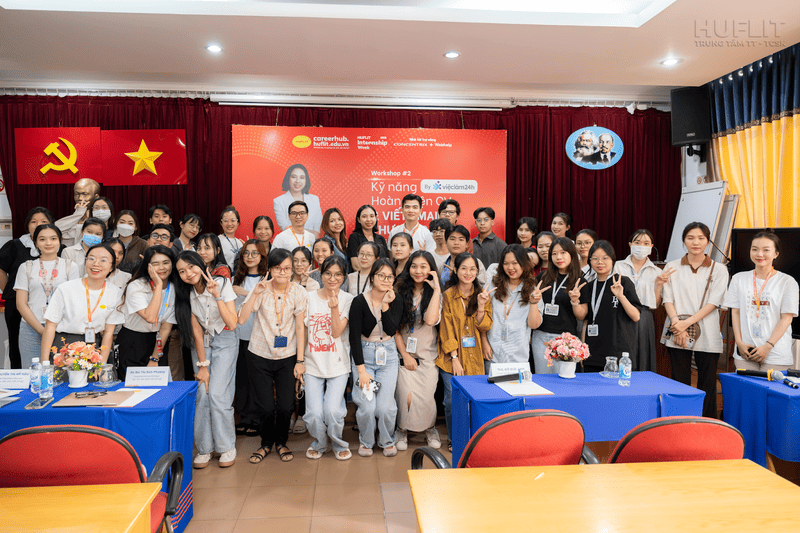
Participating in events helps students expand relationships, improve skills and increase career advantages
Study in a systematic way
Instead of cramming at the end of the term, students should build a clear study path right from the beginning of the semester. Reading the subject syllabus carefully helps grasp the content, deadlines and grading. Maintain a habit of studying every day for 30–60 minutes for each subject. At the same time, take notes scientifically and revise regularly to improve absorption effectiveness.
Systematic study helps knowledge be remembered sustainably and more deeply. Students also reduce pressure in the exam season thanks to preparing early. The study results are therefore clearly improved. In addition, participating in study groups also helps solve difficult problems faster.
Answering the questions related to how long 1 university semester lasts?
How many months does 1 academic year have in total?
According to the standard academic-year structure of Vietnamese universities, 1 official academic year lasts about 9 months, starting from September and ending in May the following year. Specifically:
- Semester 1: From early September to the end of December (4 months)
- Short Tet and summer break: January
- Semester 2: From early February to the end of May (4 months)
- Summer break: June-August (you can register for the summer semester if you want)
Note that the specific start and end times can fluctuate by 1-2 weeks depending on each school’s schedule, but overall it still keeps 9 official study months.
How many terms does 4 years of university have in total?
For a standard 4-year university programme, students will go through a total of 8 main semesters (not counting the summer semester). Specifically:
- Year 1: Semester 1 + Semester 2 = 2 terms
- Year 2: Semester 1 + Semester 2 = 2 terms
- Year 3: Semester 1 + Semester 2 = 2 terms
- Year 4: Semester 1 + Semester 2 = 2 terms
If counting the summer semester as well, students can have up to 4 more summer terms (1 term per year). However, the summer semester is not compulsory and is only for those who want to make up, study ahead, or improve their grades. Some excellent students can graduate earlier by making use of the summer semester and registering for many credits each term, shortening the time to 3-3.5 years.

A 4-year university programme usually consists of 8 main semesters, not counting the summer semester
What types of costs are there when studying at university?
When studying at university, students need to prepare a budget for 5 main types of costs:
- Tuition: This is the largest expense, ranging from 10-30 million VND/year depending on the school and the discipline. Public schools are usually cheaper than private ones, and disciplines such as Medicine, Pharmacy, Information Technology usually have higher tuition than social-science disciplines.
- Cost of books and materials: On average 2-5 million VND/year for textbooks, reference materials, and study supplies. Students can save by buying used books or using electronic materials.
- Living cost: For students living off-campus, this cost includes rent (1.5-3 million/month), meals (1.5-2.5 million/month), travel (500k-1 million/month), totalling about 3.5-6.5 million/month.
- Cost of extracurricular activities: Participating in clubs, events, study tours usually costs an additional 3-5 million/year.
- Other costs: Including health check-ups, student health insurance, making the student card, graduation photos, etc., about 1-2 million/year.
The total cost for 1 university year (not counting tuition) ranges from 50-90 million VND depending on lifestyle and region.
How long 1 university semester lasts is a common concern of many students before entering the lecture hall. Clearly understanding the semester duration helps you proactively build a more effective study and living plan. If you are looking for a study environment with a scientific schedule, an international-standard training programme and a comprehensive support system, HUFLIT is a suitable choice to accompany you on the journey to conquer knowledge.
>>>> DON’T MISS THE USEFUL ARTICLES:
If you fail an elective subject, do you need to retake it? Advice to know
What is education quality accreditation? Standards and process
CONTACT INFO
Apply for admission at
tuyensinh.huflit.edu.vn
Find out information
huflit.edu.vn
Advising education enrollment