



-
Proud to be HUFLITers #07 | M.A. Tran My Uyen – A lectern where a teacher wishes only to “watch her children grow up”At the HUFLIT Faculty of Foreign Languages, M.A. Tran My Uyen (Vice Dean) goes by many names. Some call her “Ms My”; her students call her “mother”. Colleagues often compare her to Mother Au Co with a hundred children. Yet to become the “mother” of the lecture hall she is today, she went through a profound shift in thinking that completely changed a teaching philosophy built over more than 30 years.
-
New Cybersecurity Regulations: Opportunities for the Cybersecurity Field in the Digital EraThe new cybersecurity regulations taking effect on 1 July 2026 not only help complete the legal framework but also drive demand for talent in cybersecurity. This is also the moment when the discipline becomes a promising choice for young people who love technology and information security.
-
“GenZ Major Insights 2026” – Episode 9: Boundless Journeys with HUFLIT’s Tourism and Hospitality ProgramsMany students choose the Tourism and Hospitality field simply because they love to travel. But passion alone is not enough to pursue this field in the long run. What matters more is understanding the nature of the discipline, its professional requirements, and the qualities needed to grow in a professional service environment.
HUFLIT lecturers and graduate students research “AI application in scientific research” with Yuan Ze University – Taiwan
NGÀY: 10/08/2023
Chia Sẻ Qua
Facing the challenges of the rapid technological development in the new era, Ho Chi Minh City University of Foreign Languages and Information Technology has cooperated with Yuan Ze University (YZU – Taiwan) to organize a thematic report “Application of AI in scientific research” to further improve the quality of scientific research by taking advantage of the potential of artificial intelligence (AI).

Overview of the thematic report
Accompanying the lecturers and graduate students in the program are Dr. Richard Bui – currently Assistant Professor, Faculty of Management, and Head of International Cooperation Department at YZU’s Department of External Relations and Prof. Bryan Liang – Head of External Relations Department.
In his first steps of sharing about scientific research, Dr. Richard Bui mentioned 8 important steps to start the scientific research process for those who have no experience including: Starting with the simplest project; Discussing with the supervisor; Starting a larger project; Demonstrating your research works; Learning from failures; Approaching international standards; Starting an independent project; and finally, Thinking about bigger problems. Mr. Richard always believes that AI is not everything, but think that thanks to AI, I can answer questions that I could not answer with traditional methods before.
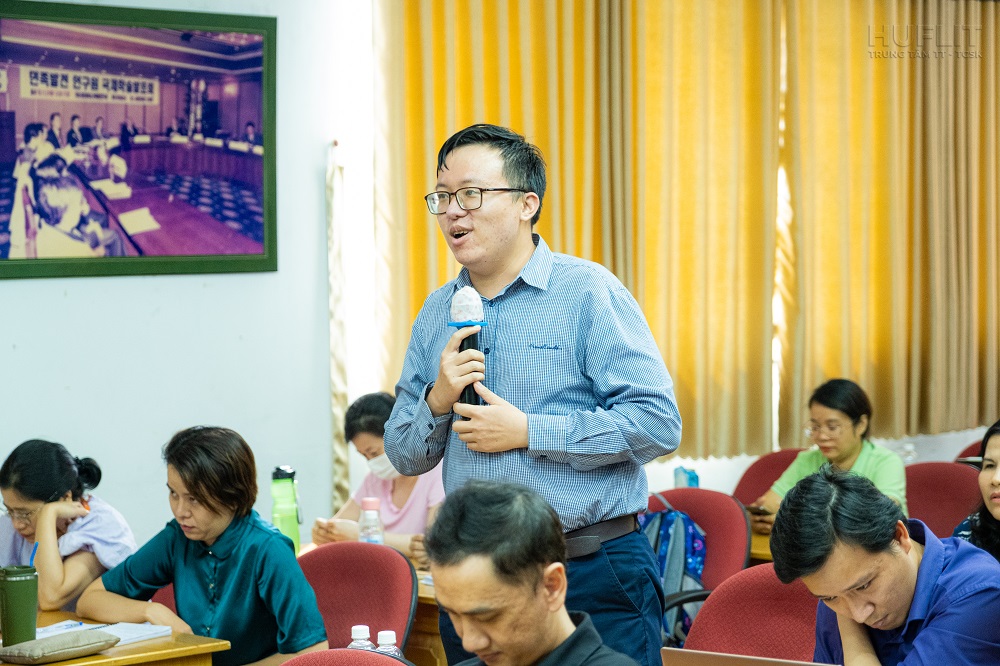
Discussing with Dr. Richard at the program, many lecturers also raised questions and concerns about the use of AI in scientific research such as “how much AI is allowed to be used in research?”. Regarding this issue, Dr. Richard said that there are no specific regulations on the level of AI use in research. Some research can rely entirely on AI, and this depends on the goals and requirements of each project.

Dr. Richard Bui and Prof. Bryan Liang shared at the program
The presentation provided the research community at HUFLIT with a valuable opportunity to approach and discuss the role of artificial intelligence in scientific research. Sharing at the program, Prof. Liang also said: “Taiwan always has policies for scholars interested in research, and YZU alone also has scholarship programs applicable to PhD students or postgraduate students studying here. This is a great opportunity for scholars who want to improve their qualifications and conduct scientific research in Taiwan .”
This is also an opportunity to open up new cooperation, promote research development and build closer relationships with prestigious partners such as Yuan Ze University.


CONTACT INFO
Apply for admission at
tuyensinh.huflit.edu.vn
Find out information
huflit.edu.vn
Advising education enrollment