


-
Proud to be HUFLITers #07 | M.A. Tran My Uyen – A lectern where a teacher wishes only to “watch her children grow up”At the HUFLIT Faculty of Foreign Languages, M.A. Tran My Uyen (Vice Dean) goes by many names. Some call her “Ms My”; her students call her “mother”. Colleagues often compare her to Mother Au Co with a hundred children. Yet to become the “mother” of the lecture hall she is today, she went through a profound shift in thinking that completely changed a teaching philosophy built over more than 30 years.
-
New Cybersecurity Regulations: Opportunities for the Cybersecurity Field in the Digital EraThe new cybersecurity regulations taking effect on 1 July 2026 not only help complete the legal framework but also drive demand for talent in cybersecurity. This is also the moment when the discipline becomes a promising choice for young people who love technology and information security.
-
“GenZ Major Insights 2026” – Episode 9: Boundless Journeys with HUFLIT’s Tourism and Hospitality ProgramsMany students choose the Tourism and Hospitality field simply because they love to travel. But passion alone is not enough to pursue this field in the long run. What matters more is understanding the nature of the discipline, its professional requirements, and the qualities needed to grow in a professional service environment.
What Are the Benefits of AI in Learning? Roles and Challenges
NGÀY: 16/03/2026
Chia Sẻ Qua
What is AI?
Artificial intelligence is a technology simulating the human ability to think, learn and solve problems through algorithms and computer systems. AI has the ability to process big data, recognise patterns, make predictions and self-improve performance over time. In education, AI is applied in many forms such as study-support chatbots, adaptive learning systems, automatic grading tools and study-data analysis software.
Tools such as ChatGPT, Gemini help students answer questions quickly, practise skills and revise effectively. For teachers, AI supports automating administrative work such as grading, tracking study progress, creating time to focus on higher-quality pedagogical activities.
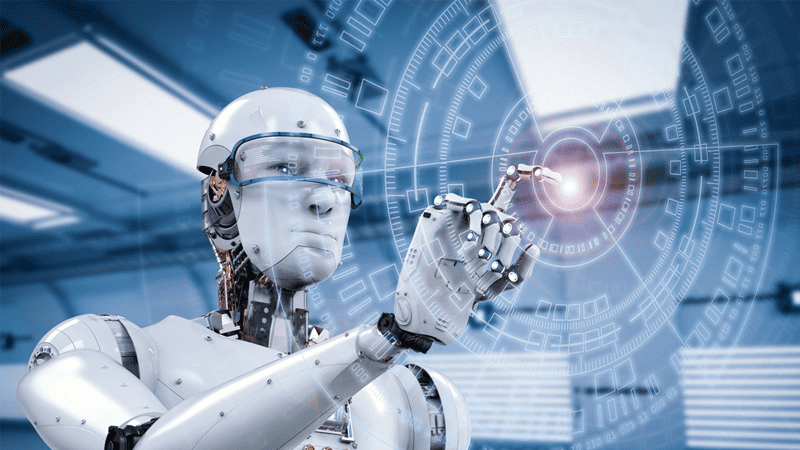
AI has the ability to process big data, recognise patterns, make predictions
>>>> REFER NOW: What discipline does an AI engineer study? TOP 5 most potential disciplines
The benefits of AI in learning
AI is becoming an indispensable part of modern education, making learning more personalised, effective and flexible. Not only supporting learners, AI also changes the way of teaching, managing and assessing in the entire education system. Specifically, the role of AI in learning includes:
- Personalising the learning process: AI analyses the capacity and study progress of each person to suggest a suitable path, content and study pace.
- Smart study support: Chatbots and AI study assistants help answer questions 24/7, revise knowledge and practise on demand.
- Enhancing teaching effectiveness: AI supports lecturers in building lessons, designing questions, tests and tracking students’ absorption level.
- Fast assessment and feedback: Automatically grading, analysing study results and giving timely, accurate feedback.
Personalising learning
Each student has a different study pace, study style and strengths. The traditional study system can hardly meet each person’s individual needs, but AI can do this. Smart learning platforms such as Coursera, Duolingo use AI algorithms to analyse the user’s study behaviour and adjust the content and difficulty of the lesson in real time.
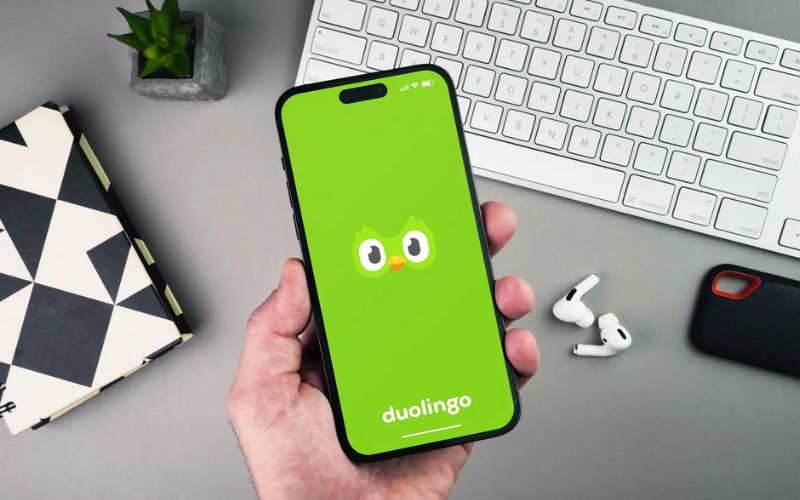
Duolingo uses AI algorithms to analyse the user’s study behaviour
Supporting teaching and helping reduce the load for teachers
A teacher’s work is not only teaching but also includes many administrative tasks such as grading, entering scores, preparing materials, replying to emails from students and parents. AI can help teachers focus on higher-value activities such as designing creative lessons, personal study consultation and developing soft skills for students.
Tools such as Gradescope, Turnitin use AI to grade essays, detect plagiarism and provide detailed feedback. Education chatbots can answer students’ frequently asked questions about the study schedule, submitting assignments, school regulations, freeing up time for teachers.
>>>> SEE MORE: Will AI replace humans? 5 skills to help you be “invincible”
Increasing management ability, optimising education resources
AI helps the school manage more effectively through analysing big data about students, teachers, resources and facilities. A Learning Management System (LMS) integrated with AI can predict the dropout rate, identify students at risk of weak studying to intervene early, optimise the allocation of teachers and classrooms.
Enhancing the quality of learning and teaching
AI not only supports administrative work but also directly enhances the quality of teaching content. Teachers can use AI to create interactive lessons, complex explanation videos, scientific-experiment simulations, learning gamification. Students have access to a huge study-resource source organised, suggested and personalised by AI. A tool such as Grammarly AI will help students improve their English writing skills, suggest vocabulary, correct grammar and style errors.
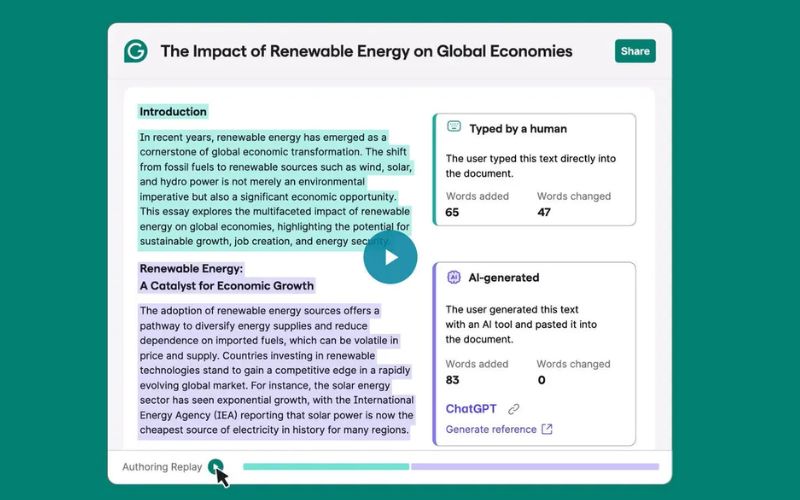
A tool such as Grammarly AI will help students improve their English writing skills
Increasing the learning experience through virtual-reality technology and simulation
AI combined with virtual-reality (VR) and augmented-reality (AR) technology creates a vivid, engaging learning experience. Medical students can practise surgery on 3D models, Architecture students can explore famous architectural works, History students can “travel back in time” to historical relics.
Platforms such as Labster provide virtual laboratories for students to practise chemistry and biology without expensive equipment or dangerous chemicals. Google Expeditions allows students to explore places around the world through VR glasses. These experiences not only increase the interest in learning but also help students remember knowledge longer.
Supporting people with disabilities in learning
AI opens up equal learning opportunities for people with disabilities. Speech-to-text technology helps the hearing-impaired follow lessons, screen-reading technology supports the visually-impaired in accessing study materials. Microsoft, Google have developed many free AI tools supporting people with disabilities such as Live Transcribe (direct transcription), Seeing AI (image description for the visually-impaired).

Google has developed many free AI tools supporting people with disabilities
>>>> POCKET THIS NOW: Will auditing be replaced by AI and the skills to survive
Challenges of AI in education to note
Besides the huge benefits, applying AI in education also faces many challenges that need to be recognised and resolved.
- Abusing AI tools: Many students depend too much on AI, using it to do assignments instead of thinking for themselves. Copying results verbatim from ChatGPT without verification leads to a lack of critical thinking and problem-solving skills.
- High cost and the digital gap: Investing in AI systems, teacher training and upgrading technology infrastructure requires large financial resources. This creates a gap between well-resourced schools and remote-area schools.
- Privacy and data security: AI needs to collect personal data and study behaviour of students to operate effectively. Storing, processing and protecting this data is a big challenge. If leaked or misused, students’ privacy will be violated.
- Reducing the role of teachers: There is a concern that AI will replace teachers in the future. However, AI is only a support tool, it cannot replace the human factor in education.
Practical applications of AI in education
AI has been and is being widely applied in many specific education activities. For instance:
- In teachers’ teaching: Teachers use AI to compose lesson plans, create multiple-choice questions, design interactive lessons. Tools such as Canva AI, Beautiful.ai help create beautiful lesson slides quickly. Knowji, Quizlet use AI to create smart vocabulary flashcards. Platforms such as Edmodo, Google Classroom integrate AI to manage the class, assign homework and track progress.
- In students’ learning: Students use ChatGPT, Claude, Gemini to explain difficult concepts, brainstorm ideas, practise writing skills. Grammarly, QuillBot support grammar checking and improving writing style. Notion AI, Mem.ai help take smart notes and organise knowledge. Anki, Remnote use the spaced-repetition algorithm to optimise memorisation.
- In school management and operation: Schools use ERP systems integrated with AI to manage enrolment, academic affairs, finance. AI analyses data on the pass rate, dropout rate, student satisfaction level to make management decisions. Chatbots automatically answer questions about administrative procedures, the study schedule, tuition, helping reduce the load for the Training and Administrative offices.

AI has been and is being widely applied in many fields
HUFLIT pioneers applying AI in learning and teaching
HUFLIT is one of the pioneering schools in applying AI to education activities. In 2024, HUFLIT organised many outstanding activities such as the Talkshow “HUFLITers – Unlocking the power of artificial intelligence AI in academics and business”, helping students better understand the potential and how to use AI effectively in learning and research.
HUFLIT’s Faculty of Accounting – Auditing organised the workshop series “Mastering the game in the battle with artificial intelligence”. Through it, students will be guided to use AI tools such as ChatGPT, Power BI, Excel AI to analyse financial data, make reports and optimise the accounting work process. Many lecturers at HUFLIT have integrated AI into lessons, using chatbots to support students 24/7 and deploying a smart learning system on the LMS platform.

HUFLIT has organised many outstanding activities about AI
Common questions about the benefits of AI in learning
The benefits of AI in learning is a topic that many students and parents care about in the context of increasingly digitalised education. Below are common questions helping you better understand the role of AI.
Is applying AI in learning suitable for every discipline?
AI is suitable for most disciplines, especially foreign languages, information technology, economics and management, if used correctly. For the Foreign Languages discipline, AI supports pronunciation practice, translation, vocabulary learning. The Economics discipline applies AI to analyse market data, forecast trends. However, disciplines such as Art, Sports still need the human factor and more practice.
How does AI help students manage study time?
AI supports making a personal study plan, reminding submission deadlines, tracking study progress and analysing effective time use. Applications such as Notion AI, Todoist AI, Motion help students automatically arrange work by priority to study each subject based on personal productivity. Students can save 2-3 hours each week just thanks to smart time management with AI.
What skills do students need to equip to use AI effectively?
Students need the skill of asking clear, specific questions (prompt engineering), selecting information and evaluating the accuracy of the content suggested by AI. They should not absolutely trust AI but need to verify information from many sources. In addition, students need to understand ethical principles when using AI, avoiding academic cheating and copyright violation.
The benefits of AI in learning are very clear because AI helps personalise learning, support teaching and enhance the effectiveness of education management. When used correctly, AI will become a powerful assistant for both learners and the school. If you want to study in an environment pioneering AI application, equipped with technology thinking, HUFLIT is the choice helping you be ready for the future.
>>>> EXPLORE ARTICLES ON THE SAME TOPIC:
AI in the legal field: Trends and applications 2026
Jobs that can be replaced by AI and how to avoid being eliminated
CONTACT INFO
Apply for admission at
tuyensinh.huflit.edu.vn
Find out information
huflit.edu.vn
Advising education enrollment