


-
Proud to be HUFLITers #07 | M.A. Tran My Uyen – A lectern where a teacher wishes only to “watch her children grow up”At the HUFLIT Faculty of Foreign Languages, M.A. Tran My Uyen (Vice Dean) goes by many names. Some call her “Ms My”; her students call her “mother”. Colleagues often compare her to Mother Au Co with a hundred children. Yet to become the “mother” of the lecture hall she is today, she went through a profound shift in thinking that completely changed a teaching philosophy built over more than 30 years.
-
New Cybersecurity Regulations: Opportunities for the Cybersecurity Field in the Digital EraThe new cybersecurity regulations taking effect on 1 July 2026 not only help complete the legal framework but also drive demand for talent in cybersecurity. This is also the moment when the discipline becomes a promising choice for young people who love technology and information security.
-
“GenZ Major Insights 2026” – Episode 9: Boundless Journeys with HUFLIT’s Tourism and Hospitality ProgramsMany students choose the Tourism and Hospitality field simply because they love to travel. But passion alone is not enough to pursue this field in the long run. What matters more is understanding the nature of the discipline, its professional requirements, and the qualities needed to grow in a professional service environment.
AI Programmer: A “Hot” Profession or Soon to Be Replaced?
NGÀY: 01/04/2026
Chia Sẻ Qua
What is an AI programmer?
An AI programmer (Artificial Intelligence Developer) is a person who designs, builds and deploys systems capable of “learning” and intelligently processing data such as image recognition, natural language processing, and so on. You will use programming languages such as Python, along with Machine Learning libraries and models, to develop solutions applying artificial intelligence to enterprise reality.

The AI programmer focuses on developing artificial-intelligence solutions
Can AI replace programmers?
The development of AI makes many people worry that programmers may be replaced. In reality, AI can support very strongly in the software-development process. However, AI cannot yet completely replace the role of the programmer for the following reasons:
Lacking creativity as well as independent thinking
AI operates based on data and pre-trained models. It can recreate or combine what already exists, but does not truly “understand” the problem the way humans do. Meanwhile, the programmer needs to create new solutions, design a system architecture suited to each enterprise and make strategic decisions for the product.
>>>> CLICK NOW: TheInformation Technology, which exam block to choose? [2026 handbook]
Limited knowledge of programming logic
AI can write code on request, but does not always ensure optimisation, security and long-term scalability. Building a large system requires a deep understanding of data structures, algorithms, software architecture, version management and testing. These are factors that need continuous supervision and adjustment from the programmer.
Encountering difficulties when interacting with context
In the enterprise environment, requirements usually change continuously and are tied to specific operations. AI can misunderstand if the requirement is unclear or lacks context. Conversely, the programmer can exchange directly with the customer, ask clarifying questions and adjust the solution to suit the business goal.

AI can misunderstand if the requirement is unclear or lacks context
Not yet self-aware of ethics and responsibility.
AI does not have the ability to bear legal or ethical responsibility for the product created. Issues such as data security, privacy, system safety or the social impact of software all need human consideration. The programmer and the technical team must be the ones who control and bear ultimate responsibility.
Who can learn to be an artificial-intelligence programmer
In reality, AI is not only for “technology geniuses” but is suitable for many different target groups if they have orientation and perseverance. Below are the groups of people with a suitable foundation and qualities to pursue this field:
- Information Technology (IT) students: Having a foundation in computer science, data structures and algorithms – this is a big advantage when learning about Machine Learning and Deep Learning.
- People who love Mathematics and logical thinking: AI is tied to probability, statistics, linear algebra and optimisation, so logical thinking and mathematical-analysis ability are an important foundation.
- Career switchers: Especially those with a STEM (Science, Technology, Engineering, Mathematics) foundation who want to expand opportunities into the artificial-intelligence field.
- Technology-passionate self-learners: Able to self-research through online materials, international courses and real projects to build a personal portfolio.
- Technology personnel: Software programmers who want to enhance their expertise, or Data Engineers who wish to work more deeply with machine-learning models and AI systems.

The software programmer suits anyone who loves technology
>>>> SEE NOW:Human-resource demand for the Information Technology field – Opportunities for the young generation
Career opportunities and salary in the AI programming field
The AI programming field opens up many attractive options in the context of strong digital transformation. This field is attracting large recruitment demand and competitive remuneration, especially for those with in-depth skills and practical experience.
Career opportunities
The AI programming field has high human-resource demand in many areas such as technology, finance, e-commerce, healthcare and manufacturing. Graduating students can take on positions such as AI Engineer, Machine Learning Engineer, Data Scientist, NLP Engineer or data-analysis specialist. Besides technology enterprises, large corporations and startups also apply AI to optimise operations and enhance customer experience.
The career-development roadmap
Beginners usually start at the Junior AI Developer or Data Analyst position to accumulate experience. After a few years, they can develop into in-depth roles such as Machine Learning Engineer, AI Solution Architect or technology-project manager. If continuing to enhance expertise and management skills, you can aim for the Technical Lead, AI Manager position.

Beginners usually start at the Junior AI Developer position
AI programmer salary in Vietnam
The salary in the AI programming field in Vietnam is assessed as being in the high group compared to the general level of the information technology industry. According to a compilation from Glassdoor, FPT Software and ITviec, the income of AI personnel varies by experience as follows:
| Position | Experience | Salary (VND/month) |
| Junior | 0 – 2 years | 20,000,000 – 40,000,000 |
| Mid-Level | 2 – 5 years | 40,000,000 – 75,000,000 |
| Senior | 5 – 8 years | 75,000,000 – 120,000,000 or more |
| Expert | Over 8 years, in-depth | Over 120,000,000 |
What do you need to study? Where to study to become a leading AI programmer of the 5.0 era?
To become an AI programmer in the 5.0 era, you need to build a solid foundation in mathematics, data structures and algorithms, and be proficient in a programming language such as Python. If you are looking for a methodical and practical training environment, HUFLIT is a choice worth considering. The University’s outstanding advantages are:
- A practice-tied training method: HUFLIT focuses on application-oriented training, combining foundational theory with project practice, case studies and business-situation simulation exercises.
- A dynamic learning environment: The University builds a modern learning environment, encouraging creativity, research and teamwork. Students have the opportunity to take part in academic clubs, technology workshops, creativity contests and applied-research projects.
- A team of lecturers and enterprise connection: The lecturers have deep expertise, combined with real-world experience, helping students clearly understand market requirements. The University regularly organises seminars, enterprise exchanges, job fairs and internship programmes, creating conditions for students to approach the real working environment early.
- Stable tuition – diverse scholarship policies: At HUFLIT, tuition is maintained stably at 1,230,000 VND/credit and committed not to increase throughout the study process, helping families proactively plan their finances. The University also has many attractive scholarship programmes such as:
- First-choice Scholarship: A 50% reduction in semester-1 tuition for candidates registering the University as their first choice.
- Experience Scholarship: A 20% reduction in whole-course tuition for 9 fields, including the Artificial Intelligence field.
- Talented New Student Scholarship: A 20% – 50% – 100% reduction in whole-course tuition depending on achievement.
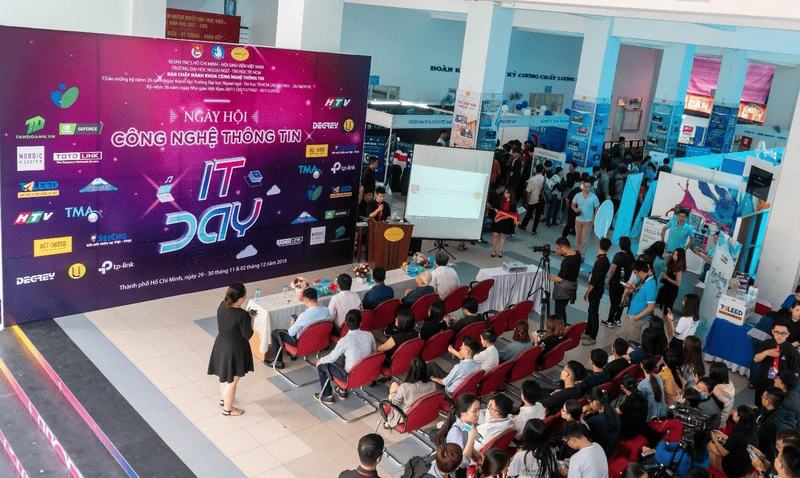
Students have the opportunity to take part in academic clubs and workshops
>>>> DON’T MISS:Software Engineering and Information Technology: Differences & Opportunities
Frequently asked questions about the AI programmer
The AI programmer always attracts the interest of students and those wanting to switch to the technology field. Let’s answer the questions related to this field.
Which AI tools for programmers are the most outstanding in 2026?
Tools such as GitHub Copilot, ChatGPT or Gemini Code Assist are widely used to support writing and optimising code. They help increase productivity but still need the programmer to control and edit.
What skills are needed when studying AI programming?
You need a foundation in mathematics, logical thinking and programming skills, especially Python. In addition, data-analysis ability and real-world problem-solving are also very important.
What are AI’s limitations?
AI can misunderstand context and lacks true creativity. At the same time, it has no awareness of ethics or legal responsibility, so it still needs human supervision.
The AI programmer not only needs a solid professional foundation but must also continuously update knowledge to adapt to the rapid development of technology. Choosing a methodical training environment will help you build a competitive advantage. If you wish to pursue this potential-rich field seriously and sustainably, learn about the training programme at HUFLIT.
>>>> SEE MORE ARTICLES OF INTEREST:
What is the Management Information Systems field? Job opportunities
What does a Management Information Systems graduate do? Review 2026
CONTACT INFO
Apply for admission at
tuyensinh.huflit.edu.vn
Find out information
huflit.edu.vn
Advising education enrollment