


-
Proud to be HUFLITers #07 | M.A. Tran My Uyen – A lectern where a teacher wishes only to “watch her children grow up”At the HUFLIT Faculty of Foreign Languages, M.A. Tran My Uyen (Vice Dean) goes by many names. Some call her “Ms My”; her students call her “mother”. Colleagues often compare her to Mother Au Co with a hundred children. Yet to become the “mother” of the lecture hall she is today, she went through a profound shift in thinking that completely changed a teaching philosophy built over more than 30 years.
-
New Cybersecurity Regulations: Opportunities for the Cybersecurity Field in the Digital EraThe new cybersecurity regulations taking effect on 1 July 2026 not only help complete the legal framework but also drive demand for talent in cybersecurity. This is also the moment when the discipline becomes a promising choice for young people who love technology and information security.
-
“GenZ Major Insights 2026” – Episode 9: Boundless Journeys with HUFLIT’s Tourism and Hospitality ProgramsMany students choose the Tourism and Hospitality field simply because they love to travel. But passion alone is not enough to pursue this field in the long run. What matters more is understanding the nature of the discipline, its professional requirements, and the qualities needed to grow in a professional service environment.
Jobs That Can Be Replaced by AI and How to Avoid Being Eliminated
NGÀY: 16/03/2026
Chia Sẻ Qua
The development of AI and its impact on the job market in 2026
The impact of AI on the labour market is no longer a distant-future matter but is happening right before our eyes. From ChatGPT, Midjourney to new-generation industrial robots, AI is penetrating every field of life and work.
How is AI changing the way enterprises operate?
AI is being strongly applied by enterprises to automate processes. For instance, customer care, accounting – finance, marketing or internal-operation management. Besides, AI also supports analysing big data, forecasting market trends and personalising the customer experience.
The inevitable consequence is the restructuring of human resources. Manual, repetitive positions gradually narrow. Meanwhile, the demand for roles related to analysis, system supervision, technology management and strategic decision-making increases.
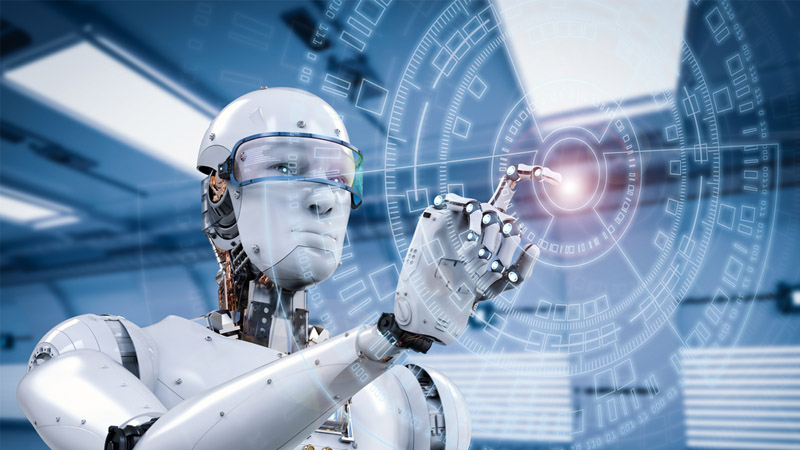
AI is being strongly applied by enterprises to automate processes
The important milestones of AI
AI has made outstanding progress in natural-language processing. This tool has the ability to communicate almost like humans; recognise images and voices with high accuracy and analyse logic – forecast trends based on big data. Current AI models not only answer questions but can also summarise documents, write reports, analyse risks and support decision-making.
Why are some jobs more easily taken over by AI?
Jobs with high repetitiveness, a clear process, high dependence on available data and requiring little empathy or ethical judgement are the group most easily replaced by AI. When a task can be standardised into rules or algorithms, AI usually performs it faster, cheaper and more stably than humans. This creates great pressure on traditional labour positions in the coming period.
The list of jobs that can be replaced by AI the earliest
The strong development of artificial intelligence is changing the structure of the labour market in many fields. Some repetitive jobs requiring little thinking and creativity are facing the risk of being replaced by AI earlier than other professions.
The Administration, Data-Entry and Junior-Accounting industry group
Repetitive jobs such as data entry, document processing, figure reconciliation are being strongly impacted by AI. With the ability to process quickly, accurately and continuously, AI can do a larger volume of work than humans in a short time, making the demand for personnel in junior positions gradually decrease.
The Customer Service and Telesales industry group
New-generation AI Voice and chatbots are increasingly smart, capable of instant responses, remembering interaction history and simulating empathy. This helps enterprises reduce personnel costs, while replacing a large part of traditional customer-care and telesales positions.
According to a 2024 survey by Deloitte Access Economics, up to 65% of enterprises in Vietnam have applied automatic-messaging tools integrated with AI in communication with customers. This rate is superior to many markets in the region such as Indonesia (58%), Malaysia (52%) and Thailand (50%). This shows that the AI-adoption speed of Vietnamese enterprises is happening very fast.

New-generation chatbots are increasingly smart, capable of instant responses
The Industrial Production and Warehousing (Logistics) industry group
In the production and logistics field, automatic robots and AI optimising the supply chain are gradually replacing manual labour. Stages such as sorting, packaging, transporting and warehouse management are automated, reducing the demand for unskilled labour.
The Translation and Basic Content-Composition industry group
AI can now translate multiple languages, write reports, summarise documents and create basic content in just a few seconds. Therefore, simple translation jobs or content writing that does not require creative depth and high expertise will face replacement pressure the earliest.
The solution from HUFLIT: Training students to master AI
HUFLIT pursues the philosophy of not teaching students to compete with AI, but teaching how to control and exploit AI as a support tool. The training focus is placed on thinking, foreign languages and technology-adaptation ability.
Focusing on critical thinking and solving complex problems
Critical thinking at HUFLIT is trained through modern training methods. Students not only learn “what to do” but also learn “why” and “when”, developing the ability to ask the right questions – the most important skill when working with AI. Specific skills students are trained in:
- Critically analysing information from many sources
- Asking open-ended questions to AI
- Verifying the reliability of AI output
- Combining AI ideas with personal creativity
- Solving complex problems that AI has not encountered
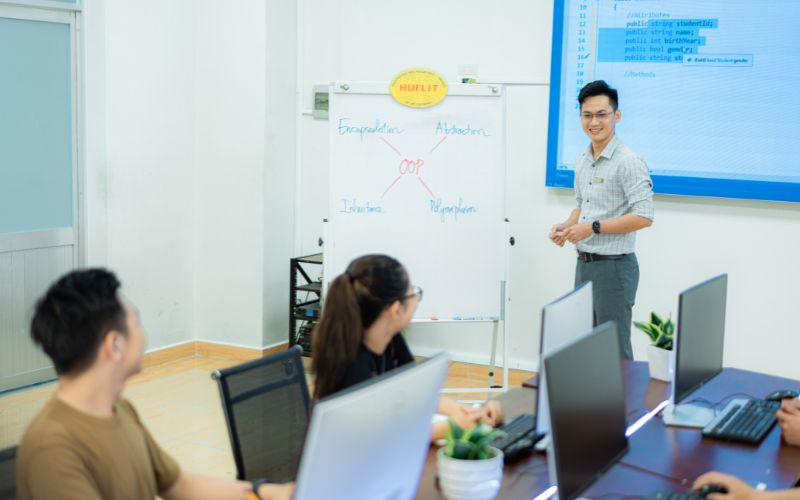
Critical thinking at HUFLIT is trained through modern training methods
Foreign language – The golden key to communicate with and control global AI
Foreign language in the technology industry is HUFLIT’s unique advantage. Reality shows that most advanced AIs such as ChatGPT-4, Claude, Midjourney work best with English. Users with a high English level can exploit 80-90% of AI’s capacity, while those who only use Vietnamese can only exploit 40-50%. HUFLIT’s output standard helps students:
- Effectively use prompt engineering (the command-writing technique)
- Read and understand the documentation of the latest AI tools
- Work for multinational technology companies
- Follow AI trends from international sources
A practical study environment applying the latest technology
HUFLIT cooperates with technology enterprises such as FPT, VNG, Viettel so that students can intern with real AI projects, building an impressive portfolio right from year 3. In addition, AI practice at HUFLIT does not stop at theory but students practise with AI tools in each specific specialisation:
- Information Technology students: Learning AI programming, Machine Learning, building chatbots
- Marketing students: Using AI to analyse customer data, create marketing content
- Law students: Using Legal Tech to look up and draft contracts
- Economics students: Using AI to analyse finance, forecast market trends
Media students: Creating multimedia content with AI (video, images, audio)

Students practise with AI tools in each specialisation
FAQ: Frequently asked questions about AI taking over jobs
The rapid development of artificial intelligence makes many people worry about the risk of job loss and the strong change of the labour market. Let’s answer the common questions about this issue.
Will AI replace doctors?
Not completely. AI can support diagnosing diseases from medical images (X-ray, CT, MRI) with high accuracy, but cannot completely replace doctors. The doctor’s role is shifting from “reading films” to “overall treatment consultation”, communicating with patients, making decisions in complex cases. AI is an excellent assistant but cannot completely replace them.
Does AI reduce recruitment demand?
Yes and no. AI reduces recruitment demand in repetitive positions, but at the same time creates many new positions such as AI Engineer, Data Scientist, Prompt Engineer, AI Ethics Specialist.
Does AI change the average salary?
Yes. The salary for simple jobs tends to decrease due to AI competition, but the salary for positions requiring high skills (analysis, consulting, creativity, management) increases considerably
Jobs that can be replaced by AI is an undeniable reality, but the important thing is what the young generation needs to prepare to not only survive but also develop strongly. Instead of fearing AI, learn how to master it. HUFLIT, with a training philosophy focusing on critical thinking, superior foreign languages and technology practice, is an ideal environment for you to prepare for the future.
CONTACT INFO
Apply for admission at
tuyensinh.huflit.edu.vn
Find out information
huflit.edu.vn
Advising education enrollment