



-
Proud to be HUFLITers #07 | M.A. Tran My Uyen – A lectern where a teacher wishes only to “watch her children grow up”At the HUFLIT Faculty of Foreign Languages, M.A. Tran My Uyen (Vice Dean) goes by many names. Some call her “Ms My”; her students call her “mother”. Colleagues often compare her to Mother Au Co with a hundred children. Yet to become the “mother” of the lecture hall she is today, she went through a profound shift in thinking that completely changed a teaching philosophy built over more than 30 years.
-
New Cybersecurity Regulations: Opportunities for the Cybersecurity Field in the Digital EraThe new cybersecurity regulations taking effect on 1 July 2026 not only help complete the legal framework but also drive demand for talent in cybersecurity. This is also the moment when the discipline becomes a promising choice for young people who love technology and information security.
-
“GenZ Major Insights 2026” – Episode 9: Boundless Journeys with HUFLIT’s Tourism and Hospitality ProgramsMany students choose the Tourism and Hospitality field simply because they love to travel. But passion alone is not enough to pursue this field in the long run. What matters more is understanding the nature of the discipline, its professional requirements, and the qualities needed to grow in a professional service environment.
Should You Study 2 Languages at the Same Time? [Answer From HUFLIT]
NGÀY: 05/03/2026
Chia Sẻ Qua
SHOULD you study 2 languages at the same time?
The answer is yes, but not for everyone. Studying 2 languages at the same time brings many benefits, but it is only suitable if you have clear goals, good time-management ability and an effective study method.
If you are easily distracted, still lack a foreign-language foundation or do not have enough time to practise regularly, then parallel study can overload you. Therefore, assess your own capacity and schedule before deciding to start the multilingual journey.

Studying 2 languages at the same time brings many benefits
>>>> POCKET IT NOW: Do you get bonus points on the university exam if you have an IELTS certificate?
3 benefits of studying 2 languages at the same time
Quite a few studies have shown that the benefits of learning a foreign language increase markedly when you conquer two languages in parallel. Let’s learn more about this observation.
Developing thinking and enhancing memory
When studying two foreign languages in parallel, the brain is always in a state of processing, classifying and comparing information, thereby forming cognitive flexibility. This is the very factor that helps you have faster language reflexes, remember longer and improve concentration.
A study by cognitive neuroscientist Christos Pliatsikas (University of Reading, UK) published in Nature Aging shows that mastering multiple languages helps slow the biological ageing of the brain, thereby maintaining memory and concentration in old age. After analysing the data of 86,000 people aged 51 to 90 in 27 European countries, scientists found that people who know only one language have nearly double the risk of fast brain ageing compared to those who speak two or more languages.
Expanding global career opportunities
In the era of integration, many enterprises will prioritise recruiting candidates who are proficient in two or more foreign languages, especially in fields such as Logistics, import-export, tourism, information technology or international Marketing.
Being proficient in two foreign languages not only helps you easily access high-quality jobs but also creates a competitive advantage in income. Because enterprises are willing to pay a more attractive salary to personnel who can communicate multilingually.

Being proficient in two foreign languages helps you easily access quality jobs
Cultural intersection and expanding worldview
When exposed to two cultures at the same time, you will develop a multidimensional perspective, understanding more deeply how people think, behave and communicate in different contexts. This not only helps you be more confident when participating in international activities but also expands your worldview, increasing your adaptability and connection with the global community.
The 2 biggest challenges when studying 2 foreign languages at the same time
Studying two foreign languages in parallel opens up many advantages, but it is not always as easy as you think. Before starting, you need to recognise the common barriers to prepare a strategy.
The risk of confusion (Language Interference)
One of the most common difficulties when studying two foreign languages in parallel is the phenomenon of “language interference”, that is, when the grammar structure or vocabulary of one language unintentionally affects the other. This easily leads to mispronunciation, language confusion or misunderstanding of meaning.
To limit this situation, you should divide study time clearly for each language and use different colour codes when taking notes. This way helps the brain separate information more effectively and remember systematically, significantly reducing the possibility of confusion.

You easily get confused about the structure between 2 languages
>>>> QUICK CLICK: Do you need to take IELTS to study the english language? A detailed answer
Pressure on time and persistence
Studying two foreign languages at the same time is a long journey and requires a high level of commitment. Many people easily become discouraged when the study schedule becomes packed or results do not come as fast as expected. To overcome this pressure, set small, clear and measurable goals (SMART) to create a sense of daily progress. In addition, finding a companion or joining a foreign-language learning community will help you maintain motivation, share experiences and keep your spirits up throughout the study process.
Strategies for studying 2 languages decode whether to study 2 languages at the same time
Studying two foreign languages in parallel is no longer a rare trend, but to be effective, you need a scientific roadmap instead of studying by inspiration. Below are 7 key strategies that help you both save time and optimise your absorption ability.
Choose a language pair smartly
Choosing the right language pair from the start will determine the level of effectiveness in the parallel study process. You can start in two directions as follows:
- Choose a language in which you already have a fairly good foundation and combine it with a completely new language. This way helps reduce pressure and make use of previous learning experience
- Choose two languages belonging to different writing systems and structures such as English – Chinese, English – Japanese. The clear difference between these languages will help the brain separate information better, limiting confusion, especially for beginners.
Allocate time by the “Timeboxing” rule
One of the golden secrets to maintaining bilingual study progress is applying the Timeboxing method. Specifically, you divide fixed and clear study time for each language. For example: you can spend Monday – Wednesday – Friday mornings on English, and Tuesday – Thursday – Saturday afternoons on Korean. This alternating schedule not only helps the brain focus deeply on each language at one time but also reduces the feeling of overload.
Using the “Contrast scale”
This is a smart study method that helps you both consolidate knowledge and avoid confusion between the two languages. When studying a grammar structure, vocabulary or expression in language A, immediately look for the equivalent structure or way of saying it in language B.
Such direct comparison creates a “contrast scale” in the brain, thereby helping you deeply understand the difference and remember longer. This study method is especially effective for languages with a certain level of similarity or when you are at an advanced stage.
Why is HUFLIT the environment for you to conquer multiple languages?
If you are wondering where is good to study foreign languages to both be good at the language and have the opportunity to develop a global career, HUFLIT university is a choice worth considering. With in-depth training strengths at the HUFLIT Faculty of Foreign Languages, the school brings a modern, multicultural learning environment with a clear practice orientation. Specifically as follows.
A leading, experienced lecturer team
HUFLIT owns a highly specialised lecturer team, with many teachers holding international qualifications. Most lecturers hold Master’s and Doctorate degrees from prestigious universities at home and abroad. Not only having deep, broad knowledge of the language, the lecturers also bring to class real stories, cultural experience and communication skills.
A diverse, internationally standard training programme
HUFLIT is known for its strengths in training foreign-language fields such as English Language, Chinese Language, Japanese Language and Korean Language. The study programme is always updated according to labour-market demand, combining theory and practical skills.
In addition, the school implements many interesting activities so that students have the opportunity to train foreign-language skills. For example, learners can participate in the “English In Action” series or international exchange programmes and overseas summer camps in Wuhan to expand their real-world experience.
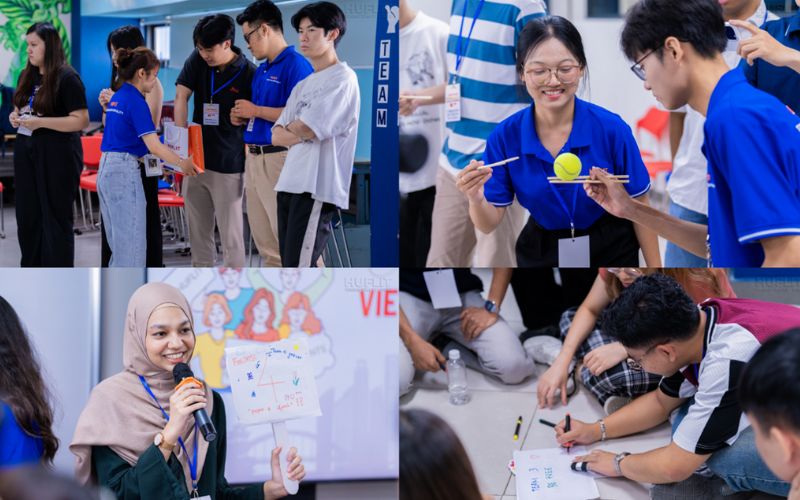
HUFLIT’s study programme helps students have the opportunity for international exchange
>>>> DO NOT SKIP: How long does it take to study Chinese to become an interpreter? Roadmap 2026
A dynamic practice environment and modern facilities
HUFLIT not only focuses on knowledge in the lecture hall but also builds a lively foreign-language practice environment. Students can join English, Japanese, Korean and Chinese clubs, academic, interpreting and debate competitions,… A typical example is the “HUFLIT 2025 Expressive Reading Voice – HUFLIT 2025 年汉语朗诵比赛” competition organised by the Chinese Club. This is where outstanding reading voices will shine through emotional and impressive presentations.
Besides, the foreign-language lab system, a rich library and modern learning equipment also help students train language skills continuously. From there, the school creates conditions for pupils to confidently conquer multiple foreign languages right during their study time at the school.
Frequently asked questions (FAQ)
Below are the common questions that many people encounter when starting the journey of studying two foreign languages in parallel. Let’s find out now.
Should you study 2 languages at the same time or start with one language first?
The general advice for foreign-language learners is to build a solid foundation with one language first. The most suitable is to reach intermediate level (B1) before starting the second language. Once you are used to the study method, language thinking and have a basic vocabulary, approaching a new language will be lighter and more effective.
However, complete beginners can still study two languages in parallel if they apply the right strategy. For example, choosing two languages that differ in writing system or starting point. At the same time, you need to allocate study time regularly and use suitable materials.
How long does it take to master 2 languages when studying in parallel?
With a serious and regular study roadmap, it can take you about 3–5 years to reach a good communication level in both languages. However, there is no exact figure for every case, because the time to master two languages depends on many factors such as the difficulty of each language, the similarity between them, and the time you invest each day.
Can you register to study 2 language specialisations at HUFLIT?
HUFLIT currently does not train 2 language specialisations in parallel in the formal (full-time) format. However, for the Faculty of Oriental Languages and Cultures, students are required to study a second foreign language such as English, Chinese or Japanese. To know accurate and latest information, you should directly contact the HUFLIT Admissions Consulting Office for detailed guidance.
Whether to study 2 languages at the same time is no longer a worry if you clearly understand your goals and have the right study method. When methodically oriented, conquering two foreign languages becomes a strong competitive advantage, helping you confidently enter the labour market. If you are looking for a place to start your multilingual journey, consider HUFLIT.
>>>> SEE MORE GOOD ARTICLES:
CONTACT INFO
Apply for admission at
tuyensinh.huflit.edu.vn
Find out information
huflit.edu.vn
Advising education enrollment