


-
Proud to be HUFLITers #07 | M.A. Tran My Uyen – A lectern where a teacher wishes only to “watch her children grow up”At the HUFLIT Faculty of Foreign Languages, M.A. Tran My Uyen (Vice Dean) goes by many names. Some call her “Ms My”; her students call her “mother”. Colleagues often compare her to Mother Au Co with a hundred children. Yet to become the “mother” of the lecture hall she is today, she went through a profound shift in thinking that completely changed a teaching philosophy built over more than 30 years.
-
New Cybersecurity Regulations: Opportunities for the Cybersecurity Field in the Digital EraThe new cybersecurity regulations taking effect on 1 July 2026 not only help complete the legal framework but also drive demand for talent in cybersecurity. This is also the moment when the discipline becomes a promising choice for young people who love technology and information security.
-
“GenZ Major Insights 2026” – Episode 9: Boundless Journeys with HUFLIT’s Tourism and Hospitality ProgramsMany students choose the Tourism and Hospitality field simply because they love to travel. But passion alone is not enough to pursue this field in the long run. What matters more is understanding the nature of the discipline, its professional requirements, and the qualities needed to grow in a professional service environment.
HUFLIT develops scientific research capacity among its teaching staff
NGÀY: 27/05/2025
Chia Sẻ Qua
Scientific research is not only one of the core standards in the quality accreditation of higher education institutions but also contributes to enhancing academic reputation, affirming the University’s standing within the national and international education systems, and promoting the personal and professional development of the teaching staff. When carried out effectively and closely linked to training activities, scientific research also brings practical value to learners, helping develop academic thinking, problem-solving capacity and creativity.

At HUFLIT, repositioning and strengthening scientific research is one of the pillars tied to the University’s development mission, made concrete through practical support policies, strategic direction and in-depth training. A typical example of these efforts is the recent training session “Strengthening scientific research capacity”, aimed at consolidating professional skills and spreading a research spirit among staff, lecturers and specialists across the University.

Assoc. Prof. Dr. Nguyen Ngoc Vu – Vice Rector of HUFLIT emphasised: students gain the most value from lecturers' scientific research.
The content of the training session was carefully designed, combining professional theory with practical activities, guided and discussed in depth by Assoc. Prof. Dr. Huynh Thanh Cong – Deputy Head of the Science and Technology Board, Vietnam National University Ho Chi Minh City, and Dr. Nguyen Vinh Khuong – Deputy Head in charge of the Postgraduate – Science and Technology Department, University of Economics and Law.
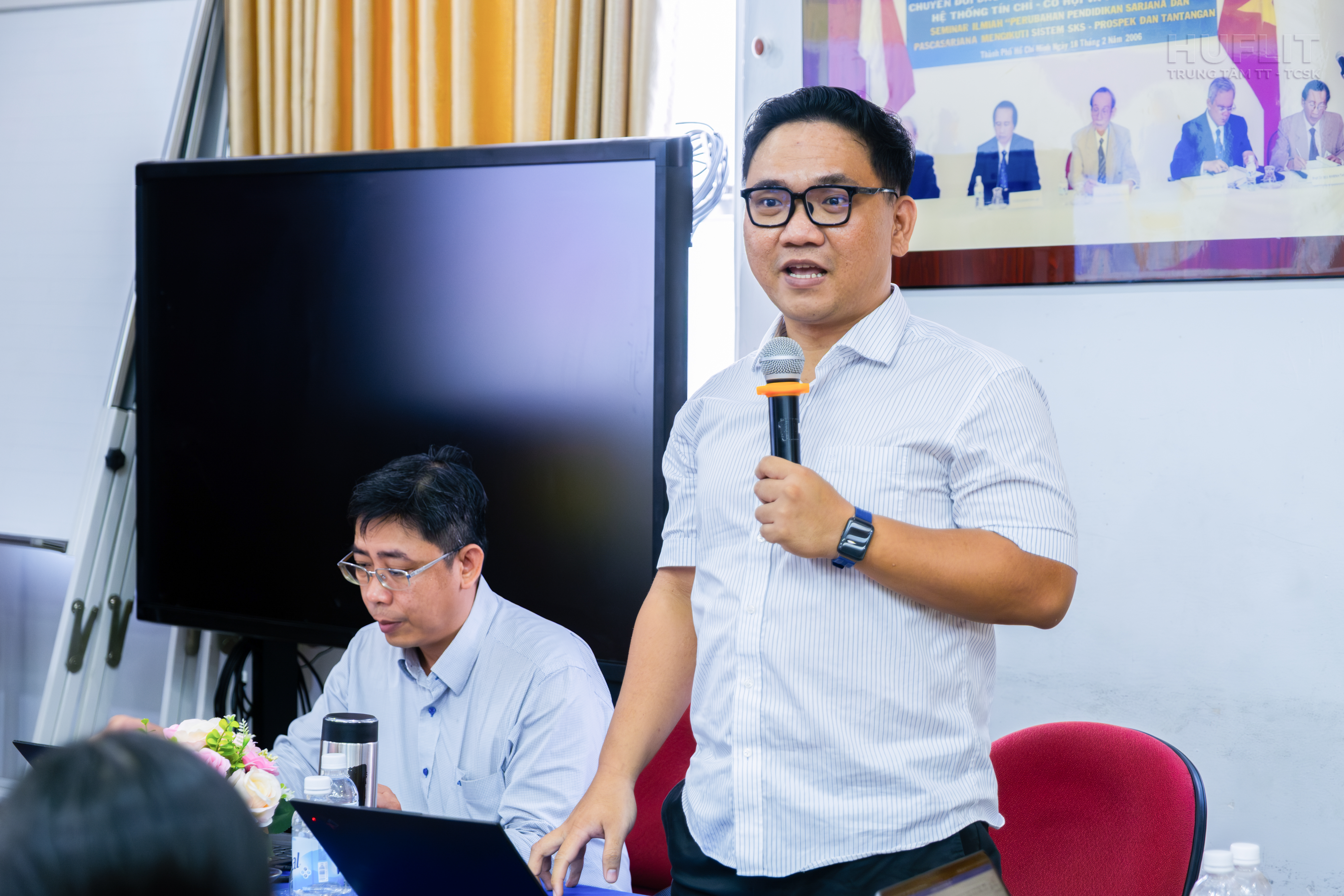
Assoc. Prof. Dr. Huynh Thanh Cong – Deputy Head of the Science and Technology Board, Vietnam National University Ho Chi Minh City (right) and Dr. Nguyen Vinh Khuong – Deputy Head in charge of the Postgraduate - Science and Technology Department, University of Economics and Law (left).
In the theory section, participants were given an overview of science and technology activities in higher education institutions today, and were introduced to essential knowledge for research work such as how to write a project proposal, methods of collecting and processing data, techniques for presenting research results, and skills for writing scientific papers. In addition, the programme provided guidance on finding and accessing research funding sources — an important factor helping lecturers and specialists turn academic ideas into reality.


Lecturers proactively asking questions and joining the speakers in "dissecting" real issues in scientific research.
The practical part of the training session was carried out through discussion and the development of University-level research proposals, divided into two specialist groups to ensure depth. The first group focused on engineering and technology, guided directly by Assoc. Prof. Dr. Huynh Thanh Cong. The other group covered economics, law, social sciences and humanities, tourism and foreign languages, led by Dr. Nguyen Vinh Khuong. Participants had prepared their research topics in advance and, through the activity, received specific feedback from the experts to refine their approach, proposal structure and implementation direction in line with practice.

Dr. Nguyen Vinh Khuong guiding participants on how to access research funding sources effectively during the practical session.
Beyond providing knowledge, the training session also had practical significance in generating research topics with high applicability and potential for international publication, aiming to connect research activities with the University’s training and development requirements. Through this activity, HUFLIT hopes to build a team of lecturers and specialists with systematic research thinking, ready to expand cooperation with experts at home and abroad, thereby fostering a robust research ecosystem in the university environment. This is also an important step in the roadmap for developing science and technology capacity tied to HUFLIT’s strategy of improving training quality in the period ahead.
CONTACT INFO
Apply for admission at
tuyensinh.huflit.edu.vn
Find out information
huflit.edu.vn
Advising education enrollment