



-
Proud to be HUFLITers #07 | M.A. Tran My Uyen – A lectern where a teacher wishes only to “watch her children grow up”At the HUFLIT Faculty of Foreign Languages, M.A. Tran My Uyen (Vice Dean) goes by many names. Some call her “Ms My”; her students call her “mother”. Colleagues often compare her to Mother Au Co with a hundred children. Yet to become the “mother” of the lecture hall she is today, she went through a profound shift in thinking that completely changed a teaching philosophy built over more than 30 years.
-
New Cybersecurity Regulations: Opportunities for the Cybersecurity Field in the Digital EraThe new cybersecurity regulations taking effect on 1 July 2026 not only help complete the legal framework but also drive demand for talent in cybersecurity. This is also the moment when the discipline becomes a promising choice for young people who love technology and information security.
-
“GenZ Major Insights 2026” – Episode 9: Boundless Journeys with HUFLIT’s Tourism and Hospitality ProgramsMany students choose the Tourism and Hospitality field simply because they love to travel. But passion alone is not enough to pursue this field in the long run. What matters more is understanding the nature of the discipline, its professional requirements, and the qualities needed to grow in a professional service environment.
What Does a Judge Study to Begin the Path of Adjudication? Details
NGÀY: 01/04/2026
Chia Sẻ Qua
Who is a judge?
A judge is a person holding a judicial title in the People’s Court system. You have the task of adjudicating criminal, civil, administrative, economic, labour cases… according to the provisions of the law. The judge, in the name of the State, issues verdicts, ensuring that adjudication is carried out fairly, objectively and in accordance with the law.
Besides the adjudication role, the judge is also responsible for protecting justice, human rights and the legitimate rights and interests of individuals and organisations. At the same time, the person in this position also contributes to maintaining social order and discipline.
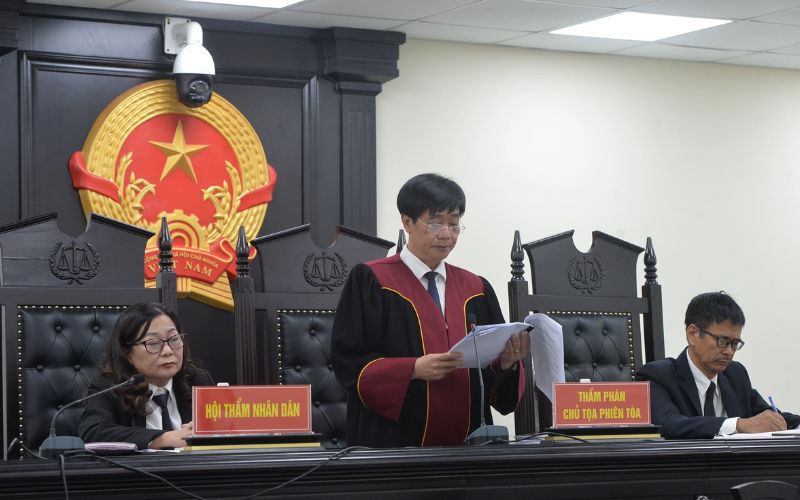
A judge is a person holding a judicial title in the People’s Court system
What does a judge study?
To become a judge, first you need to graduate from university in the field of Law, most commonly Jurisprudence or Economic Law. After graduation, candidates must have a period of practical legal work, take part in professional training at the Court Academy and pass the exams and selection according to the regulations.
Besides professional knowledge of law, learners also need to train logical thinking and analytical ability. Besides, you must have professional ethics and mettle to meet the specific requirements of the judge profession.
>>>> SEE NOW: Can you become a lawyer by studying Economic Law? Explore now
Details of the process of becoming a judge
The process of becoming a judge in Vietnam is built rigorously, to ensure that the appointed person is solid in legal expertise and has moral qualities and professional mettle. Specifically as follows.
Step 1: Pass the university entrance exam in the field of Law
This is an important starting step, laying the foundation for the entire journey to becoming a judge. Being admitted to Law fields helps learners systematically approach basic legal knowledge. Besides, this stage is the condition for you to form legal thinking and career orientation in the judicial field early on.

Being admitted to the Law field helps learners systematically approach legal knowledge
Step 2: Become a Bachelor of the field of Law
The university stage helps students be equipped with in-depth knowledge of fields such as constitutional law, criminal law, civil law, procedural law… The role of this step is to build a solid professional foundation, while training research, argumentation and legal-analysis skills. These are the core competencies of a future judge.
Step 3: Take the civil-servant recruitment exams of the Court sector
After graduation, candidates must take the civil-servant recruitment exams to be selected into the People’s Court system. This step has the role of filtering individuals who meet the standards of professional level, capacity and moral qualities to work in the judicial environment.
Step 4: Be sent to study Court Clerk professional training
Successful candidates will be assigned to take part in Court Clerk professional training courses. This is a stage that helps learners directly approach adjudication activity, procedural processes and real work at the court. In addition, professional training also helps you understand legal theory and career practice.
Step 5: Be appointed as a Court Clerk
When appointed as a Court Clerk, learners officially take part in the case-resolution process, such as recording court-session minutes and supporting the judge in procedural work. The role of this step is to help accumulate practical experience and understand the adjudication process more deeply. At the same time, you can train your professional manner in a serious legal environment.
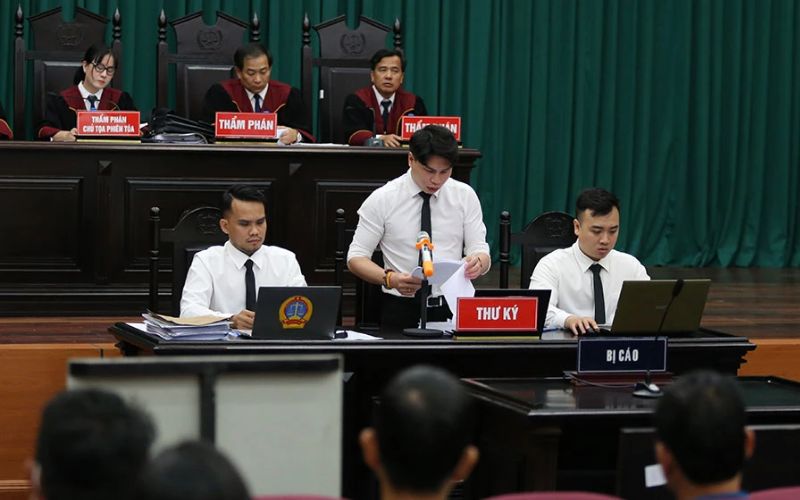
When working as a court clerk, you can train your professional manner
Step 6: Complete adjudication professional-training courses
After a period of work, the Court Clerk will continue to take part in in-depth training courses on adjudication expertise. This step helps enhance legal knowledge, the skill of applying law in practice and the ability to evaluate evidence. This is also the foundation preparing for the role of independent adjudication in the future.
Step 7: Pass the Primary Judge exam
The Primary Judge exam is a comprehensive assessment step on the professional level, practical experience and moral qualities of the candidate. The role of this step is to select individuals who are truly capable and have the mettle to take on the title of judge, ensuring the quality of the adjudication team.
Step 8: Be appointed as a Judge
After passing, the candidate will be appointed as a Judge by the competent authority. This is the step that completes the career roadmap, marking the learner officially exercising, in the name of the State, the right of adjudication, protecting justice, human rights and the strictness of the law.
>>>> SEE MORE:Economic lawyer: The work, qualities and income you need to know
The current salary of a judge
The judge profession has a salary paid according to the grade-rank system, tied to the court level from district level, provincial level to the Supreme People’s Court. According to the provisions of Resolution No. 730 of 2024, the salary of judges was adjusted upward and officially applied from 1/7/2024, with an increase of about 1.49 million VND for each rank.
Specifically, judges working at district-level People’s Courts have a salary ranging from about 3.5 to 7.5 million VND/month, depending on the rank bracket. For provincial-level judges, the salary rises to about 6.5 to 10.1 million VND/month, while judges at the Supreme People’s Court – the highest adjudication level – have a salary from about 9.2 to 12 million VND/month.
Skills required for the judge position
The judge is a judicial title that requires very high standards in both professional capacity and moral qualities. To perform the adjudication role well, a judge needs to combine many specific skills, helping to ensure that justice is enforced strictly and objectively.
- Fairness, objectivity and honesty: This is the core quality of a judge, expressed in adjudicating impartially, without bias, not swayed by personal interests or external pressure. Fairness and honesty help ensure that verdicts correctly reflect the nature of the matter and the provisions of the law.
- Professional sensitivity: A judge needs the ability to be sharp in identifying important details, key legal factors and abnormal signs in a case. This skill helps the judge promptly correctly assess the degree and nature of each matter.
- High analysis and synthesis ability: In the adjudication process, the judge must study a large volume of files, evidence and legal provisions. Logical analysis and accurate information synthesis are the foundation for making correct judgements and appropriate verdicts.
- Logical thinking and tight argumentation: Every judgement and decision of a judge needs a clear legal basis and persuasive argumentation. Logical thinking helps ensure consistency, transparency and the ability to defend the verdict before the law and society.
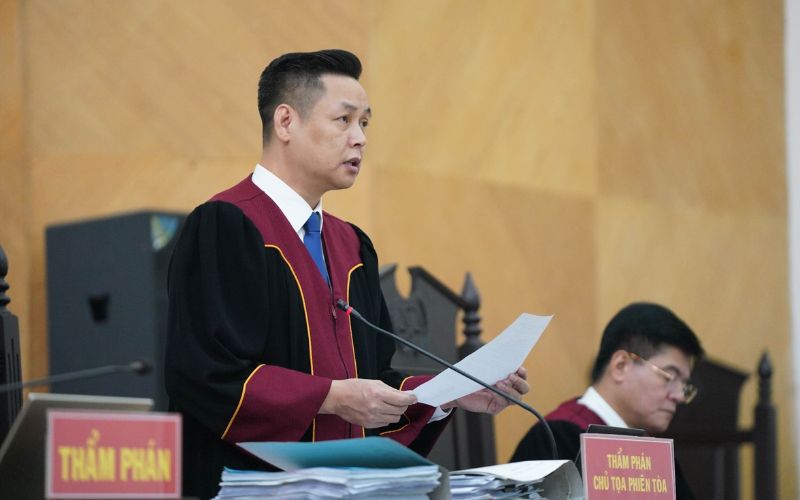
The judge is a judicial title that requires very high standards
Studying Law at HUFLIT: An important starting step to becoming a judge
Pursuing the path to becoming a judge requires a solid foundation of legal knowledge together with comprehensive professional skills. With a training orientation tied to reality, the Faculty of Law – HUFLIT will bring students a methodical, modern learning environment.
Knowledge tied to reality
The Law training programme at HUFLIT is built along a highly applied orientation, closely combining theory and practice. Students not only master foundational jurisprudence knowledge but also get access to real legal situations. This is the foundation for you to form analytical, argumentation and effective law-application thinking.
Besides, the programme also especially focuses on training specialised legal English. Thanks to that, students will become familiar with legal terminology in English, read and understand international materials and enhance communication ability in a global legal environment. This is an important advantage that helps students be more confident when working at enterprises, international organisations or in the context of integration.
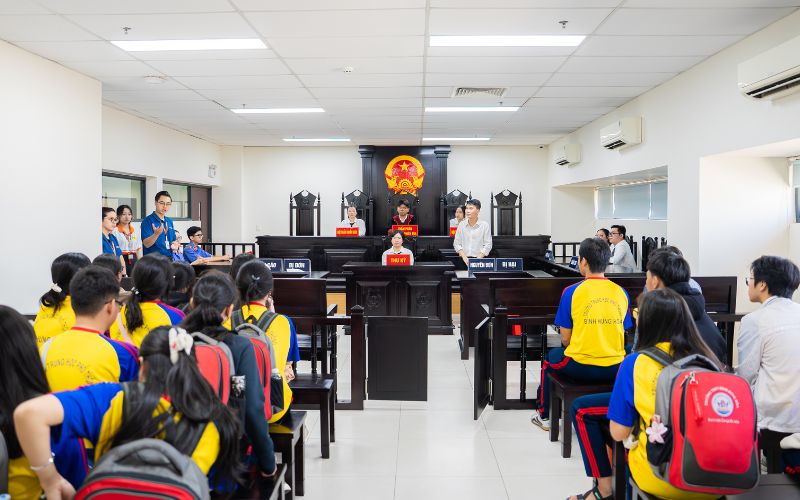
The Law training programme at HUFLIT is built along a highly applied orientation
Experienced lecturers at Associate Professor, PhD and Lawyer level
HUFLIT has a team of lecturers at Associate Professor, PhD and Lawyer level, rich in teaching experience and professional practice. The lecturers’ companionship helps students approach in-depth knowledge and update new laws. At the same time, students are also supported to have a realistic view of the career-development path in the Law field.
Enhancing the profession, perfecting jurisprudence skills
Understanding the increasingly high requirements of the labour market, HUFLIT creates conditions for students to do observation visits and internships through its network of cooperation with agencies and enterprises at home and abroad. Through the HUFLIT Job Fair, HUFLIT Career Talks and Company Tours, students get access to a real working environment and enhance their career skills.
Besides, the University also organises many workshops, academic contests on law and field-visit trips to learn about courts. Through that, students can train legal thinking, debating skills and enhance the ability to apply jurisprudence knowledge in practice.
>>>> SEE MORE:What’s new about Law lecturers in the era of integration?
Common questions about what a judge studies
The judge is one of the important judicial titles, requiring a high professional level and a rigorous training and selection process. Therefore, the question of what a judge studies always receives much interest from students. Let’s find out right away.
What ranks does a court judge include?
Based on the provisions of Article 66 of the 2014 Law on Organisation of People’s Courts, the current Judge ranks include:
- Judge of the Supreme People’s Court;
- Senior Judge;
- Intermediate Judge;
- Primary Judge.
What is the main work of a court judge?
The main work of a judge is to adjudicate cases within the Court’s jurisdiction according to the provisions of the law. The judge is responsible for studying the case file, conducting the court session, evaluating evidence, applying the law and issuing judgements and decisions ensuring objectivity, fairness and compliance with the law.
Who is suited to the judge profession?
The judge profession suits people with logical thinking, analytical and tight-argumentation ability, together with steadfast mettle and a spirit of upholding the law. Besides professional knowledge, those pursuing this profession need high professional ethics, impartiality, honesty and the ability to withstand great pressure in adjudication work.
What a judge studies is not only a question about choosing a field of study but also the starting step for a journey that requires mettle, knowledge and high professional ethics. Equipping a solid jurisprudence foundation, tied to practical skills, will help learners be ready to meet the demanding requirements of the judicial field. Refer to this specialisation at HUFLIT.
>>>> SEE MORE RELATED ARTICLES:
What does a lawyer’s secretary do? The work and detailed salary
Prosecutor or lawyer, who is higher? A detailed A-Z comparison
CONTACT INFO
Apply for admission at
tuyensinh.huflit.edu.vn
Find out information
huflit.edu.vn
Advising education enrollment