


-
Proud to be HUFLITers #07 | M.A. Tran My Uyen – A lectern where a teacher wishes only to “watch her children grow up”At the HUFLIT Faculty of Foreign Languages, M.A. Tran My Uyen (Vice Dean) goes by many names. Some call her “Ms My”; her students call her “mother”. Colleagues often compare her to Mother Au Co with a hundred children. Yet to become the “mother” of the lecture hall she is today, she went through a profound shift in thinking that completely changed a teaching philosophy built over more than 30 years.
-
New Cybersecurity Regulations: Opportunities for the Cybersecurity Field in the Digital EraThe new cybersecurity regulations taking effect on 1 July 2026 not only help complete the legal framework but also drive demand for talent in cybersecurity. This is also the moment when the discipline becomes a promising choice for young people who love technology and information security.
-
“GenZ Major Insights 2026” – Episode 9: Boundless Journeys with HUFLIT’s Tourism and Hospitality ProgramsMany students choose the Tourism and Hospitality field simply because they love to travel. But passion alone is not enough to pursue this field in the long run. What matters more is understanding the nature of the discipline, its professional requirements, and the qualities needed to grow in a professional service environment.
Will AI Replace Humans? 5 Skills to Help You Be “Invincible”
NGÀY: 17/03/2026
Chia Sẻ Qua
Correctly understanding the nature of Artificial Intelligence (AI)
To answer the question of whether AI will replace humans, first we need to clearly understand what AI is in nature. Artificial intelligence is not a living being with its own consciousness, but a technology tool programmed to perform specific tasks based on data and algorithms.
AI is strong at data processing and repetition
AI stands out for its extremely fast processing speed, the ability to analyse large volumes of data and perform repetitive tasks continuously without tiring. Thanks to this, AI helps optimise work performance and reduce the load for humans in many fields.
Specific examples:
- Processing large amounts of data at an outstandingly fast speed: AI has the ability to receive and analyse huge amounts of data in a short time, something humans can almost not do manually, making AI a powerful tool in data analysis and evidence-based decision-making.
- Automating repetitive tasks: AI can automate repetitive and time-consuming work, helping save human resources and enhance work performance, while allowing humans to focus on more strategic tasks.
- The ability to learn from data to continuously improve: When data is accumulated and processed correctly, AI not only analyses current data but also learns from previous patterns, thereby making predictions and giving more effective suggestions in the future.

AI processes huge volumes of data at a speed far exceeding humans in many fields
The core limitations of Artificial Intelligence today
The core limitations mainly stem from the nature of depending on data and algorithms. AI does not possess consciousness, emotion or the ability of moral reasoning like humans, but only processes and gives results based on trained models. In addition, the quality and diversity of the input data directly affect AI’s accuracy, leading to the risk of deviation or bias.
>>>> SAVE NOW: Not good at any subject, what discipline should you study? Top 15+ disciplines to know
The evolution from support AI to collaborative AI
The evolution from support AI to collaborative AI shows an important shift in the role of artificial intelligence. Instead of only automating repetitive work, AI today can analyse data, give suggestions and work in parallel with humans. This combination helps make use of the strengths of both technology and human thinking, thereby enhancing the effectiveness and quality of decision-making.
Will AI replace humans in the labour market?
The question of the future of AI jobs and which profession AI replaces is the biggest concern of students and workers. Below is a capacity-comparison table you can refer to:
| Criteria | Humans | AI |
| Data-processing speed | Slow | Extremely fast |
| Ability to learn new things | Flexible, diverse | Needs to be reprogrammed |
| Emotion and empathy | Yes | No |
| Real creativity | Yes | Only combining/imitating |
| Ethics and conscience | Yes | No |
| Maintenance cost | High (salary, benefits) | Low (only electricity, maintenance) |
| Working 24/7 | Cannot | Can |
The industry groups at high risk of being threatened
Professions easily replaced by AI are usually work with high repetitiveness, based on a fixed process and not requiring much human interaction:
- Data entry and simple text processing: AI can automate 95%
- Junior accounting: AI software can do bookkeeping, automatic reconciliation
- Assembly-line workers: Industrial robots are gradually replacing them
- Reception and basic phone answering: AI chatbots are taking over
- Simple translation: Google Translate, DeepL are increasingly accurate
- Basic data analysis: AI can create automatic reports
According to research by the University of Oxford (2023) published in the journal Science (the world’s leading science journal): “47% of current jobs are at risk of being automated in the next 20 years, focusing mainly on repetitive work not requiring complex social interaction”.
The industry groups AI can hardly completely replace
Professions safe from AI are work requiring emotion, real creativity, ethics and complex interaction:
- Psychology and mental-health counselling: Needs empathy and human connection
- Deeply meaningful artistic creation: Artists, writers, directors
- Human resource management and leadership: Needs EQ, strategic vision
- Education and teaching: Needs to understand student psychology, inspire
- Complex diagnostic healthcare: Needs experience, clinical intuition
- Lawyers and judges: Need moral judgement, understanding of the social context
- Breakthrough scientific research: Needs creative thinking, asking new questions
>>>> DON’T MISS: What are the benefits of AI in learning? Roles and challenges
The appearance of new jobs thanks to AI
New jobs from AI are appearing at a dizzying speed:
- Prompt Engineer: Designing optimal commands for AI
- AI Ethics Specialist: Ensuring AI is used responsibly
- AI Operations Manager: Operating and supervising AI systems
- AI Trainer: Training and fine-tuning AI models
- Data Curator: Managing and ensuring data quality for AI
- Synthetic Media Designer: Creating content with AI
According to LinkedIn Learning (2024), there are more than 150 new job positions related to AI that have appeared in the past 2 years, with an average salary 35-50% higher than traditional positions of the same level.

AI not only replaces old jobs but also creates many new professions with an attractive income
HUFLIT: Training a young generation with mettle in the AI era
The question “Is studying at HUFLIT good” is posed by many young people when looking for a training environment suitable to the AI era. HUFLIT is proud to be a place building a practical training environment helping students not only not fear AI but also know how to master technology.
A study programme focusing on creative and applied thinking
HUFLIT deploys the bachelor programme with the goal of not only imparting knowledge but also promoting students to develop creative thinking and the ability to apply it in reality. The disciplines at the school are all designed for students to combine academics with career experience and teamwork skills, helping them confidently face the challenges of the 21st century.

HUFLIT orients students to master AI with creative thinking and critical capacity
The Foreign-Language strength – The key to global communication with AI
HUFLIT is famous for its foreign-language training strength lasting more than 30 years, helping students build a solid language foundation and confidently communicate in an international environment. The study programme at the Faculty of Foreign Languages combines language skills with professional knowledge and technology, supporting students to access international opportunities and develop their career in the globalisation context, especially important when applying AI in many fields.
>>>> CLICK NOW: Which school in HCMC is best to study Artificial Intelligence?
Extracurricular activities training sustainable soft skills
HUFLIT promotes students to participate in many extracurricular activities such as professional seminars, international-exchange programmes, career seminars and student movements. These activities create an environment for students to practise soft skills such as communication, teamwork, critical thinking and real connection, contributing to creating a sustainable development foundation for their later career.
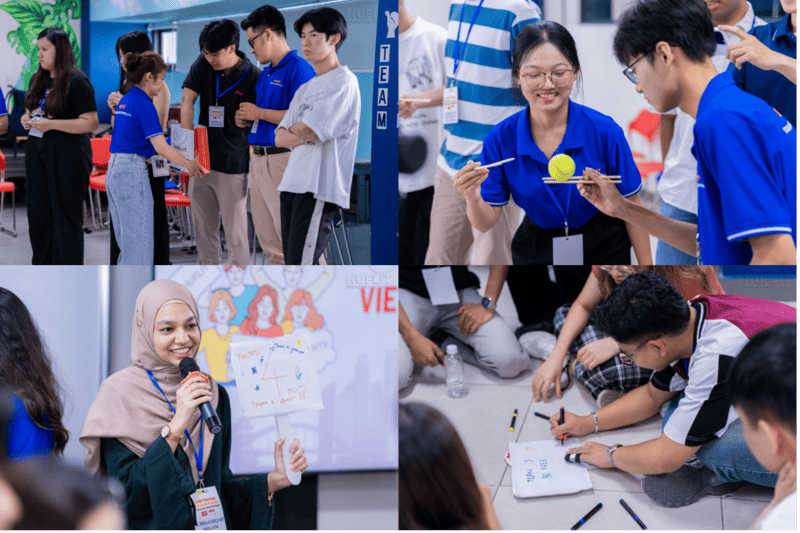
Extracurricular activities at HUFLIT help students train soft skills and be ready for the real working environment
FAQ: Common questions about AI replacing humans
Is AI smarter than humans?
AI is smarter than humans in some specific fields such as calculation, data analysis. But overall, AI is still very far from having “general intelligence” like humans. AI has no consciousness, no emotion, does not understand “meaning” and has no real creative ability.
What discipline should you study to not worry about AI?
Study disciplines requiring human interaction, creativity and complex thinking: Psychology, Education, Medicine, Law, Art, Business Administration. In particular, study technology disciplines such as AI, Data Science to become a person controlling AI instead of being replaced by AI.
Which jobs are hard to be replaced by AI?
Jobs needing high EQ (psychology, education, leadership), real creativity (art, meaningful design), complex decision-making (senior management, strategic consulting), and jobs requiring subtle social interaction (B2B sales, HR, event management), etc.
Whether AI will replace humans is a question with no simple answer. AI will replace some jobs but create even more new jobs. HUFLIT, with a practical training method focusing on foreign languages and soft skills, is an ideal environment for you to prepare for a future where you are not replaced by AI but become a person mastering AI.
>>>> REFER TO THE RELATED ARTICLES:
Salary in the artificial intelligence (AI) industry 2026: Latest update
What discipline does an AI engineer study? TOP 5 most potential disciplines
CONTACT INFO
Apply for admission at
tuyensinh.huflit.edu.vn
Find out information
huflit.edu.vn
Advising education enrollment