


-
Proud to be HUFLITers #07 | M.A. Tran My Uyen – A lectern where a teacher wishes only to “watch her children grow up”At the HUFLIT Faculty of Foreign Languages, M.A. Tran My Uyen (Vice Dean) goes by many names. Some call her “Ms My”; her students call her “mother”. Colleagues often compare her to Mother Au Co with a hundred children. Yet to become the “mother” of the lecture hall she is today, she went through a profound shift in thinking that completely changed a teaching philosophy built over more than 30 years.
-
New Cybersecurity Regulations: Opportunities for the Cybersecurity Field in the Digital EraThe new cybersecurity regulations taking effect on 1 July 2026 not only help complete the legal framework but also drive demand for talent in cybersecurity. This is also the moment when the discipline becomes a promising choice for young people who love technology and information security.
-
“GenZ Major Insights 2026” – Episode 9: Boundless Journeys with HUFLIT’s Tourism and Hospitality ProgramsMany students choose the Tourism and Hospitality field simply because they love to travel. But passion alone is not enough to pursue this field in the long run. What matters more is understanding the nature of the discipline, its professional requirements, and the qualities needed to grow in a professional service environment.
What Discipline Does an AI Engineer Study? TOP 5 Most Potential Disciplines
NGÀY: 17/03/2026
Chia Sẻ Qua
Suggesting the 5 best foundational disciplines for the “AI Engineer”
To become a professional AI engineer, you need to choose the right artificial intelligence discipline or disciplines with a suitable technology foundation. Below are the 5 most highly rated disciplines:
The Computer Science discipline
Studying computer science to do AI is the choice most recommended by experts because this discipline provides a solid foundation on algorithms, data structures and programming – the core factors of AI.
The Computer Science training programme includes: Data Structures and Algorithms, Discrete Mathematics, Linear Algebra, Probability and Statistics, Object-Oriented Programming, Operating Systems, Databases, Computer Networks, and in-depth AI subjects such as Machine Learning, Deep Learning, Computer Vision, NLP.

Computer science is the most solid foundation to develop an AI career
>>>> DON’T MISS: Not good at any subject, what discipline should you study? Top 15+ disciplines to know
The Artificial Intelligence discipline
The AI specialisation is the most direct choice for those who want to specialise in this field from the start. The discipline is specially designed to train AI engineers with comprehensive knowledge of Machine Learning, Deep Learning, Neural Networks models and real applications.
In Vietnam, the Artificial Intelligence discipline has been officially recognised by the Ministry of Education and Training and many universities are deploying the training programme. The AI discipline trains students not only to know how to use available tools but also to understand the mathematics behind them, with the ability to research and develop new algorithms.
The Information Technology discipline
According to the “IT Workforce Skill Gap Analysis 2024” report by the Vietnam Software and IT Services Association (Studying IT to become an AI engineer is a flexible and popular direction, especially suitable for those who want a broad technology foundation before specialising in AI. The IT discipline focuses on developing applications, software systems and technology management.
The strength of the Information Technology discipline is high applicability; students learn how to deploy AI (artificial intelligence) solutions into reality, building production-ready AI systems, etc. The programme includes: web/mobile programming (website, mobile applications), databases, Cloud Computing, DevOps (software operation and deployment) and elective subjects on AI/ML (artificial intelligence/machine learning).
The Data Science and Analytics discipline
Data Science is a discipline tied to AI, focusing on collecting, processing, analysing big data and extracting insights from data. This is an important foundation because AI cannot operate without quality data. Data Science students learn about Statistics, Data Mining, Data Visualization, Big Data Technologies (Hadoop, Spark), SQL/NoSQL, Python/R for Data Analysis, Machine Learning, and Business Analytics.
The Robotics and Automation Engineering discipline
This discipline combines AI, mechanics, electronics and automation, focusing on applying AI to robots, self-driving vehicles, smart factories and IoT (Internet of Things). This is a suitable choice for those who like combining hardware and software.
According to the “Robotics and AI Market Vietnam 2024” report by the International Federation of Robotics (IFR – an international robotics organisation with 70 years of history): “The industrial-robot market in Vietnam grows 45% each year, creating a large demand for engineers with AI and robotics skills”.

Robotics and automation engineering suits those who want to combine AI with hardware and smart systems
>>>> READ NOW: What are the benefits of AI in learning? Roles and challenges
The “golden” knowledge blocks and skills of an AI engineer
AI-engineer skills do not stop at knowing how to code but also include much other foundational knowledge. Below is a checklist of the most important AI-discipline subjects:
- Discrete Mathematics
- Probability & Statistics
- Linear Algebra
- Calculus
- Python, Java, C++
- SQL and NoSQL
- Machine Learning algorithms
- Deep Learning frameworks (TensorFlow, PyTorch)
- Data structures and Algorithms
- Computer Vision / NLP
The Mathematics foundation and Algorithmic thinking
The mathematics foundation and algorithmic thinking are the core factors helping the AI engineer understand the nature of how a model works and give accurate solutions. Knowledge such as linear algebra, probability – statistics, calculus and optimisation helps the learner grasp how data is represented, trained and how to improve the performance of an artificial-intelligence model.
Besides, algorithmic thinking and data structures help the AI engineer build effective solutions, optimise processing speed and system scalability. Clearly understanding algorithms not only supports deploying AI models accurately but also helps evaluate, adjust and apply AI effectively in real problems such as prediction, classification or big-data processing.

Mathematics and algorithmic thinking are the core foundation to understand and develop in-depth AI
Programming languages and popular AI tools
AI programming with Python is the industry standard today. Python accounts for 57% of the market share in AI/ML projects according to a Stack Overflow survey (2024). Besides Python, R is used a lot in Data Science, Java/C++ in high AI systems. The important libraries include:
- TensorFlow – Google’s framework, suitable for production
- PyTorch – Meta’s framework, suitable for research
- Scikit-learn – Traditional ML library
- Keras – Easy-to-use high-level API
- OpenCV – Computer Vision library
- NLTK/SpaCy – NLP library
Knowledge of Natural Language Processing (NLP) and Computer Vision
Natural Language Processing – NLP and Computer Vision are the two core fields of artificial intelligence, with a high level of application and a large human-resource demand. NLP is deployed in chatbot systems, virtual assistants, machine translation and text analysis, while Computer Vision is applied in face recognition, medical-image analysis and self-driving vehicles.
>>>> CLICK NOW: Will AI replace humans? 5 skills to help you be “invincible”
Why should you study Information Technology and AI at HUFLIT?
The question “Where to study AI in HCMC” has many answers, but HUFLIT stands out with unique strengths helping students have a big competitive advantage in the labour market.
An international-standard training programme, updating new technology
HUFLIT IT training is built based on the ACM/IEEE Computing Curricula – the international-standard programme framework, combined with the real needs of Vietnamese enterprises. The special point is that the programme is continuously updated according to the latest technology trends. Students learn from lecturers with practical experience at large technology companies such as FPT, VNG, Zalo, and access real case studies from enterprises.
Focusing on Foreign-Language and Informatics (MOS) skills
HUFLIT students’ most outstanding advantage is their superior foreign-language capacity. A good AI engineer needs to read international materials, follow the latest research on arXiv, and work with multinational teams.
According to the “Tech Talent Compensation 2024” report by Michael Page Vietnam – Asia’s leading senior-personnel recruitment company: “AI engineers with IELTS 7.0+ and experience working for foreign clients have a salary 50-70% higher than colleagues who only use Vietnamese”.
A widespread enterprise-connection network
HUFLIT’s widespread enterprise-connection network in the AI industry creates conditions for students to study and gain real technology-environment exposure right while in the lecture hall. Through cooperation with technology enterprises, software companies and research units, students have the opportunity to participate in applied AI projects, professional internships and be oriented in their career early.
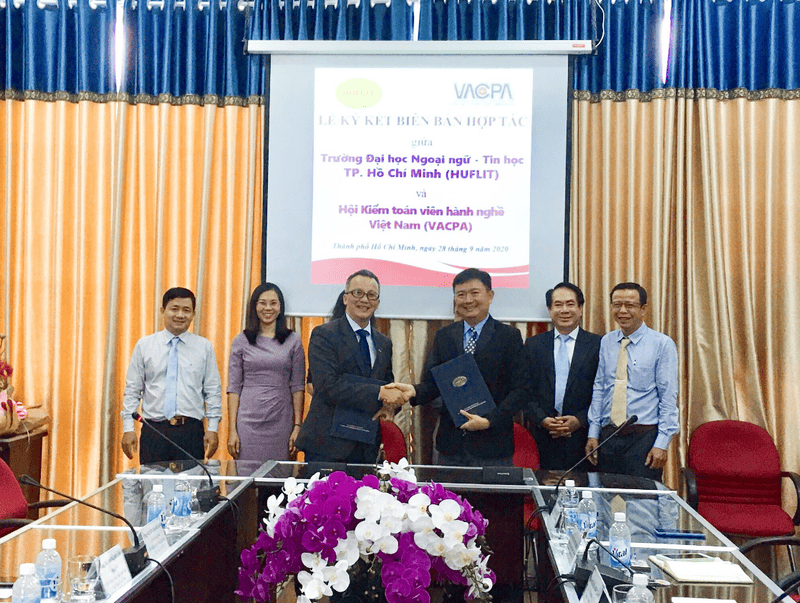
HUFLIT has a wide enterprise network, helping students easily intern and have a job early after graduation
Job opportunities and the salary of an AI engineer in 2026
The AI engineer is rated very positively as the demand for applying artificial intelligence increasingly expands in many fields. An AI engineer can undertake diverse career positions with a competitive income and a clear development roadmap, including:
- Working at multinational technology corporations in the role of developing, deploying and optimising AI systems
- Participating in or starting a startup in the field of digital technology, AI, data and digital products
- Researching and teaching Artificial Intelligence at research institutes, universities or technology centres
The AI-engineer salary and AI jobs are the two most attractive factors of this industry. Below is a reference salary table by level:
| Level | Experience | Salary (million VND/month) |
| Junior AI Engineer | 0-2 years | About 15-25 million VND |
| Middle AI Engineer | 2-5 years | About 28-45 million VND |
| Senior AI Engineer | 5-8 years | About 50-80 million VND |
| Lead AI Engineer | 8+ years | About 70-120 million VND |
| AI Architect/Manager | 10+ years | About 100-200+ million VND |
FAQ: Frequently asked questions when choosing the AI Engineer discipline
How much is the tuition of the AI discipline?
Currently, the tuition of the Artificial Intelligence discipline ranges around 12–32 million VND/year, depending on the type of training school (public about 12–18 million, private about 20–32 million). At HUFLIT, the AI-discipline tuition is 1,230,000 VND/credit, accompanied by many attractive scholarship policies, up to 100%, helping considerably reduce the financial burden for students.
Is the AI discipline difficult?
AI is a discipline requiring good logical thinking and study perseverance. However, if you have passion and the right study method, you can completely keep up with the programme. Schools such as HUFLIT have a training programme from basic to advanced, suitable for every audience.
What are the English requirements of an AI Engineer?
An AI engineer needs English at a fairly good level and above to read specialised materials, scientific research, use AI tools and work with international teams; reading-comprehension and professional-communication skills are the most important.
What discipline an AI engineer studies is an important choice for long-term career orientation. Among the suitable disciplines, HUFLIT stands out with a highly practical AI programme and methodical foreign-language training. This is an ideal environment to build a competitive advantage in the technology field. Register for HUFLIT counselling today to start the journey to become a professional AI engineer.
>>>> REFER TO THE RELATED ARTICLES:
CONTACT INFO
Apply for admission at
tuyensinh.huflit.edu.vn
Find out information
huflit.edu.vn
Advising education enrollment