



-
Proud to be HUFLITers #07 | M.A. Tran My Uyen – A lectern where a teacher wishes only to “watch her children grow up”At the HUFLIT Faculty of Foreign Languages, M.A. Tran My Uyen (Vice Dean) goes by many names. Some call her “Ms My”; her students call her “mother”. Colleagues often compare her to Mother Au Co with a hundred children. Yet to become the “mother” of the lecture hall she is today, she went through a profound shift in thinking that completely changed a teaching philosophy built over more than 30 years.
-
New Cybersecurity Regulations: Opportunities for the Cybersecurity Field in the Digital EraThe new cybersecurity regulations taking effect on 1 July 2026 not only help complete the legal framework but also drive demand for talent in cybersecurity. This is also the moment when the discipline becomes a promising choice for young people who love technology and information security.
-
“GenZ Major Insights 2026” – Episode 9: Boundless Journeys with HUFLIT’s Tourism and Hospitality ProgramsMany students choose the Tourism and Hospitality field simply because they love to travel. But passion alone is not enough to pursue this field in the long run. What matters more is understanding the nature of the discipline, its professional requirements, and the qualities needed to grow in a professional service environment.
What Do You Need to Graduate from University? The Latest Conditions and Regulations
NGÀY: 05/03/2026
Chia Sẻ Qua
What do you need to graduate from university according to current regulations?
According to the regulations of the Ministry of Education and Training, graduating from university means the student has completed the entire training programme and fully met the output standards prescribed by the school. Simply put, to graduate, students need to accumulate enough credits according to the programme, meet study conditions, complete the graduation thesis or replacement course units (if any). At the same time, meet the foreign-language and informatics standards as required.
However, these conditions may differ between each school, each discipline and training system (regular, high-quality, etc.). Therefore, students need to proactively carefully learn about the Training Regulation and output standards of the school they study at. In particular, students note that not every university requires students to do a graduation thesis.
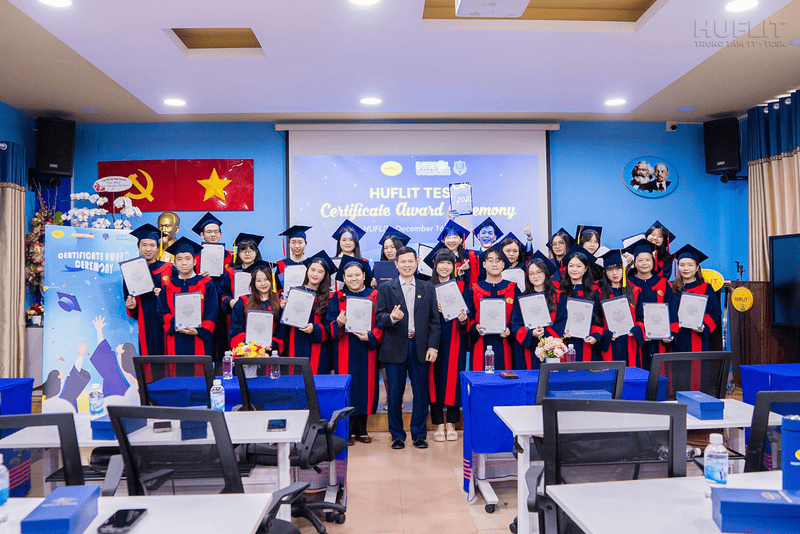
Graduating from university means the student has completed the entire training programme and fully met the output standards
General regulations of Vietnamese universities
Based on Circular 08/2021/TT-BGDĐT on university training, students must fully meet the following conditions to be considered for graduation recognition and degree issuance: accumulate enough credits and complete all compulsory course units, meet the programme’s output standards, have a cumulative grade point average of average or above, not be disciplined and complete financial obligations.
The Circular also stipulates that study-result evaluations are the basis for considering graduation and classifying the degree. GPA is calculated by the number of credits and the scores of the course units, based on the scale the school uses, 4.0 points or 10 points.
Study-result classification based on the 4 scale:
| 4.0 scale | Meaning |
| 3.6 – 4.0 | Excellent |
| 3.2 – 3.6 | Good |
| 2.5 – 3.2 | Fairly Good |
| 2.0 – 2.5 | Average |
| 1.0 – 2.0 | Weak |
| < 1.0 | Poor |
The 10-point scale also has an equivalent level (9-10: excellent, 8-9: good, 7-8: fairly good, 5-7: average, <5: weak/poor).
>>>> DON’T MISS: Do you get bonus points on the university exam if you have an IELTS certificate?
The difference between training programmes
University training programmes today have a clear difference in study volume, usually ranging from 120 – 150 credits depending on the discipline. Some universities today also require students to meet international English standards such as IELTS to be eligible to graduate. For example, at HUFLIT the output standard for the English Language discipline requires students to achieve a certificate such as TOEIC ≥ 780 or IELTS ≥ 7.0.
In addition, some specific disciplines such as Pedagogy, Medicine-Pharmacy, Police have their own requirements on admission, professional-ethics standards, practice time and graduation conditions. Besides, high-quality or international programmes usually have higher entry, lecturers teaching in English and higher tuition compared to the mass programme. In return, students will focus on practice, a modern study environment and have international-linkage opportunities.

University training programmes usually range from 120 - 150 credits depending on the discipline
What are the study conditions for university graduation consideration?
The study conditions for university graduation consideration are the mandatory criteria to evaluate the level of completion of the student’s training programme. These conditions include:
Completing enough credits according to the programme
Completing a minimum of 120 credits according to the programme is a mandatory condition for university graduation consideration. Each discipline has its own regulations on compulsory and elective credits, including theory, practice, seminars and internship. In addition, students can check the number of credits studied and still missing on the school’s online training system.
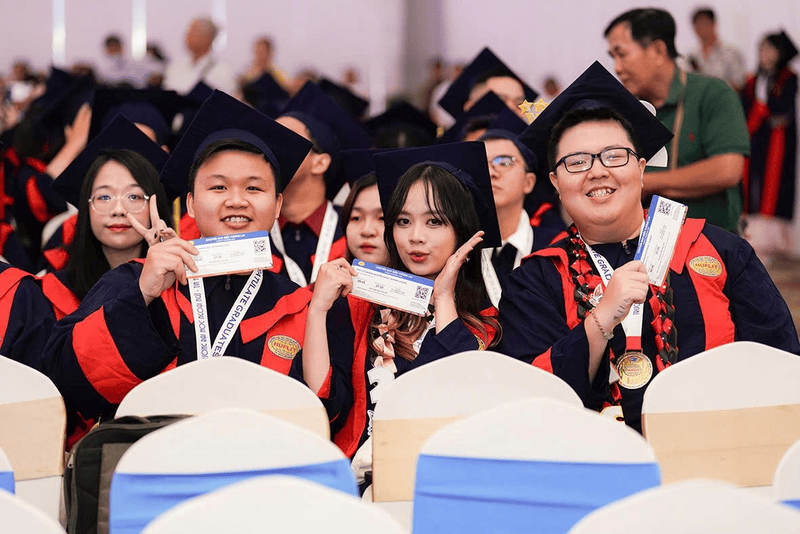
Complete enough credits according to the programme for university graduation consideration
Achieving the minimum cumulative grade point average (GPA)
The cumulative grade point average (GPA) reflects the entire study result of the student throughout the course. GPA is usually calculated on the 4.0 or 10 scale and many schools require a minimum of 2.0/4.0 to graduate. This indicator is also used to classify the degree, consider scholarships and evaluate job applications.
No owed course units, F scores
Students must have no owed course units or F scores to be eligible for graduation consideration. When not achieved, learners need to retake or re-sit according to the regulation. Some schools allow replacement with an equivalent subject if the programme changes. Completing these course units must be within the maximum duration of the training programme prescribed by the school.
Completing the compulsory course units (politics, Physical Education, National Defence-Security, etc.)
According to current regulations, students are required to complete common course units such as political theory, physical education (PE) and national defence – security (NDS). These subjects aim to ensure a common knowledge foundation and are not exempted, except for special cases as regulated. If still missing, students need to register to retake or make up on the school’s training system before the graduation-consideration time.
Usually, when logging into the school’s learning management system, students will see a report on the status of missing course units, listing the compulsory subjects if not yet completed. Therefore, students need to submit a retake registration form through the system or meet an advisor to arrange a suitable study schedule.

Completing the compulsory course units ensures a common knowledge foundation
>>>> QUICK FOLLOW: The necessary soft skills for HUFLIT students
Completing the final internship
Completing the final internship is a mandatory requirement in the training programme, with the number of internship credits clearly prescribed for each discipline. The internship can be carried out in the form of an internship at an enterprise or a real project/topic according to the school’s guidance.
The internship result is an important criterion in graduation consideration and evaluating the student’s ability to apply knowledge. At the same time, internship experience also helps increase the value of the CV and improve job opportunities after graduation.
What do students need to meet to do a graduation thesis?
To carry out a graduation thesis, students need to meet the study conditions and comply with the separate regulations of each school and each training discipline. Specifically:
Register a thesis or replacement subject
Students can register to do a thesis at the end of the course if they meet the study conditions prescribed by the school. A minimum GPA from about 2.5 – 3.0/4.0 or above, completing most of the course units and having no subjects with an F score or owed subjects.
Doing a thesis helps students train skills such as in-depth research, developing the ability to write long reports, presenting a scientific approach. Moreover, having a graduation thesis topic can make a stronger impression on employers or when applying for scholarships.
Some disciplines allow students to choose a replacement subject instead of a thesis. However, in some in-depth or technical disciplines such as Information Technology, Medicine, Pharmacy, Security, etc., the thesis is a compulsory course unit in the training programme. Therefore, students need to clearly grasp each faculty’s regulations to choose the suitable form.

Students register to do a thesis at the end of the course or a replacement subject
The process of carrying out and defending the graduation
The process of carrying out and defending the graduation is uniformly prescribed by the school to ensure scientificity, transparency and correct evaluation of the student’s capacity:
- Register the topic, assign the supervising lecturer according to the faculty’s plan.
- Write the proposal, carry out and report progress within the prescribed time.
- Defend before the council, grade according to the school’s scale and criteria.
Grading criteria and minimum requirements
When grading a graduation thesis, the grading council usually evaluates based on many important aspects, including: content, research method, presentation form and defence skills.
According to the Circular of the Ministry of Education and Training and the schools, the graduation work or defence session is graded on the 10-point scale, with the minimum passing score being >5. If the score is below this level, students usually have to redo and re-defend in a subsequent semester.
Therefore, to achieve a high score when defending, students need to prepare a clear topic, logical content and coherent presentation. In addition, carefully preparing the presentation, answering confidently and on-point to the council’s questions will help improve the evaluation result.
Thesis submission file
Besides defending before the council, students must also submit a complete thesis file correctly according to the regulation and on time. The file includes a printed bound report, soft file, appendix and the lecturer’s guidance/comment sheet.
Schools usually set a deadline for submitting the thesis file before a fixed milestone in the semester schedule (2-3 weeks) to be in time to send to council members to read before the defence. If submitted late without a legitimate reason approved by the training office, students may have their defence session postponed to a later period, delaying graduation consideration.

Students must submit a complete thesis file correctly according to the regulation and on time
>>>> CLICK NOW: The common difficulties that first-year students face
What do you need to graduate from university in terms of foreign languages and informatics?
To be considered for university graduation, students must also meet the output standards on foreign languages and informatics as regulated. Below are the detailed requirements:
Informatics certificate
Students need to meet the basic or applied IT skill standard according to the output standard. The form of recognition is through a separate informatics certificate or the subject score in the training programme. However, some schools do not require a separate certificate if students have fully completed the informatics subjects at the school.
Foreign-language certificate
The foreign-language output standard is a mandatory requirement to ensure students have foreign-language competence at a minimum level before graduation. Students can prove their foreign-language competence with one of the following certificates: TOEIC, IELTS, VSTEP or equivalent.
The requirement level is determined according to the 6-level Vietnamese Foreign Language Competence Framework, with a corresponding score-conversion method for consideration. In addition, students studying a foreign-language discipline may be exempted from the certificate if they have completed enough related course units in the programme.
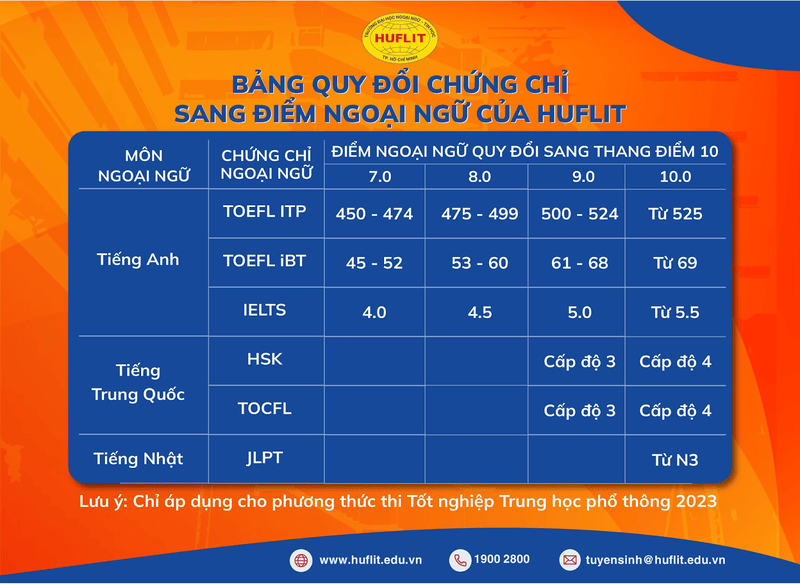
Students must meet the output standards on foreign languages and informatics as regulated
Graduation-consideration conditions at HUFLIT
At HUFLIT, students are only considered for graduation when they fully meet the criteria according to the training programme as follows:
Course units and number of credits
Students must complete all course units and accumulate enough 120 credits according to the requirements of the discipline’s training programme. This includes both compulsory course units (specialised, general education, other compulsory subjects, etc.) and the output-standard conditions prescribed in the training programme.
Minimum cumulative grade point average (GPA)
HUFLIT stipulates that to graduate, students have a whole-course GPA of average or above (i.e. ≥ 2.0/4.0). This ensures students have a comprehensive study level enough to apply knowledge to their later career.
Not being prosecuted for criminal liability or suspended from study
When considering graduation, students are required not to be in the period of being prosecuted for criminal liability and not to be disciplined at the study-suspension level. This is an administrative and study-ethics condition, to protect the reputation of the degree and meet the school’s regulations.
Meeting the foreign-language and informatics certificate
HUFLIT clearly stipulates the foreign-language output standard for each discipline based on the Common European Framework of Reference for Languages (CEFR) and equivalent international certificates. For example, the requirement level for some disciplines at HUFLIT:
- English Language: TOEIC ≥ 780 or IELTS ≥ 7.0
- Business Administration: TOEIC ≥600 or IELTS ≥ 5.5
- Chinese Language: HSK ≥ 5, etc.
In addition, HUFLIT accepts IT certificates such as: MOS (Word, Excel) or advanced IT-application certificates according to the output standard of the training programme.

University graduation-consideration conditions at HUFLIT
Frequently asked questions about graduation conditions
How many credits do you have to study in 4 years of university?
In 4 years of university, students usually have to study 120-150 credits for most regular university disciplines. Some specific disciplines such as Medicine, Architecture, Pedagogy, etc. may require 160 credits or more. In addition, for High-quality or International-linkage programmes it may be more due to additional skill and foreign-language course units.
What GPA is required for graduation consideration?
According to current training regulations, students are considered for graduation if their GPA (cumulative grade point average) is 2.0/4.0 or above (equivalent to about 5.5/10 on the 10-point scale).
Some schools/faculties stipulate higher if students want to do a graduation thesis (usually requiring a GPA from 2.5-2.8/4.0) or a high graduation classification (Good, Excellent).
Can you be considered for graduation if you still owe subjects?
No. To be considered for graduation, students must:
- Have no subjects owed or F scores.
- Complete all compulsory course units.
- Have retaken/re-sat or done a replacement subject (if permitted).
If you still owe subjects, the profile is not yet eligible for the training office to consider graduation.
Is internship mandatory to graduate?
Yes. Most disciplines require internship as a mandatory part of the training programme, especially Economics – Administration – Marketing, Information Technology, Journalism – Communication, Tourism – Restaurant – Hotel, Pedagogy, Healthcare, Architecture. However, some disciplines may replace the internship with a project or thesis if students meet the prescribed conditions.
Above is the overview information, helping to answer the question of what you need to graduate from university. Students need to complete enough credits, meet the GPA standard, meet the foreign-language, informatics and internship requirements to be eligible for graduation consideration. If you have any questions, you can contact HUFLIT for detailed advice and timely support.
>>>> DON’T MISS THE RELATED ARTICLES
9+ benefits of studying university in English you can’t miss
CONTACT INFO
Apply for admission at
tuyensinh.huflit.edu.vn
Find out information
huflit.edu.vn
Advising education enrollment