



-
Proud to be HUFLITers #07 | M.A. Tran My Uyen – A lectern where a teacher wishes only to “watch her children grow up”At the HUFLIT Faculty of Foreign Languages, M.A. Tran My Uyen (Vice Dean) goes by many names. Some call her “Ms My”; her students call her “mother”. Colleagues often compare her to Mother Au Co with a hundred children. Yet to become the “mother” of the lecture hall she is today, she went through a profound shift in thinking that completely changed a teaching philosophy built over more than 30 years.
-
New Cybersecurity Regulations: Opportunities for the Cybersecurity Field in the Digital EraThe new cybersecurity regulations taking effect on 1 July 2026 not only help complete the legal framework but also drive demand for talent in cybersecurity. This is also the moment when the discipline becomes a promising choice for young people who love technology and information security.
-
“GenZ Major Insights 2026” – Episode 9: Boundless Journeys with HUFLIT’s Tourism and Hospitality ProgramsMany students choose the Tourism and Hospitality field simply because they love to travel. But passion alone is not enough to pursue this field in the long run. What matters more is understanding the nature of the discipline, its professional requirements, and the qualities needed to grow in a professional service environment.
Personal Financial Management for Students: Planning Secrets
NGÀY: 05/03/2026
Chia Sẻ Qua
Why do students need to manage personal finances early?
Managing personal finances early is an essential skill that helps students be more proactive in study and life. When you understand how to control income and expenses, you will easily make smart decisions and build a stable foundation for the future.
Avoiding falling into a “broke” state
Students very easily “go broke” if they don’t know how to control spending. This case can lead to having to borrow from friends, take out credit or even turn to informal P2P lending forms with high interest rates.
According to the survey “Credit history of Ho Chi Minh City students” at the Ho Chi Minh City Youth Union in 2023 with 18,988 responses collected from 62 universities and colleges in the area, the results show that 59% of students have borrowed capital during their studies. This reflects the reality that the credit issue for students is still very common and needs proper attention.
However, this is also the student debt trap, causing many people to fall into a spiral of debt-repayment pressure. In reality, there have been many cases of being scammed through quick-loan forms, easy-work-high-pay or borrowing the name of student support. This shows that equipping knowledge to protect yourself is extremely necessary.

Students very easily “go broke” if they don’t know how to control spending
Training planning – financial management skills
Planning and managing personal finances is one of the most important soft skills that students need to train early. If you know how to manage money, you will be more proactive in spending, form independent-financial thinking and avoid depending on your family.
In particular, once you firmly grasp the basic principles such as budgeting, tracking cash flow or setting saving goals, you also build a solid foundation for big steps later. For example, investing, buying a house or developing a career. This is not only a skill serving the present but also important baggage for the future.
>>>> REFER TO DETAILS: The necessary soft skills for HUFLIT students
Detailed guide to effective budgeting methods
Understanding and correctly applying budgeting methods will help you use money proactively instead of spending emotionally. The following guides will bring you an effective, easy-to-apply way of managing finances.
The 50/30/20 rule: The standard version for students with little money
The 50/20/30 rule helps you divide your income into three clear spending groups, suitable for actual daily needs. These three groups include: necessary expenses, savings, investment and needs serving personal interests. Specifically as follows:
- Essential needs (50%): This group includes mandatory expenses such as room rent, food, living costs, travel or buying basic items. These expenses usually cannot be cut too much. Therefore, you need to plan so that the total essential cost does not exceed 50% of your income.
- Savings and investment (20%): This is the money source for your future, which can be put into an emergency fund, retirement fund or investment channels such as stocks, open-ended funds. Even if your income is not high, you should still form the habit of setting aside 20% each month to create a safe financial foundation. This amount will help you cope with unexpected situations and get closer to long-term goals such as buying a car, buying a house or developing assets.
- Personal wants & interests (30%): The final 30% is for activities that help you enjoy life: small shopping, going out, watching movies, coffee with friends, travelling or pursuing personal hobbies. This is a flexible spending group, which you can balance according to your needs, as long as it does not exceed the allowed level.
Example: For students, the 50/30/20 rule sometimes needs to be flexibly adjusted to 60/30/10 to better suit the actual living-cost level. For instance, if you have an income of 3,000,000 VND/month,, you will spend 1,800,000 VND on essential needs, 900,000 VND on wants and 300,000 VND on savings or investment.

The 50/20/30 rule helps you divide your income into three spending groups
The 6-jars method (practical application) and the simple 2 jars
The 6-jars (Jars) method is a famous financial-management model that divides income into 6 different funds. Including, essential spending, long-term savings, education, self-development, entertainment, charity and investment. However, for students, dividing into too many small parts sometimes causes confusion and is hard to maintain regularly. Therefore, you can apply a simpler version with 2 jars, including the Daily Spending Jar and the Savings/Reserve Jar.
Example: If each month you have 3,000,000 VND and want to apply the 2-jars model, you can spend 2,200,000 VND on essential spending (food, accommodation, travel) and keep 800,000 VND for the Savings/Reserve jar. This way helps you control finances more easily, without the pressure of dividing into too many categories but still keeping discipline in spending.
>>>> SEE DETAILED INFORMATION: The common difficulties that first-year students face
Secrets to saving and increasing income for students
Saving and increasing income are two factors that help students be more proactive in finance, reduce dependence and create a foundation for the future. The following secrets will help you manage money more smartly, while opening up more opportunities to improve your income.
Applying spending-management technology (app/tool)
In the digital age, spending-management applications are becoming powerful tools that help students track cash flow. Below are the outstanding apps, easy to use and highly rated for income-expense management effectiveness.
-
- MISA Income-Expense Book (MoneyKeeper): The MISA Income-Expense Book is a Vietnamese application with a simple, easy-to-use interface, suitable for students who are just starting to manage finances. The app stands out in quick recording, intuitive spending reports and safe data synchronisation.
- Advantages: Free for many features, easy to use, clear reports.
- Disadvantages: Some advanced features require payment, the interface is not as modern as international apps.
- Money Lover: This is a popular spending-management application, supporting spending classification, creating plans and tracking personal budgets in detail. The app also has bank-synchronisation capability, helping to automatically record transactions.
- Advantages: Friendly interface, many strong features, intuitive reports.
- Disadvantages: The free version limits features. The Premium version has a rather high price compared to students.
- MISA Income-Expense Book (MoneyKeeper): The MISA Income-Expense Book is a Vietnamese application with a simple, easy-to-use interface, suitable for students who are just starting to manage finances. The app stands out in quick recording, intuitive spending reports and safe data synchronisation.
- Money Manager: This application focuses on tracking income and expenses with intuitive charts. Thanks to this, users will grasp financial trends by day/week/month. The application also supports recording loans, debts, savings and investment.
-
- Advantages: Simple interface, strong statistics, easy to customise.
- Disadvantages: Has ads, does not support Vietnamese.
- Spendee: The app impresses with a colourful, easy-to-look-at interface and the ability to track multiple wallets at once (personal wallet, family wallet). In addition, Spendee is also strong in income-expense charts, helping users clearly understand spending habits.
- Advantages: Intuitive, diverse charts, easy to budget.
- Disadvantages: Many good features are behind a paid package; the bank-linking feature is not strong yet.
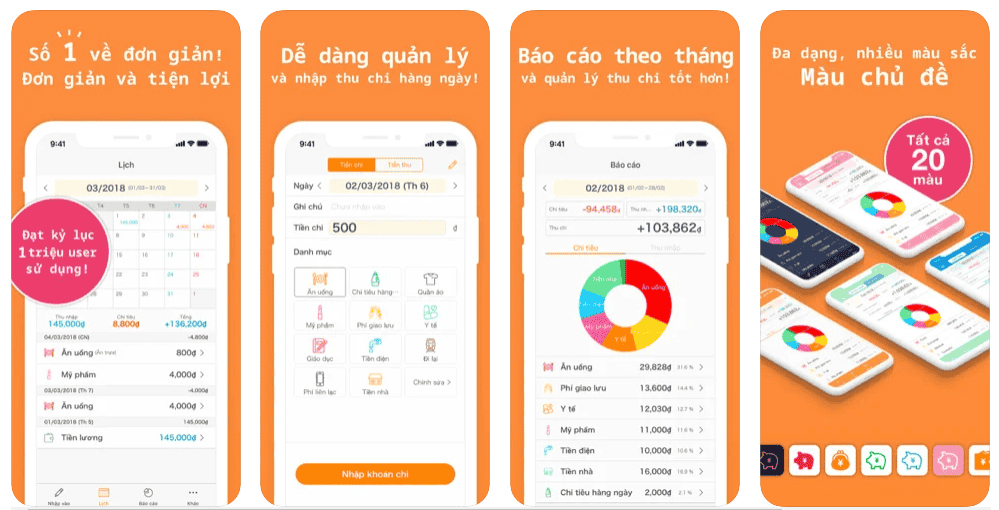
You can use income-expense apps to manage spending
Doing part-time work to earn extra income
Doing part-time work to earn extra income is a way to help students be more proactive about finances, while accumulating practical experience matching their career orientation. When choosing a part-time job, you should prioritise positions suitable to your major. Below are suggestions for safe jobs, suitable for each discipline group:
Marketing discipline
- Content-creation collaborator (Content)
- Basic image design (Design)
- Running Facebook/Google ads
- Managing a fanpage, monitoring the page
- TikTok editor or freelance video shooting-editing
English Language / Translation-Interpreting discipline
- Translating documents, translating subtitles
- Teaching assistant at an English centre
- English tutor at home or online
- Academic writing on request
- Supporting communication for tourism enterprises
Accounting. Finance discipline
- Entering document data
- Part-time internal accounting support
- Seasonal audit collaborator
Tourism – Restaurant – Hotel discipline
- Trainee tour guide
- Tour support staff, tour operator
- Hotel receptionist
- Restaurant service staff
- Event coordinator (Event staff)
>>>> YOU SHOULD NOT MISS: 20+ part-time jobs for students hot 2026
Frequently asked questions about personal finance for students
Managing personal finances is always an issue that makes many students wonder, especially when having to handle spending themselves and balance the monthly budget. The FAQ section below will help you answer the most common questions.
Should you invest while still a student?
Students should only invest when they have stabilised their basic finances and have the necessary reserve fund. Investing early helps form money-management thinking, accumulate experience and take advantage of the time factor to increase assets. You should start with a small amount of capital and prioritise safe channels such as accumulation savings, open-ended funds or fund certificates.
In addition, students need to research information carefully before participating in investment. Consulting family, lecturers or official financial sources helps limit risks. Be cautious with high-profit invitations, avoid being drawn into non-transparent investment forms or scams..
How should students record their spending?
Students can record spending in many ways such as using a notebook, Excel/Google Sheets or specialised applications. However, using an app is still the fastest and easiest way to track because it has automatic reports and spending reminders.
Should students buy insurance?
Yes, students should get insurance, especially health insurance, because this is a necessary financial solution that helps significantly reduce medical costs when sick or in an accident. During their studies, students usually have limited income, so just one arising hospital fee can cause great financial pressure.
Should students borrow money to cover tuition?
Students should not borrow capital indiscriminately because it carries many risks about interest rates and debt-repayment pressure after graduation. Instead, you should prioritise support policies, tuition borrowing – deferral from the school (such as HUFLIT) to reduce the financial burden. You should only borrow when truly necessary and must have a clear, feasible repayment plan, avoiding affecting your studies and long-term life.
Managing personal finances for students helps you control spending better and create a solid foundation for the future when entering independent life. When you know how to save and plan, you will reduce financial pressure and improve your quality of life. HUFLIT hopes the above knowledge will help you be more confident on the journey of building smart financial habits.
>>>> YOU SHOULD NOT MISS THE USEFUL ARTICLES:
Should students take part-time jobs or not? A handbook from A-Z
Should you take a part-time job or join a club – Which choice is suitable?
CONTACT INFO
Apply for admission at
tuyensinh.huflit.edu.vn
Find out information
huflit.edu.vn
Advising education enrollment