



-
Proud to be HUFLITers #07 | M.A. Tran My Uyen – A lectern where a teacher wishes only to “watch her children grow up”At the HUFLIT Faculty of Foreign Languages, M.A. Tran My Uyen (Vice Dean) goes by many names. Some call her “Ms My”; her students call her “mother”. Colleagues often compare her to Mother Au Co with a hundred children. Yet to become the “mother” of the lecture hall she is today, she went through a profound shift in thinking that completely changed a teaching philosophy built over more than 30 years.
-
New Cybersecurity Regulations: Opportunities for the Cybersecurity Field in the Digital EraThe new cybersecurity regulations taking effect on 1 July 2026 not only help complete the legal framework but also drive demand for talent in cybersecurity. This is also the moment when the discipline becomes a promising choice for young people who love technology and information security.
-
“GenZ Major Insights 2026” – Episode 9: Boundless Journeys with HUFLIT’s Tourism and Hospitality ProgramsMany students choose the Tourism and Hospitality field simply because they love to travel. But passion alone is not enough to pursue this field in the long run. What matters more is understanding the nature of the discipline, its professional requirements, and the qualities needed to grow in a professional service environment.
Artificial Intelligence – Mastering Technology, Shaping the Digital Future
NGÀY: 01/05/2025
Chia Sẻ Qua
1. General Introduction
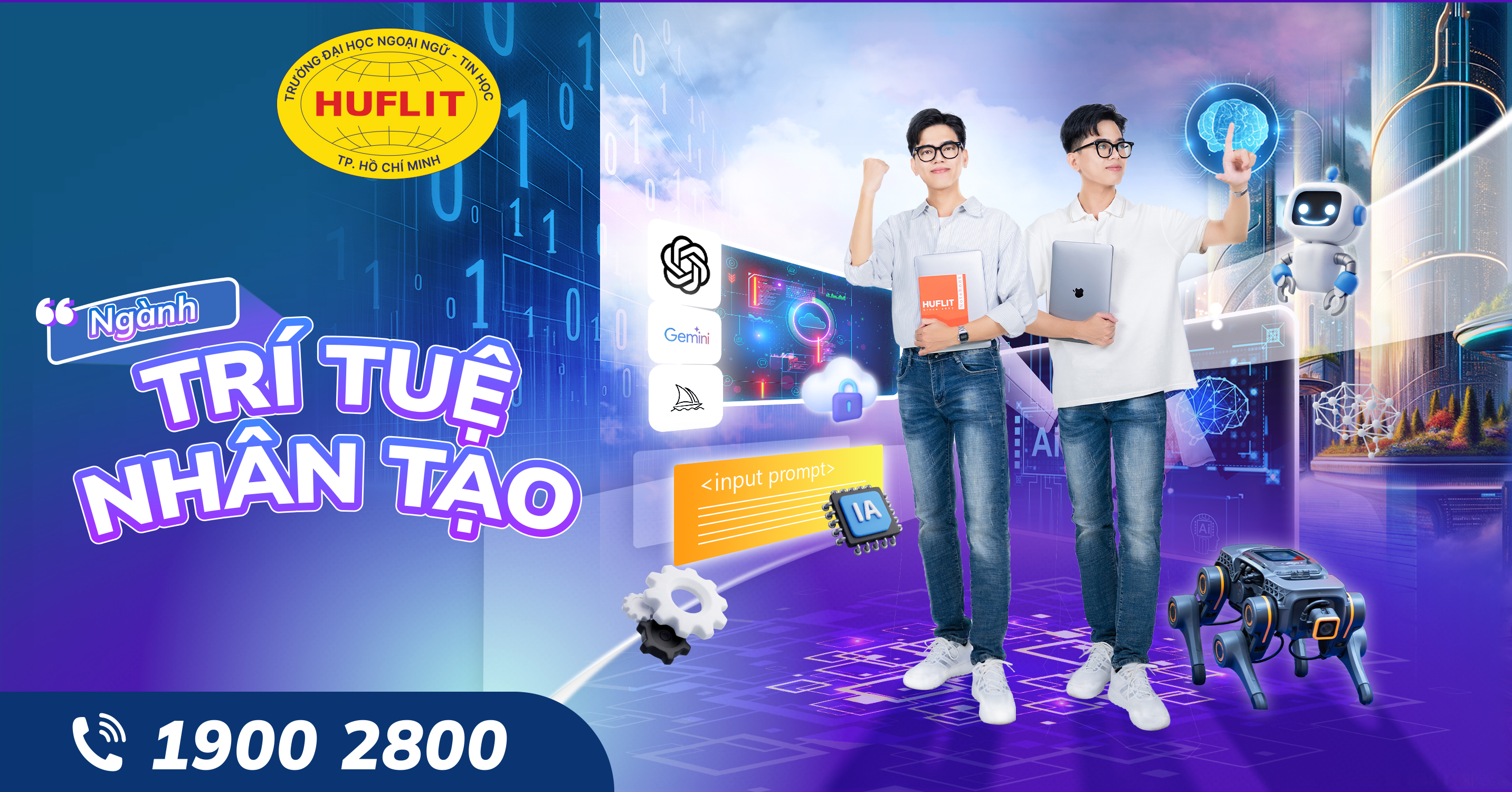
The Artificial Intelligence (AI) major at HUFLIT aims to train students to become professionals capable of developing and applying intelligent systems that can simulate and replicate human intelligence. This field combines computer science, mathematics, and logic to enable learners to create advanced technological products such as chatbots, robots, big data analysis systems, facial recognition, and automated decision-making tools.
In the context of the Fourth Industrial Revolution and the strong trend of digital transformation, AI has become a core technology and a central driver across various sectors—ranging from manufacturing, finance, and education to healthcare and transportation. Choosing this major at HUFLIT means preparing for the future through a well-structured and practical program with strong industry connections.
2. Major Code and Training Duration
- Major code: 7480107
- Total credits: 141
- Training duration: 3.5 years
3. Key Highlights of the Training Program
- Comprehensive and up-to-date global AI curriculum: Students are trained from foundational to advanced levels, covering topics such as machine learning, deep learning, image and natural language processing (NLP), neural networks, and real-world AI applications.
- Integrated learning model combining practice, projects, and enterprise collaboration: From the second year, students have opportunities to participate in real-life AI projects such as customer service chatbots, user behavior prediction systems, or AI-based image and sound recognition tools.
- Highly qualified lecturers and corporate mentors: HUFLIT brings together experienced instructors and collaborates with industry experts and technology enterprises to ensure students can learn directly from practice and stay updated with the latest innovations.
4. Skills Acquired After Graduation
Graduates of the AI major at HUFLIT will be able to:
- Design, build, and deploy AI systems
- Program using languages such as Python, R, and Java for AI applications
- Apply machine learning and deep learning in image recognition and data analysis
- Develop chatbots, automated consulting systems, and virtual assistants
- Analyze large datasets and optimize predictive models
- Understand and apply AI algorithms to fields such as manufacturing, business, finance, healthcare, and education
5. Teaching Methods
The training program combines theoretical foundations with hands-on applications. HUFLIT applies a project-based learning approach, enabling students to solve real-world problems, work in teams, engage in debates, and develop tangible products. Each course integrates the latest technologies and is updated regularly to keep pace with the rapid evolution of the field.

6. Program Structure
6.1 Foundational Knowledge
- Mathematical Foundations for AI (Linear Algebra, Probability and Statistics, Optimization)
- Programming Techniques, Data Structures, and Algorithms
- Computer Networks, Operating Systems, Databases
- Introduction to Information Technology
6.2 Specialized Knowledge
- Machine Learning
- Deep Learning
- Natural Language Processing (NLP)
- Image Processing and Computer Vision
- Neural Networks and Expert Systems
- AI Applications in Big Data
- AI in Robotics and Automation
6.3 Practical and Professional Skills
- Data Analysis and Visualization
- AI Model Development with Python
- Chatbot and Recommendation System Development
- Hands-on practice with TensorFlow, Keras, and OpenCV
- Capstone Projects and AI System Development
- Internship and Final Thesis at Enterprises or Research Institutes
7. Career Opportunities
Artificial Intelligence is currently one of the highest-paying fields within Information Technology, with extremely high demand for skilled professionals. Graduates can work in various positions such as:
- AI Application Developer at technology, fintech, healthtech, or edtech companies
- AI/ML Engineer responsible for building intelligent models for businesses
- Data Scientist or AI Analyst
- Automation or Robotics System Developer
- AI Solution Consultant and Implementer for enterprises
- AI Researcher at research institutes or innovation centers
- AI Lecturer or postgraduate student in Vietnam or abroad

CONTACT INFO
Apply for admission at
tuyensinh.huflit.edu.vn
Find out information
huflit.edu.vn
Advising education enrollment